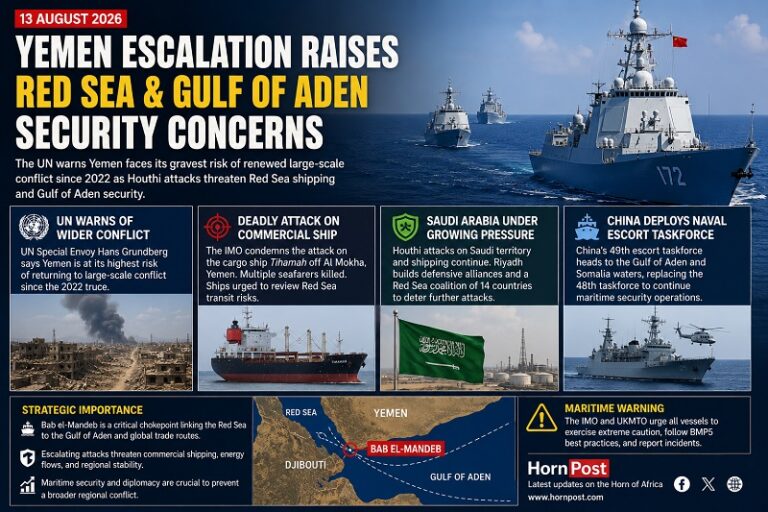
YEMEN —(HornPost) The United Nations has warned that Yemen faces its most serious risk of returning to large-scale conflict since the 2022 U.N.-brokered truce, as intensified fighting between Iran-aligned Houthi forces and the Saudi-backed Yemeni government coincides with renewed attacks on commercial shipping in the Red Sea and Gulf of Aden.
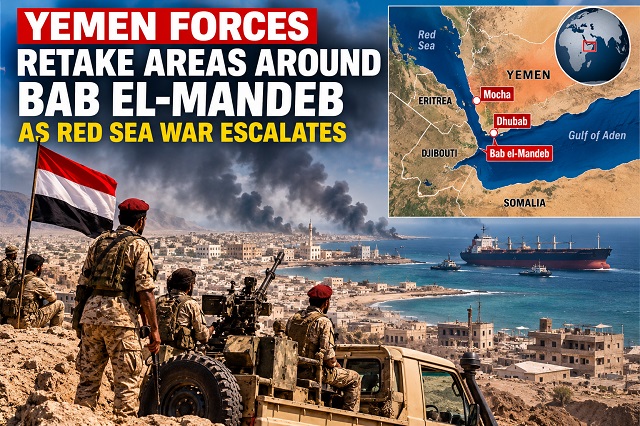
U.N. Special Envoy for Yemen Hans Grundberg said military activity and hostilities have intensified in several parts of Yemen, including Marib, Hadramawt and Mocha, raising concerns that the escalation could develop into a broader regional conflict. The United Nations has urged the parties to de-escalate and return to negotiations.
Red Sea Shipping Under Renewed Threat
The maritime security situation has deteriorated following the deadly attack on the Tihamah, a cargo vessel struck by a projectile off Al Mokha, Yemen, near the strategic Bab el-Mandeb Strait.
The International Maritime Organization condemned the attack, confirming multiple seafarer deaths and warning that continued attacks on international shipping threaten global supply chains. The IMO urged shipowners and operators to conduct thorough risk assessments before transiting the Red Sea and Gulf of Aden and to follow established maritime security practices.
The Bab el-Mandeb is one of the world’s most strategically important maritime chokepoints, linking the Red Sea with the Gulf of Aden and providing a major route between Europe, the Middle East and Asia.
Saudi Arabia Faces Growing Security Pressure
Saudi Arabia is facing increasing pressure from Houthi attacks against its territory, infrastructure and maritime interests. Riyadh has been pursuing defensive alliances and a proposed Red Sea maritime coalition as it seeks to deter further attacks while avoiding a wider regional war. Fourteen countries have reportedly joined the proposed Red Sea coalition.
Reports that Saudi Arabia is considering support for a Yemeni ground offensive against Houthi forces would represent a significant potential escalation, although such a move should be treated as a developing report rather than confirmation that a new offensive has begun.
China Expands Naval Presence in Gulf of Aden
Meanwhile, China has dispatched its 49th naval escort taskforce toward the Gulf of Aden and waters off Somalia to replace the 48th taskforce and continue maritime escort missions. The deployment underscores the strategic importance of the Gulf of Aden as an international shipping corridor and China’s longstanding naval presence in the region.
The deployment comes as commercial shipping faces renewed risks from Houthi attacks in the Red Sea and concerns over piracy and maritime security off Somalia.
HornPost Assessment
The latest developments point to a widening security challenge linking Yemen’s internal conflict, Houthi attacks, Saudi national security, Red Sea shipping and the strategic Bab el-Mandeb corridor.
The immediate concern is not only the safety of commercial vessels but also the potential disruption of global trade and energy flows. If Yemen’s renewed military escalation expands alongside continued attacks on shipping, the Red Sea and Gulf of Aden could become a major regional security flashpoint with consequences far beyond Yemen.
HornPost will continue monitoring developments involving Bab el-Mandeb, the Red Sea, Gulf of Aden, Yemen, Saudi Arabia and international maritime security.
Prepared by:
HornPost Staff
info@hornpost.com
www.hornpost.com