
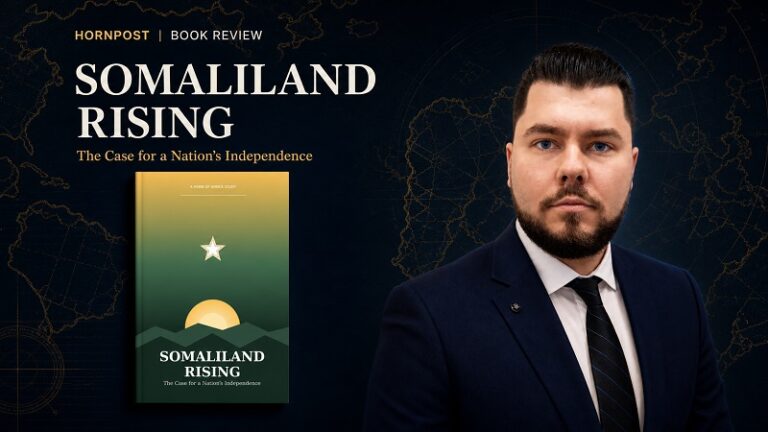
HARGEISA, Somaliland (HornPost) — A new book titled Somaliland Rising: The Case for a Nation’s Independence examines Somaliland’s long-running quest for international recognition, arguing that its record of self-government, political stability and institution-building provides a strong case for sovereign statehood.
Written by Cosmin Ivan, the book carries the subtitle History, Statehood, and Lessons from Europe’s Road to Sovereignty. It presents an advocacy-oriented argument for Somaliland’s international recognition while also examining the principal objections raised by Somalia, the African Union and other international actors.
Ivan is a business development and diplomatic representation specialist with more than a decade of cross-border experience spanning Europe, the Middle East and Africa. He currently serves as Director of Business Development & International Relations at Zarza7 Group and has worked on organizational and diplomatic interests involving Austria, Kosovo, Slovakia and other countries.
His work also focuses on advancing Somaliland’s international recognition and strengthening bilateral relations between Romania and Somaliland. He holds a master’s degree in psychology from the University of Belgrade and is completing an Executive MBA at Quantic School of Business and Technology.
A Case Built Around Statehood
At the heart of Somaliland Rising is a fundamental question: Can a territory that has governed itself for more than three decades meet the practical requirements of statehood while remaining internationally unrecognized?
Ivan argues that Somaliland has developed many of the institutions normally associated with a functioning state, including its own government, parliament, judiciary, currency, passport, security forces and electoral system.
The book highlights Somaliland’s competitive multiparty elections and peaceful transfers of political power as important elements of its state-building record.
The author therefore frames Somaliland’s situation around the distinction between de facto statehood and formal international recognition.
In practical terms, the argument is that Somaliland has operated as a self-governing entity since 1991, while its diplomatic status has remained unresolved.
The 1960 Independence Argument
One of the central arguments in the book concerns Somaliland’s historical status in 1960.
According to the book, British Somaliland became independent on June 26, 1960, before entering into union with the former Italian-administered Somalia on July 1, 1960, to form the Somali Republic. The book states that more than 30 states recognized Somaliland during its brief period of independence.
This historical interpretation is central to the book’s argument.
Rather than describing Somaliland’s 1991 declaration as a conventional act of secession, Ivan presents the case as one of restoration — the reassertion of a previously independent political entity within its former borders.
The distinction is significant because Somaliland’s supporters argue that the case differs from movements seeking to create an entirely new state from territory that had never previously existed as an independent entity.
At the same time, the book acknowledges that questions surrounding the legal mechanics and validity of the 1960 union remain contested.
Colonial Borders and African Union Principles
Another major element of the book is the principle of uti possidetis juris, particularly the preservation of colonial-era borders at independence.
Ivan argues that Somaliland’s claimed territory corresponds to the borders of the former British Somaliland Protectorate and that this gives its recognition argument a different legal and historical character from many other separatist movements in Africa.
This argument, however, exists within a complicated African political environment.
The African Union has historically emphasized the importance of territorial integrity and the preservation of inherited borders, while also exercising considerable caution toward unilateral changes involving the territory of existing member states.
That tension remains one of the central obstacles to Somaliland’s international recognition.
What Europe Can Teach Somaliland
The book’s European comparisons are among its most distinctive features.
Ivan examines the historical experiences of Romania, the Baltic states, Czechoslovakia and Kosovo, using them as examples of different paths toward sovereignty and international recognition.
Romania
The Romanian experience is presented as an example of institution-building, patience and the importance of geopolitical timing. Romania developed institutions before declaring full independence from the Ottoman Empire and ultimately secured formal recognition following the geopolitical changes surrounding the Russo-Turkish War.
The Baltic States
Estonia, Latvia and Lithuania are examined through the lens of legal continuity and sustained international advocacy. The book emphasizes the role of Western governments that did not recognize the Soviet annexation as legitimate and the persistence of Baltic diaspora communities in maintaining the issue internationally.
Czechoslovakia
The peaceful dissolution of Czechoslovakia is presented as a lesson in negotiated political separation. The so-called Velvet Divorce resulted in the creation of two states that were both admitted to the United Nations on the same day.
Kosovo
Kosovo provides a different lesson. Despite gaining recognition from more than 100 states, its path to United Nations membership remains blocked by opposition from major powers.
For Ivan, Kosovo demonstrates that legal and moral arguments alone may not be enough. International recognition also depends on geopolitical alliances and support from influential states.
The Strongest Part of the Argument
One of the book’s strengths is that it does not present Somaliland’s case entirely as a one-sided narrative.
The author explicitly describes Somaliland Rising as an advocacy book rather than a neutral textbook. He also devotes a chapter to the arguments against recognition, including Somalia’s position, African Union concerns and questions surrounding Somaliland’s eastern territories.
This distinction is important for readers.
The book is not attempting to provide a neutral encyclopedia-style history of Somaliland. Instead, it builds a case for recognition while acknowledging the arguments that challenge that case.
Somalia’s Position
The book presents the Federal Government of Somalia’s position as one of the principal obstacles to Somaliland’s recognition.
According to the book, Somalia considers Somaliland an inseparable part of Somali territory and views the 1991 declaration of independence as an internal secession rather than the restoration of a previously independent state.
That fundamental disagreement means that Somaliland’s recognition question is not simply a legal debate. It is also a political dispute between Hargeisa and Mogadishu over sovereignty, territorial integrity and the legacy of the 1960 union.
The African Union’s Dilemma
The African Union presents another challenge.
The book notes the apparent tension between the African principle of respecting inherited colonial borders and the organization’s concern that recognizing Somaliland could encourage other separatist movements across the continent.
This creates a difficult policy question: Would recognizing Somaliland reinforce the principle of colonial borders, or create a precedent that could generate new territorial disputes elsewhere in Africa?
Somaliland’s Eastern Territories
Importantly, the book also acknowledges that Somaliland’s territorial claims face internal challenges.
It points to disputes involving Sool and Sanaag, including competing political and administrative loyalties involving Somaliland and Puntland. These unresolved questions are cited by critics who argue that Somaliland’s claimed borders are not entirely uncontested in practice.
This acknowledgment strengthens the book’s analytical value, even though its overall conclusion remains supportive of Somaliland’s independence.
From Recognition Campaign to State-Building Strategy
Perhaps the most practical part of Somaliland Rising is its recommendations.
Ivan argues that Somaliland should treat recognition as a long-term process rather than a single diplomatic breakthrough.
The book recommends:
- Strengthening state institutions and governance
- Diversifying the economy beyond livestock and remittances
- Using the Somaliland diaspora as a long-term diplomatic asset
- Building international relationships incrementally
- Protecting the country’s record of peaceful elections
- Engaging Somalia and the African Union constructively
- Investing in historical and legal research
- Expanding Somaliland’s contribution to maritime security in the Gulf of Aden and Red Sea approaches
The recommendations move the discussion beyond the question of whether Somaliland deserves recognition and toward the more strategic question of how Somaliland can increase the political likelihood of recognition.
Somaliland, Berbera and the Red Sea
The book also places Somaliland within a broader geopolitical context.
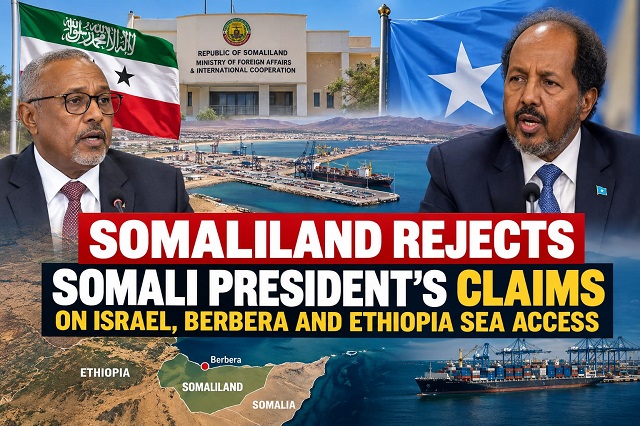
It highlights Somaliland’s roughly 850-kilometer coastline, the strategic location of Berbera and the development of the Berbera port and corridor linking Somaliland to Ethiopia.
This is increasingly relevant to discussions about Red Sea security, Gulf of Aden maritime routes, trade corridors and Horn of Africa geopolitics.
The book argues that Somaliland can strengthen its international position by continuing to contribute to maritime security and developing practical relationships with external partners, even in the absence of formal diplomatic recognition.
An Advocacy Book, Not an Academic Monograph
There is an important limitation that readers should understand.
Somaliland Rising describes itself as a concise advocacy primer rather than an academic monograph. It does not contain traditional footnotes and instead directs readers toward additional literature and sources, including material from international organizations, research institutions and the governments involved in the dispute.
Consequently, the book should be read as an argument for Somaliland’s recognition, rather than as the final scholarly word on Somaliland’s legal or political status.
Its European comparisons should also be treated as historical parallels rather than exact legal precedents. The circumstances surrounding Romania, the Baltic states, Czechoslovakia and Kosovo were different from Somaliland’s situation.
Why the Book Matters
The significance of Somaliland Rising lies less in offering a new answer to Somaliland’s recognition question than in bringing several strands of the argument together:
1960 independence → 1991 restoration claim → three decades of self-government → international law and colonial borders → European sovereignty precedents → geopolitical diplomacy.
The book argues that Somaliland’s strongest asset is its record of internal governance, while its greatest challenge is converting that record into sufficient international political support.
Its conclusion is therefore cautious despite its advocacy position: Somaliland may have developed the internal foundations of statehood, but recognition ultimately depends on diplomacy, international politics and the emergence of a favorable geopolitical moment.
HornPost Assessment
Somaliland Rising is best understood as a strategic advocacy book about Somaliland’s independence rather than a neutral history of the territory.
Its strongest contribution is its attempt to connect Somaliland’s historical experience with broader international examples of sovereignty and state recognition. Its most important limitation is that some of its legal and historical arguments require deeper scholarly examination and comparison with opposing interpretations.
For Somaliland’s recognition campaign, however, the book offers a clear strategic message:
institution-building, credible elections, economic development, diaspora diplomacy, regional engagement and sustained international advocacy may matter as much as the legal argument itself.
The recognition question, therefore, remains not only a question of whether Somaliland has a case, but whether it can build the diplomatic coalition and geopolitical circumstances capable of turning that case into international recognition.
Here more details about Author Cosmin Ivan activities, publications, school
https://www.linkedin.com/in/cosmin-i-ai37
Prepared by:
Horn Post Staff
HARGEISA, Somaliland


Abdikarim Saed Salah
Abdikarim Saed Salah is Editor-in-Chief and Founder of HornPost.com, an independent Hargeisa-based news platform covering Somaliland, the Horn of Africa, East Africa, the Red Sea and international affairs. A journalist, television presenter, producer and geopolitical analyst, he has more than 15 years of experience in broadcast journalism, digital media, reporting and diplomacy. He works with Horn Cable TV and focuses on politics, elections, security, foreign policy and conflict. He holds a BA in Journalism and an MA in International Relations.