WASHINGTON —(HornPost) U.S. forces struck two Iranian launchers on Larak Island after officials said the IRGC was preparing to deploy sea mines into the Strait of Hormuz.
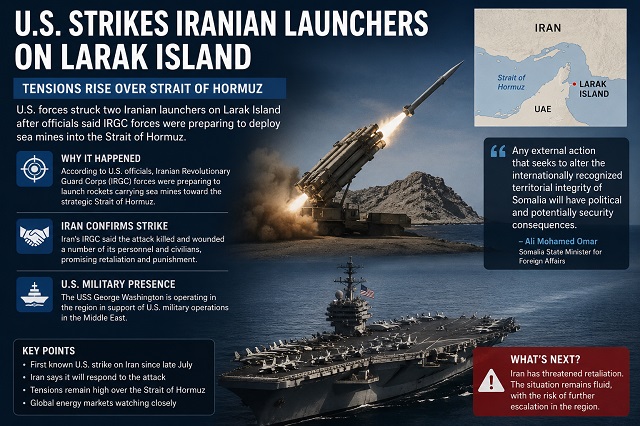
U.S. forces struck two Iranian launchers on Larak Island on Sunday after American officials said Iran’s Islamic Revolutionary Guard Corps was preparing to use the systems to deploy sea mines into the strategic Strait of Hormuz.
The strike, the first known U.S. attack on Iran since late July, comes amid renewed tensions over the strategically important waterway and follows weeks of reduced direct military exchanges between Washington and Tehran.
A U.S. official confirmed to Reuters that American forces had targeted two Iranian launchers on Larak Island after the IRGC was observed preparing to launch rockets carrying sea mines into the Strait of Hormuz. Axios separately reported the same account, while Al Jazeera also confirmed the strike through a U.S. official.
The incident was initially reported after Iran’s Fars news agency said an explosion had been heard near Larak Island, although the cause of the blast was not immediately clear.
Iran Confirms U.S. Strike
Iran’s Islamic Revolutionary Guard Corps later confirmed that the United States had attacked Larak Island.
The IRGC said the strike killed and wounded a number of its personnel and civilians, without providing an exact casualty figure. Iranian state media quoted the Guards as saying the attack would be met with a response and punishment.
Iran’s semi-official Tasnim news agency separately reported, citing preliminary and unconfirmed information, that two people were killed and two others wounded.
Iranian authorities did not immediately provide independent details about the weapons used in the attack. Tasnim reported that the strike was carried out by U.S. drones.
Why Larak Island Was Targeted
According to the U.S. official, the two launchers were being prepared by IRGC forces to fire rockets carrying sea mines into the Strait of Hormuz.
The waterway is one of the world’s most strategically important maritime chokepoints, linking the Persian Gulf with the Gulf of Oman and the wider Indian Ocean.
The United States has increasingly focused its military operations on protecting commercial shipping through the strait.
Last week, President Donald Trump said U.S. forces had cleared mines from international waters in the Strait of Hormuz and warned Iran against placing new mines in the waterway.
The latest strike appears to underscore Washington’s warning that any renewed effort to mine the international shipping route could trigger further military action.
Tensions Over Strait of Hormuz Continue
The strike comes as the United States and Iran remain sharply divided over the status of the Strait of Hormuz.
Washington has maintained that the strategic waterway remains open for international shipping and has deployed military forces to support commercial vessels.
Iran, meanwhile, has continued to assert restrictions over maritime traffic and has maintained pressure on shipping in the region.
U.S. Central Command has previously said American forces are working to protect commercial vessels transiting the waterway. In July, CENTCOM reported multiple rounds of strikes against Iranian missile, drone and maritime capabilities, saying the operations were aimed at reducing threats to civilian mariners and commercial shipping.
First Known U.S. Strike on Iran Since July
The Larak Island operation marks the first known U.S. military strike on Iranian territory since late July, according to Reuters.
The development comes after several weeks in which direct U.S.-Iran military confrontations had declined, with Washington increasingly relying on economic pressure and sanctions.
The latest attack could nevertheless increase the risk of renewed escalation, particularly if Iran carries out its threat to retaliate.
Al Jazeera reported that the strike demonstrates that Washington remains willing to use military force despite its recent emphasis on financial and economic pressure against Tehran.
USS George Washington Supports U.S. Operations
The development also came as CENTCOM released footage showing U.S. Navy personnel conducting nighttime flight operations aboard the aircraft carrier USS George Washington.
CENTCOM said the carrier was operating in regional waters in support of U.S. military operations in the Middle East.
The carrier’s presence underscores the continued deployment of significant U.S. military capabilities in the region as Washington seeks to protect its forces and maintain maritime security.
Global Energy Concerns
The renewed tensions around the Strait of Hormuz carry major implications for global energy markets.
The waterway has historically carried a significant share of the world’s oil shipments, making any prolonged disruption a potential threat to international energy supplies and shipping costs.
The current conflict has already sharply reduced maritime traffic through the strait compared with pre-conflict levels, according to recent reporting.
The latest U.S. strike therefore adds another layer of uncertainty to efforts to maintain commercial navigation through one of the world’s most important energy corridors.
What Happens Next?
The immediate concern is whether Iran will follow through on its warning of retaliation.
Any Iranian response targeting U.S. forces, commercial shipping or regional partners could trigger another round of military escalation.
For Washington, the stated priority remains preventing Iran from disrupting maritime traffic and deploying sea mines in the Strait of Hormuz. For Tehran, the U.S. strike represents another attack on Iranian territory that it says requires a response.
The situation remains fluid, with the potential for further military action as both sides seek to influence control and security around the strategic waterway.
Prepared by:
HornPost staff
info@hornpost.com
https://www.hornpost.com/