


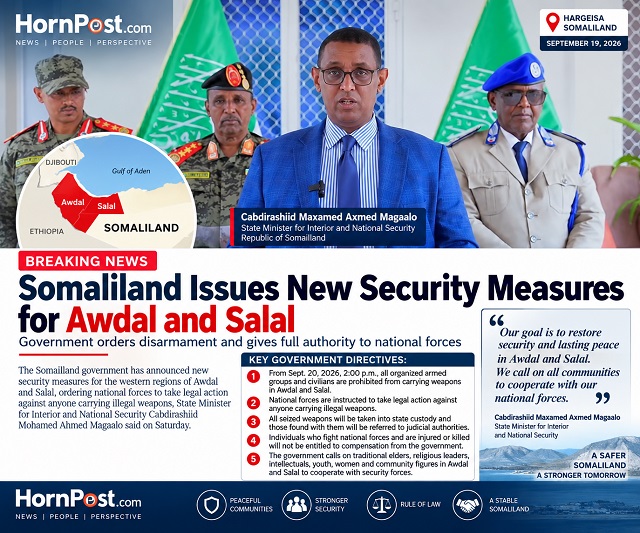
HARGEISA, Somaliland (HornPost) The Somaliland government has announced new security measures for the western regions of Awdal and Salal, ordering national forces to act against unauthorized armed groups and civilians carrying illegal weapons as authorities seek to contain renewed conflict in the area.
The measures, announced Saturday by Abdirashid Mohamed Ahmed “Magalo,” Somaliland’s State Minister for Interior and National Security, are due to take effect at 2 p.m. on Sunday, Sept. 20, 2026, according to the government announcement.
The decision marks a significant shift from the reconciliation efforts that have dominated the government’s response to the conflict in recent months. It follows repeated attempts to establish ceasefires and peace agreements between communities involved in fighting in the two western regions.
Under the new directives, authorities have prohibited organized armed groups and civilians from carrying weapons in Awdal and Salal.
The government has also ordered Somaliland’s national forces to take legal action against anyone found possessing illegal weapons.
Somaliland Orders Weapons Surrender in Awdal and Salal
The government issued five main directives as part of the new security measures.
First, beginning at 2 p.m. Sept. 20, organized armed groups and civilians carrying weapons will be prohibited from doing so in Awdal and Salal.
Second, Somaliland National Army forces have been instructed to take legal action against anyone found carrying illegal weapons.
Third, weapons seized from individuals found in possession of them will be taken by the national forces and designated as state property, while those carrying the weapons will be referred to judicial authorities.
Fourth, the government said that individuals who engage in fighting against national forces and are injured or killed will not be entitled to compensation from the government.
Fifth, the government appealed to traditional elders, community leaders, intellectuals, religious scholars, youth, women and other influential figures in Awdal and Salal to cooperate with security forces during operations intended to restore and maintain security.
The measures effectively place the responsibility for enforcing the ceasefire and controlling weapons more directly on state security institutions.
Conflict Has Followed Months of Tension
The latest decision comes after months of tension and armed clashes in western Somaliland.
The conflict escalated in late 2025 amid disputes involving communities in Awdal and Salal, with tensions surrounding a planned event connected to Xeer Ciise, a customary legal tradition associated with the Issa community.
Reports in December 2025 said clashes broke out around Saylac and surrounding areas, with disputes also involving land and community concerns.
reported at the time that the fighting had escalated between communities in Salal and Awdal and that casualties were reported, although the exact number was unclear.
The unrest subsequently developed into a broader security challenge for the Somaliland government, which has attempted to balance security measures with traditional reconciliation efforts.
The European Union Agency for Asylum’s 2026 security assessment records earlier political and security tensions in Awdal, including protests in Borama and longstanding grievances among some local communities over political representation.
Peace Efforts Produced Temporary Agreements
The government and traditional leaders have made several attempts to end the conflict through dialogue.
In August 2026, two communities from Awdal and Salal signed a peace agreement following a three-day reconciliation conference in Geerisa.
The conference brought together government officials, traditional elders, religious leaders, military commanders and representatives of the communities involved.
The agreement called for an immediate cessation of hostilities, stronger coexistence and additional reconciliation efforts. It also required security agencies to take legal action against individuals who attempted to undermine the peace process.
The agreement was presented as an effort to establish a more durable settlement after months of fighting.
However, subsequent reports indicated that the ceasefire remained fragile.
Government Later Seized Weapons and Military Vehicles
On Aug. 25, Somaliland security forces reported seizing weapons and armored military vehicles from groups involved in the fighting in Awdal and Salal.
Military officials said the operation followed the reported violation of a peace agreement between the rival communities.
The authorities displayed some of the recovered weapons and vehicles and warned civilians and armed groups against possessing military equipment outside state authority.
The military said it had been instructed to take firm action against anyone attempting to revive the conflict or openly carrying weapons.
The operations represented an earlier attempt to enforce the peace agreement through disarmament, rather than relying exclusively on negotiations.
Government Had Earlier Expressed Optimism
The latest security order comes only days after Somaliland authorities publicly expressed optimism about the possibility of resolving the western conflict through dialogue.
On Sept. 7, local media reported that the government said significant efforts were underway to end the conflict in Awdal and Salal.
State Minister for Interior and National Security Abdirashid Mohamed Ahmed said there were signs that peace was approaching and that President Abdirahman Mohamed Abdullahi “Irro” had opened a peace process involving the communities in conflict.
The government also indicated that the expected involvement of the senior traditional leader of the Issa community, Ugas Mustafe, could contribute to the reconciliation process.
The new security directives suggest that the government is now combining those reconciliation efforts with stronger enforcement against illegal weapons.
Awdal’s Earlier Security Record
Awdal has historically been regarded as one of Somaliland’s more stable regions, although political tensions and localized violence have occurred.
The EUAA’s June 2026 security assessment said the Somaliland administration-maintained control across Awdal, including Borama, Zeyla and Lughaye, while noting earlier political and communal tensions. European
Earlier EUAA reporting found relatively few security incidents in Awdal between April 2023 and March 2025, with six recorded incidents and one reported fatality during that period.
The security picture changed substantially during late 2025 and early 2026.
Data from the FSNAU early-warning dashboard, which uses ACLED security-event data, recorded elevated numbers of reported security incidents in several Awdal districts during late 2025 and early 2026.
In December 2025, the dashboard recorded 11 incidents in Borama, four in Lughaye and 12 in Zeylac. In January 2026, it recorded nine incidents in Borama, 11 in Baki and 18 in Zeylac.
The same dataset shows that reported incidents declined considerably in several districts during the spring and early summer of 2026, although some incidents were still recorded in August.
These figures measure security events rather than providing a complete assessment of the conflict’s political or social dimensions.
President Irro’s Government Faces a Difficult Balance
The conflict presents a difficult challenge for President Irro’s administration.
On one side, the government has relied on traditional elders, religious leaders and community representatives to negotiate ceasefires and reconciliation agreements.
On the other, repeated violations of agreements have increased pressure on state institutions to prevent armed groups from retaining weapons and military vehicles.
The government’s latest order reflects a stronger emphasis on state enforcement.
Its appeal to elders, religious scholars, women, youth and other community figures indicates that authorities are still seeking cooperation from local communities rather than relying solely on military measures.
Why Awdal and Salal Matter
The western regions have political and geographic importance for Somaliland.
Awdal’s capital, Borama, is one of Somaliland’s major urban centers and an important commercial and educational hub. The region extends toward the borders with Ethiopia and Djibouti, while the coastal areas around Zeylac and Lughaye connect Somaliland to the Gulf of Aden and the wider Red Sea region.
Salal, which includes Zeylac, also has strategic significance because of its proximity to Djibouti and major maritime routes.
Consequently, prolonged instability in the western regions could have implications beyond the immediate communities involved, particularly for trade, border movement and regional security.
The Next Test: Enforcing the New Order
The government’s announcement places significant responsibility on Somaliland’s security forces from Sept. 20 onward.
The immediate question will be whether the authorities can enforce the weapons ban while preventing further clashes and maintaining channels for reconciliation.
The government has called on communities to cooperate with the national forces, while traditional leaders remain important to resolving the underlying disputes.
The history of the conflict suggests that security measures alone may not resolve the broader grievances that contributed to the violence. Previous agreements have demonstrated the importance of dialogue, but their reported breakdowns have also increased pressure for stronger enforcement.
For the Somaliland government, the challenge now is to combine disarmament, law enforcement and reconciliation in a way that prevents renewed fighting while addressing the local disputes that have fueled tensions.
Timeline of the Awdal-Salal Conflict
– Late 2025: Tensions escalated around disputes linked to the planned Xeer Ciise event in Saylac, followed by clashes in Awdal and Salal.
– December 2025: Security incidents increased significantly in several Awdal districts, according to ACLED-based FSNAU data.
– March 2026: President Irro convened national leaders and officials to discuss a lasting solution to the conflict.
– April 2026: Somaliland authorities said the security situation in Awdal and Salal had been brought to an end following reconciliation efforts.
– August 2026: Communities signed another peace agreement after a reconciliation conference in Geerisa.
– Aug. 25, 2026: Somaliland forces reported seizing weapons and armored vehicles following reported violations of the peace agreement.
– Sept. 7, 2026: The government said there were positive signs for a negotiated resolution.
– Sept. 19, 2026: The government announced new restrictions on weapons and ordered national forces to take legal action against illegal armed activity.
– Sept. 20, 2026: The new weapons restrictions are scheduled to take effect at 2 p.m.
Prepared by:
Horn post staff
HARGEISA, Somaliland

Abdikarim Saed Salah
Abdikarim Saed Salah is Editor-in-Chief and Founder of HornPost.com, an independent Hargeisa-based news platform covering Somaliland, the Horn of Africa, East Africa, the Red Sea and international affairs. A journalist, television presenter, producer and geopolitical analyst, he has more than 15 years of experience in broadcast journalism, digital media, reporting and diplomacy. He works with Horn Cable TV and focuses on politics, elections, security, foreign policy and conflict. He holds a BA in Journalism and an MA in International Relations.