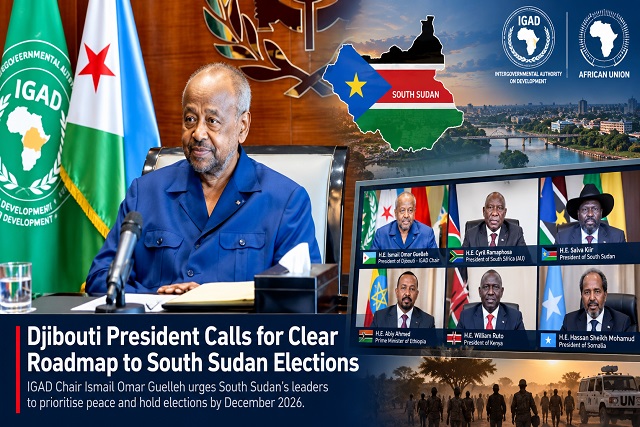
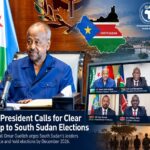
DJIBOUTI — (HornPost)— Djibouti President and current Chairperson of the Intergovernmental Authority on Development (IGAD), Ismail Omar Guelleh, has called for a clear and definitive roadmap for South Sudan’s political transition and urged the country’s leaders to prioritize peace and national consensus ahead of elections scheduled for December.
Guelleh made the remarks on Tuesday during a virtual summit of the African Union High-Level Ad Hoc Committee on South Sudan, chaired by South African President Cyril Ramaphosa.
The meeting reviewed political and security developments in South Sudan and assessed preparations for elections scheduled for December 22, 2026, according to the South African presidency.
In his address, Guelleh said South Sudan’s leaders bear the primary responsibility for choosing dialogue and political consensus over confrontation.
“We believe that the primary responsibility lies with the South Sudanese leaders themselves to choose the path of concord over confrontation,” Guelleh said, according to the Djiboutian presidency.
The Djiboutian president linked lasting stability in South Sudan to a transparent and consensus-based political process, while emphasizing the importance of completing the country’s transitional arrangements.
IGAD urges clear electoral roadmap
Guelleh said IGAD was reiterating its call for a “clear and definitive roadmap” for the transition and elections.
“Neither South Sudan, nor the region, nor the continent can afford a new delay,” he said, according to the statement published by the Djiboutian presidency.
The call follows an IGAD Council of Ministers meeting in Djibouti earlier this month, which reaffirmed the Revitalised Agreement on the Resolution of the Conflict in South Sudan (R-ARCSS) as the framework for the country’s peace process.
IGAD has called for inclusive dialogue among South Sudan’s political parties and stakeholders to restore confidence and establish a consensus-based pathway toward the December elections.
Concerns over South Sudan’s political transition
Guelleh also referred to political developments following the Nasir incident in March 2025, saying subsequent decisions had raised concerns among stakeholders.
He cited initiatives to modify elements of the R-ARCSS and uncertainty surrounding the transition as issues requiring attention.
South Sudan has faced repeated delays in implementing the 2018 peace agreement, which established the country’s transitional political arrangements.
The African Union has similarly called for the full implementation of the peace agreement and credible elections by December 2026, without another extension of the transitional period.
Regional leaders urge peaceful transition
The virtual meeting brought together members of the AU’s High-Level Ad Hoc Committee on South Sudan and leaders and representatives from IGAD member states.
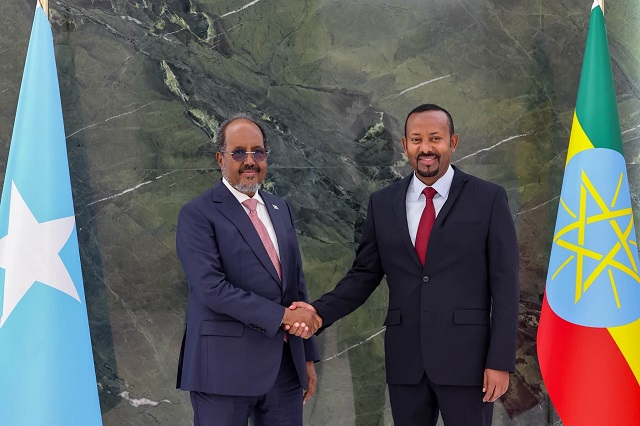
Participants included Cyril Ramaphosa of South Africa, Abiy Ahmed of Ethiopia, William Ruto of Kenya, Salva Kiir of South Sudan and Hassan Sheikh Mohamud of Somalia, according to the Djiboutian presidency.
The meeting was also attended by representatives of the African Union Commission, the United Nations and other organizations involved in South Sudan’s peace process.
The gathering comes at a critical stage for South Sudan, with the country preparing for elections while political disagreements and security concerns continue to challenge implementation of the peace agreement.
President Salva Kiir’s government has reaffirmed its commitment to holding the December elections. In a recent inter-party dialogue in Juba, Kiir said preparations were progressing across legal, administrative, logistical and security areas.
Why the December elections matter
The December 2026 elections are intended to mark the end of South Sudan’s extended transitional period and the beginning of a new political phase.
However, the African Union and IGAD have stressed that elections must be supported by an inclusive political process, adequate preparations and implementation of the peace agreement.
The regional and continental organizations have therefore continued to press South Sudan’s political leaders to resolve outstanding disputes through dialogue before the vote.
For Djibouti, which currently chairs IGAD, the South Sudan crisis remains a major regional security and diplomatic concern because instability in South Sudan could have wider consequences for the Horn of Africa.
HornPost will continue to follow developments in South Sudan and the region’s diplomatic efforts ahead of the December elections.
Prepared by:
HornPost Staff
info@hornpost.com
www.hornpost.com