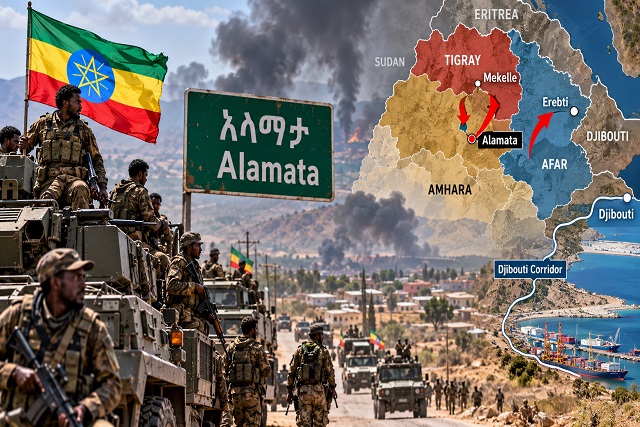
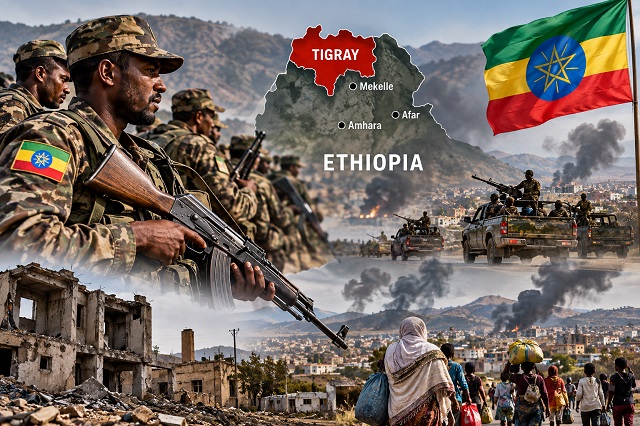
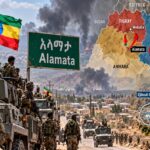
ADDIS ABABA, Ethiopia (HornPost) Fighting in northern Ethiopia has intensified, with federal forces and allied fighters claiming to have retaken the strategic town of Alamata, as clashes continue across Tigray, Amhara and Afar regions.
Reuters reported that footage showed Ethiopian government forces inside Alamata, a town located about 120 kilometers south of Mekelle, the capital of Tigray. Diplomatic sources also said the town had fallen under government control. Reuters report
Why Alamata Matters
Alamata is strategically located near the boundary between Tigray and Amhara. Its position gives forces controlling the town access to important roads linking the two regions and could provide the federal side with a potential route toward Mekelle.
The latest fighting follows a sharp deterioration in relations between Ethiopia’s federal government and the Tigray People’s Liberation Front (TPLF), raising fears that the region could slide back into a broader war similar to the conflict that lasted from 2020 to 2022.
Fighting Spreads Beyond Tigray
The renewed conflict is no longer confined to Tigray. Fighting has also been reported in Afar and Amhara, increasing concerns about a wider regional conflict.
Tigrayan forces have claimed advances in parts of Afar, including the town of Erebti, while government forces have reported military operations in several areas of Amhara.
The expansion of fighting into Afar is particularly significant because the region contains the main road and transport routes connecting Ethiopia to Djibouti, Ethiopia’s principal maritime trade corridor.
Any prolonged disruption along this route could affect the movement of fuel, food, imports and other essential goods into Ethiopia.
Humanitarian Situation Deteriorates
The renewed fighting is also creating a rapidly deteriorating humanitarian situation.
Medical organizations have reported large numbers of wounded people arriving at hospitals in areas affected by the fighting. Reports from the region indicate that hundreds of casualties have required medical treatment, while tens of thousands of civilians have reportedly been displaced.
Access to reliable information has also become increasingly difficult.
Telephone and internet services have been disrupted in parts of Tigray, limiting independent verification of battlefield developments and making it difficult for civilians to communicate with relatives or seek assistance.
Ethiopia Accuses Regional Powers
Ethiopian military officials have accused Eritrea, Sudan and Egypt of supporting armed groups opposed to the federal government.
Those accusations have been disputed by the countries concerned and should be treated as claims by the Ethiopian government rather than independently established facts.
The accusations nevertheless highlight the broader regional dimension of the crisis. Tigray borders Eritrea, while the wider conflict is unfolding against the backdrop of tensions involving Sudan, Egypt and Ethiopia.
A New Anti-Government Alliance
The TPLF has also joined an alliance involving several armed opposition groups.
The coalition, known as the Ethiopian Peoples’ Forces Alliance for Survival, brings together groups with different political and regional backgrounds that oppose Prime Minister Abiy Ahmed’s government.
The emergence of such an alliance could make the conflict more complicated than the previous confrontation between Addis Ababa and the TPLF.
Pretoria Peace Agreement Under Pressure
The renewed fighting has placed further pressure on the 2022 Pretoria Agreement, which ended the two-year Tigray war.
The African Union has called for restraint, an immediate de-escalation and a return to dialogue.
The agreement remains an important reference point for efforts to prevent another prolonged conflict in northern Ethiopia, but the latest fighting demonstrates how fragile the post-war settlement remains.
What the Conflict Means for Djibouti and Berbera
One of the most important regional consequences could involve Ethiopia’s access to international trade.
Ethiopia relies heavily on the Djibouti corridor for imports and exports. The main transport route passes through Afar before reaching Djibouti.
If fighting were to threaten major roads or logistics routes in Afar, Ethiopia’s supply chains could face additional pressure.
That could also increase attention on alternative trade corridors, including the Berbera corridor in Somaliland, although the extent to which Ethiopia could shift substantial trade away from Djibouti would depend on security, infrastructure, costs and political agreements.
For Djibouti, Somaliland and the wider Red Sea region, the renewed Tigray conflict therefore has implications beyond Ethiopia’s internal politics.
The Bigger Regional Picture
The latest developments point to three major risks:
- A wider Ethiopian conflict involving Tigray, Amhara and Afar.
- Regionalization of the conflict, particularly if Eritrea, Sudan or other external actors become more directly involved.
- Disruption of Ethiopia’s trade corridors, with potential consequences for Djibouti and increased strategic attention on Berbera.
For now, the situation remains fluid, and battlefield claims from the various sides require independent verification.
HornPost will continue to monitor developments as more verified information emerges.
Prepared by:
HornPost staff
info@hornpost.com