




HARGEISA, Somaliland (HornPost) The Horn of Africa may be entering a new strategic chapter, one in which Ethiopia’s search for reliable access to the sea, America’s growing security interests, Eritrea’s control of its Red Sea coastline, and the vulnerability of the Bab el-Mandeb are increasingly becoming interconnected.
In late July 2026, Addis Ababa hosted the African Logistics and Communications Symposium, co-hosted by the United States Africa Command (AFRICOM) and the Ethiopian National Defense Force. The gathering brought together more than 200 senior military, logistics and communications officials, defense-industry representatives and participants from nearly 40 African countries. Its focus included logistics, communications, military readiness, innovation and security cooperation.
The significance of the meeting was not simply its size. Its timing and location were particularly important given the rapidly changing security environment around the Red Sea and Bab el-Mandeb.
AFRICOM Commander Gen. Dagvin Anderson was in Ethiopia from July 26, meeting Prime Minister Abiy Ahmed and senior Ethiopian military officials before traveling to Kenya and Somalia for additional meetings with political and military leaders. At the same time, Ethiopia has become increasingly vocal about its need for reliable access to the sea, while tensions with Eritrea have risen.
This raises a larger strategic question: Is Washington developing a deeper strategic relationship with Ethiopia as part of a broader effort to strengthen security around the Horn of Africa and the Bab el-Mandeb?
There is no evidence that the United States is preparing Ethiopia to seize Eritrean territory. Such a claim would go beyond the available evidence.
But another possibility deserves serious examination: What happens if Ethiopia’s growing military capacity, its determination to obtain Red Sea access and America’s interest in securing the Bab el-Mandeb increasingly converge?
That is where Assab question becomes important.
The Bab el-Mandeb: Why Washington Cares
The Bab el-Mandeb is the narrow maritime gateway connecting the Red Sea with the Gulf of Aden. It forms part of one of the world’s most important shipping corridors, linking the Indian Ocean with the Suez Canal and, ultimately, European and Asian markets.
Its strategic importance has become even more apparent following attacks by the Houthis in Yemen on commercial shipping. Those attacks demonstrated how vulnerable international maritime trade can be when a relatively well-organized non-state actor is able to threaten shipping through a critical chokepoint.
Ships have been attacked, shipping routes disrupted and vessels diverted around the Cape of Good Hope, increasing both travel times and costs for global trade.
For Washington, this creates a direct strategic concern.
The Bab el-Mandeb is no longer simply a strategic chokepoint shown on a map. It has become an active security theater.
The United States therefore has a strong interest in maintaining freedom of navigation and preventing hostile actors from acquiring the ability to dominate or repeatedly disrupt the waterway.
That makes the African side of the Bab el-Mandeb increasingly important — placing the Horn of Africa at the center of the strategic calculation.
Ethiopia Wants the Sea
Ethiopia is one of Africa’s largest and most powerful states, but it has been landlocked since Eritrea became independent in 1993.
For Addis Ababa, dependence on foreign ports is increasingly viewed as a strategic vulnerability. Prime Minister Abiy Ahmed has repeatedly argued that Ethiopia needs reliable access to the sea. In March, he said Ethiopia had no intention of invading its neighbors and maintained that the issue should be resolved peacefully through negotiations.
Nevertheless, the Ethiopian maritime debate has become increasingly assertive.
Ethiopian commentary has increasingly presented maritime access as a matter of national strategy, while Assab has returned to public discussion as a historically important Ethiopian port.
The message is increasingly clear: Ethiopia wants to reduce its long-term dependence on being landlocked.
The question is how.
Why Assab Matters
Assab is not simply another port.
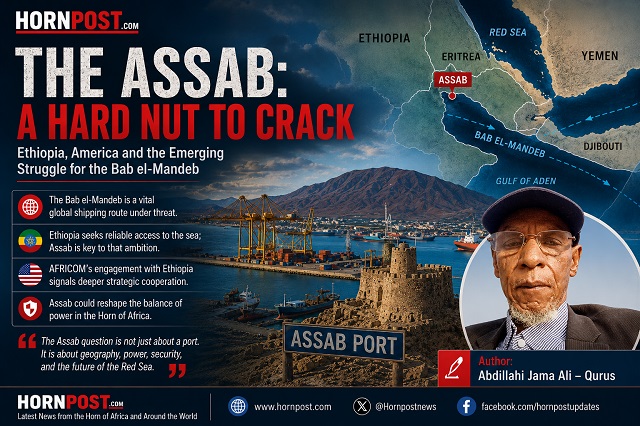
Located on Eritrea’s southern Red Sea coast, it is relatively close to the Bab el-Mandeb and geographically close to Ethiopia’s Afar region.
For Ethiopia, access to Assab would provide a direct outlet to the Red Sea.
For Eritrea, however, Assab is sovereign Eritrean territory.
That is the central strategic tension.
In February 2026, Ethiopia raised the possibility of negotiating access through Assab while relations between Addis Ababa and Asmara were simultaneously deteriorating. Ethiopia accused Eritrea of military aggression and support for armed groups, while Eritrea remained deeply suspicious of Ethiopia’s intentions toward its Red Sea coastline.
The Assab issue is therefore no longer merely theoretical. It has become part of the broader strategic contest between Ethiopia and Eritrea.
The American Connection
This is where the recent U.S.-Ethiopian security relationship becomes important.
The Addis Ababa symposium focused on logistics, communications and military readiness — areas that are fundamental to modern military capabilities because they determine how forces move, communicate, receive supplies and sustain operations.
AFRICOM’s decision to hold the event jointly with the Ethiopian military, combined with high-level meetings between American and Ethiopian officials, demonstrates the importance of the two countries’ security relationship.
That does not prove that Washington has selected Ethiopia as a future Red Sea military power.
But it raises a legitimate strategic question:
If the United States wants a stronger security architecture around the Bab el-Mandeb, could Ethiopia become one of its principal regional military partners?
If so, Ethiopia’s growing military capabilities could eventually have implications beyond its existing counterterrorism role.
Assab Scenario
Consider a possible trajectory.
The United States could deepen cooperation with Ethiopia in areas such as military training, logistics, communications, intelligence and defense.
Ethiopia could consequently become more capable of projecting power.
At the same time, Addis Ababa could continue to regard maritime access as a strategic necessity.
Negotiations with Eritrea could either succeed or fail.
If negotiations succeed, Ethiopia could obtain commercial access to the Red Sea.
If they fail, the situation could become considerably more dangerous.
The critical question would then be whether Washington would insist that Ethiopia respect the existing territorial order, or whether it could eventually view expanded Ethiopian access to the Red Sea as compatible with broader U.S. strategic interests.
There is currently no evidence that the United States supports an Ethiopian military seizure of Assab.
But that is not the only question worth asking.
The more important question is whether a stronger Ethiopia could eventually become part of an American security architecture around the Bab el-Mandeb.
Eritrea Has Every Reason to Be Concerned
From Asmara’s perspective, the issue is straightforward.
Assab is Eritrean.
Any Ethiopian attempt to acquire it by force would threaten Eritrea’s territorial integrity and fundamentally alter the balance of power along the Red Sea.
Eritrea therefore has strong reasons to closely monitor the developing U.S.-Ethiopian military relationship.
If Addis Ababa continues demanding sea access while simultaneously becoming a stronger military partner of Washington, Asmara will inevitably ask whether the two developments are connected.
That concern is further reinforced by Eritrea’s growing relationship with Egypt.
In June, Egypt and Eritrea agreed to strengthen cooperation in several areas, including the maritime economy. Egypt has also shown interest in Eritrean ports, including Assab and Massawa.
The regional strategic picture is changing.
Egypt’s Red Line
Egypt’s position could be even more consequential.
Cairo’s strategic interests extend from the Nile River to the Suez Canal and the Red Sea. Its dispute with Ethiopia over the Grand Ethiopian Renaissance Dam has already created a significant strategic rivalry.
An Ethiopian military foothold on the Red Sea would add another dimension to that competition.
Egypt has indicated that it could support commercial Ethiopian access to the sea, but it is considerably more cautious about a permanent Ethiopian military presence along the Red Sea.
In July, Egypt and Eritrea emphasized that the security and governance of the Red Sea should remain the responsibility of the littoral states and rejected attempts by non-littoral states to impose arrangements that could undermine regional stability.
The message is significant because Ethiopia is a non-littoral state.
Egypt and Eritrea are effectively asserting that the Red Sea security order should remain primarily in the hands of the countries bordering the waterway.
That position directly intersects with Ethiopia’s maritime ambitions.
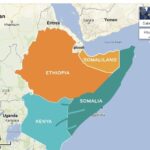
Somalia, Somaliland and the Gulf of Aden
The wider strategic picture also includes Somalia and Somaliland.
Somalia remains an important U.S. security partner. During Gen. Anderson’s July visit to Mogadishu, he met President Hassan Sheikh Mohamud and senior Somali defense officials to discuss security cooperation and support for Somalia’s security forces.
Somaliland occupies a different position in the maritime geography.
Its coastline faces the Gulf of Aden, while Berbera is strategically positioned along the maritime corridor leading toward the Bab el-Mandeb.
This gives Berbera Port strategic importance independent of the broader political dispute.
For Ethiopia, this creates another potential pathway.
Instead of seeking a military foothold on Eritrea’s Red Sea coast, Ethiopia could pursue expanded commercial and logistical access through Berbera.
The two options are strategically different.
Assab puts Ethiopia directly on the Red Sea.
Berbera provides access to the Gulf of Aden.
Both are connected to the same maritime system, but their political consequences would be very different.
The Houthi Threat Changes the Calculation
This is where the Houthi factor becomes particularly important.
The attacks from Yemen have demonstrated that maritime security cannot be understood solely through the lens of conventional borders.
A threat emerging from Yemen can affect commercial shipping thousands of kilometers away.
That makes the African coastline opposite Yemen strategically valuable.
Eritrea, Djibouti, Somaliland and Somalia all occupy positions within this maritime security environment.
Ethiopia, despite being landlocked, possesses something the coastal states do not possess to the same degree: significant military and demographic weight.
The United States therefore has an obvious interest in developing relationships with capable regional states.
But the Houthi threat also creates a strategic paradox.
The more important the Bab el-Mandeb becomes to Washington, the more strategically valuable the surrounding African coastline becomes — and the greater the significance of Ethiopia’s desire to reach it.
A New Strategic Equation
The pieces are beginning to align.
- Ethiopia wants reliable access to the sea.
- Eritrea controls Assab and Massawa.
- Egypt wants to protect the Nile, Suez and the Red Sea balance.
- Somalia remains a major U.S. security partner.
- Somaliland occupies the Gulf of Aden and controls access to Berbera.
- Djibouti remains a critical maritime and military hub.
- The Houthis have demonstrated the vulnerability of the Bab el-Mandeb.
- The United States has a direct interest in keeping this maritime gateway open.
None of these interests automatically leads to conflict.
But together, they are creating a considerably more complicated strategic environment.
The Real Question
The central question is therefore not simply whether the United States is “arming Ethiopia.”
That is too narrow.
The real question is:
What kind of regional security architecture is Washington helping to build around the Bab el-Mandeb — and what role will Ethiopia play in it?
If Ethiopia becomes a stronger American security partner while continuing to demand Red Sea access, the strategic consequences could be profound.
If Ethiopia obtains negotiated access, the region may adjust.
If Ethiopia establishes a military presence on the Red Sea, Egypt and Eritrea are likely to respond.
And if Ethiopia ever attempts to obtain Assab by force, the consequences could extend far beyond Ethiopia and Eritrea.
Such a crisis could draw in Egypt, reshape Somalia’s security environment, affect Somaliland and Berbera, and force Washington to navigate competing strategic priorities.
Assab Question
The Horn of Africa is therefore approaching a strategic crossroads.
The Houthi attacks have exposed the vulnerability of the Bab el-Mandeb.
Washington has a growing interest in the security architecture surrounding the waterway.
Ethiopia wants the sea.
Eritrea wants to preserve sovereignty over its Red Sea coastline.
Egypt wants to prevent a new strategic imbalance on its southern maritime flank.
Somalia remains central to America’s security engagement in the Horn.
And Somaliland and Berbera occupy a crucial position on the Gulf of Aden.
There is no evidence today that Washington is preparing Ethiopia to capture Assab.
But there is enough strategic evidence to ask whether a stronger U.S.-Ethiopian relationship could eventually alter the balance of power around the Red Sea.
And that brings us back to Assab.
Who controls Assab may not determine who controls the Bab el-Mandeb. But whoever shapes the strategic environment around Assab could have significant influence over one of the world’s most important maritime gateways.
The next chapter of Horn of Africa geopolitics may therefore be written not in Addis Ababa, Asmara, Cairo or Mogadishu alone, but across the narrow waters of the Bab el-Mandeb.
Author: Abdillahi Jama Ali – Qurus
Hargeisa, Somaliland