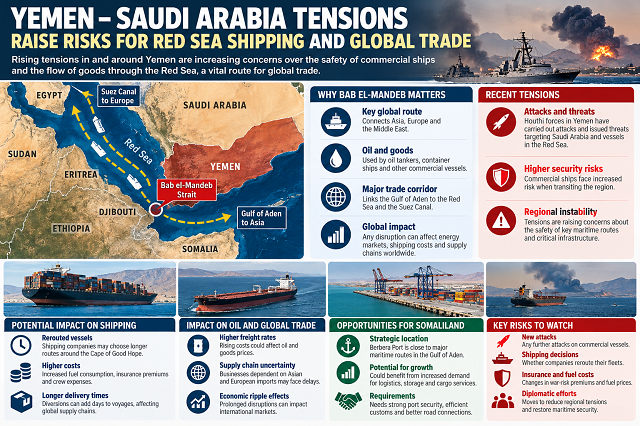
HARGEISA, Somaliland (HornPost) Rising security tensions involving Yemen and Saudi Arabia are increasing concerns over commercial shipping and the movement of goods through the Red Sea, particularly the strategic Bab el-Mandeb Strait, which connects the Gulf of Aden to the Red Sea.
If attacks and threats against commercial vessels and critical infrastructure continue, shipping companies could reconsider their routes, potentially increasing transportation costs, insurance premiums and delivery times for goods moving between Asia, Europe and the Middle East.
Bab el-Mandeb: A Strategic Global Trade Route
The Bab el-Mandeb Strait is one of the most important maritime chokepoints connecting international trade routes. Oil tankers, container ships and other commercial vessels use the passage to travel from the Gulf of Aden through the Red Sea toward the Suez Canal and European markets.
Any deterioration in security along this route could have consequences far beyond Yemen and Saudi Arabia. If shipping companies consider the strait too dangerous, they may divert vessels around the Cape of Good Hope in southern Africa. Depending on the origin and destination of a shipment, such diversions can add days to voyages and substantially increase operating costs.
However, security threats do not automatically mean that Bab el-Mandeb has been closed. The actual impact depends on the scale of attacks, the security situation at sea and decisions made by shipping operators.
Potential Impact on Oil and Global Supply Chains
Changes to maritime routes can increase fuel consumption, crew expenses and war-risk insurance premiums. These additional costs may eventually affect freight rates and the prices of goods in international markets.
Oil exporters, shipping companies and businesses transporting industrial products are particularly vulnerable to prolonged disruptions. If vessels face repeated delays or are forced to take longer routes, businesses that depend on deliveries from Asia and Europe could experience higher costs and supply-chain uncertainty.
The scale of the economic impact will depend on how long the tensions persist and whether commercial shipping continues operating through the affected waters.
What the Situation Means for Somaliland and Berbera Port
The security situation is also significant for Somaliland, whose Port of Berbera occupies a strategic position along the Gulf of Aden, close to major international maritime routes.
If shipping companies and regional traders seek additional logistics, storage and cargo-handling services, Berbera could potentially benefit from changes in regional trade patterns. The port’s location gives it strategic relevance for businesses serving Somaliland, Ethiopia and other parts of the Horn of Africa.
However, these opportunities are not guaranteed. Deteriorating maritime security could also increase insurance costs, operational expenses and risks for ports and commercial vessels across the region.
To benefit from potential changes in trade flows, Somaliland would need to maintain port security, improve logistics services, strengthen road connections and ensure efficient customs procedures.
What to Watch Next
Several developments will be important in assessing the direction of the crisis: any new attacks against commercial vessels, decisions by shipping companies to reroute their fleets, changes in maritime insurance premiums and fuel prices, and diplomatic efforts to reduce regional tensions.
The greatest risk to Red Sea trade is not necessarily the complete closure of Bab el-Mandeb. Even without a formal closure, persistent insecurity could make the route more expensive and less reliable for international shipping.
If tensions continue, the consequences could extend to global supply chains and the wider Horn of Africa economy. For Somaliland, the priority is to monitor developments closely, distinguish confirmed economic opportunities from speculation, and prepare for both the commercial possibilities and security challenges arising from instability along one of the world’s most important maritime corridors.
Prepared by:
HornPost staff
info@hornpost.com