HARGEISA, Somaliland (HornPost) There is a recurring danger in international politics: powerful countries can sometimes mistake size for importance.
Ethiopia is a large country with a huge population, a substantial economy and significant political and military influence.
Somaliland is much smaller.
But strategic importance is not measured by population alone.
Geography matters. Security matters. Economic corridors matter. Strategic partnerships matter.
And on all four fronts, Somaliland matters to Ethiopia.
More Than a Road to the Sea
Ethiopia’s interest in Somaliland is often discussed as though it were primarily about gaining access to the sea.
That is too narrow.
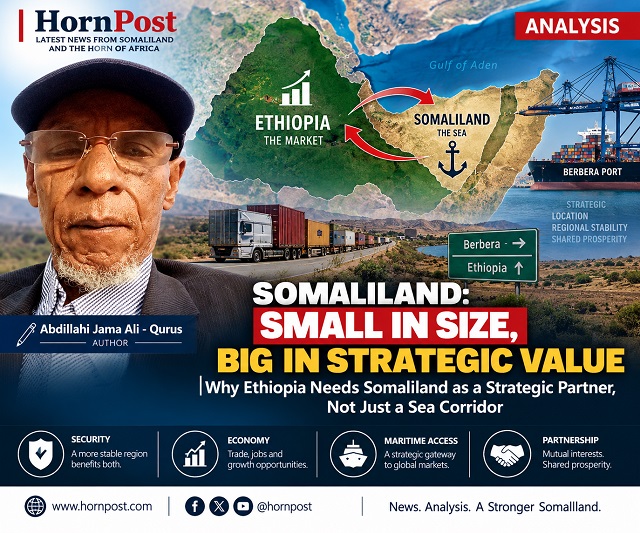
Somaliland is not simply a road connecting Ethiopia to Berbera Port. It is a neighboring country positioned along the Gulf of Aden, directly adjacent to Ethiopia’s Somali Region and connected to Ethiopia through longstanding commercial, social and transport networks.
For Ethiopia, Somaliland represents three interests at the same time:
A security environment.
An economic corridor.
A maritime gateway.
These interests cannot easily be separated.
The Security Dimension
For decades, Somaliland’s stability has had consequences beyond its borders.
Its location places it alongside Ethiopia’s eastern frontier and within a region affected by terrorism, arms trafficking, smuggling and political instability.
A relatively stable neighbor is an asset.
A destabilized neighbor is a security problem.
This should be clear to any Ethiopian strategist.
Somaliland’s stability therefore has value for Ethiopia even before a single container passes through Berbera Port.
Security is infrastructure.
Without security, there can be no reliable trade corridor, dependable logistics or sustainable maritime access.
The Economic Dimension
Ethiopia needs reliable access to international markets.
As a landlocked country, its economic development depends heavily on efficient connections to the sea. That makes neighboring maritime gateways strategically important.
Berbera Port is one of those gateways.
But a corridor cannot function on geography alone.
It requires cooperation between the countries through which it passes. It requires predictable customs arrangements, secure roads, efficient logistics and traders who trust the system.
It also requires communities on both sides of the border to see economic opportunity rather than unnecessary restrictions.
In other words:
Ethiopia needs Somaliland not simply as territory between itself and the sea, but as an economic partner.
The Strategic Dimension
There is another factor Ethiopia should not overlook.
Somaliland’s position on the Gulf of Aden gives it significance far beyond its physical size.
The Red Sea and Gulf of Aden have become increasingly important strategic theaters involving regional and global powers.
Ports, shipping lanes, naval operations, energy routes and security partnerships all converge in this wider maritime space.
Somaliland therefore possesses something that cannot simply be created with money or population:
strategic geography. And geography cannot easily be manufactured, relocated or replaced.
Do Not Mistake Asymmetry for Subordination
Ethiopia is larger.
Somaliland is smaller.
That is a fact.
But size does not establish a hierarchy of national interests.
Ethiopia has something Somaliland needs:
a huge neighboring market.
Somaliland has something Ethiopia needs:
strategic maritime geography.
The relationship is therefore not simply one of dependence.
It is a relationship built around mutual interests and mutual leverage.
Ethiopia has the market.
Somaliland has the maritime position.
That should be the foundation of the relationship.
Not superiority.
Not pressure.
Reciprocity.
Somaliland Has Options
Ethiopia should also understand that Somaliland does not exist in an empty strategic space.
Other countries have growing interests in the Gulf of Aden and the Red Sea. Regional and global powers are looking toward ports, shipping routes, logistics, investment and security cooperation.
Somaliland therefore has opportunities to develop multiple economic and strategic partnerships.
This does not have to be directed against Ethiopia.
Indeed, it should not be.
But it means Ethiopia should not assume that Somaliland’s strategic value can simply be taken for granted.
A partner with alternatives deserves to be negotiated with, not taken for granted.
The Wise Ethiopian Policy
The wiser policy for Ethiopia is not to underestimate Somaliland.
It is to recognize that Ethiopian interests are better served by a stable, prosperous and cooperative Somaliland than by a resentful or marginalized neighbor.
A strong Somaliland can become an economic bridge between Ethiopia and the maritime world.
A secure Somaliland can contribute to Ethiopia’s own security.
A prosperous Somaliland can become a larger market for Ethiopian goods and services.
And a cooperative Somaliland can help build a regional economic corridor connecting Ethiopia to global commerce.
That is not a threat to Ethiopia. It is an opportunity for Ethiopia.
The Choice
Ethiopia has a choice.
It can view Somaliland narrowly — as a corridor to the sea.
Or it can view Somaliland strategically — as an important neighbor whose cooperation contributes to Ethiopia’s security, economic development and maritime ambitions.
The second approach is wiser.
The Horn of Africa is changing, and the old assumption that political and strategic power belongs only to the largest country is becoming increasingly inadequate.
In the modern geopolitical environment, strategic geography can give a small country extraordinary importance.
Somaliland possesses that geography.
Ethiopia possesses the market.
Both possess something valuable.
Neither needs to be subordinate to the other.
The wiser Ethiopia will recognize Somaliland not merely as a gateway to the sea, but as a strategic neighbor whose stability, cooperation and goodwill are themselves valuable national assets.
Analysis | Somaliland–Ethiopia Relations.
By Abdillahi Jama Ali – Qurus
abdillahijamac9@gmail.com
Hargeisa, Somaliland