WASHINGTON (HornPost) — A new analysis published by Foreign Policy is calling on the United States to formally recognize Somaliland, arguing that Washington’s strategic interests in the Horn of Africa, the Red Sea and the Gulf of Aden outweigh concerns over opposition from some U.S. partners in the region.
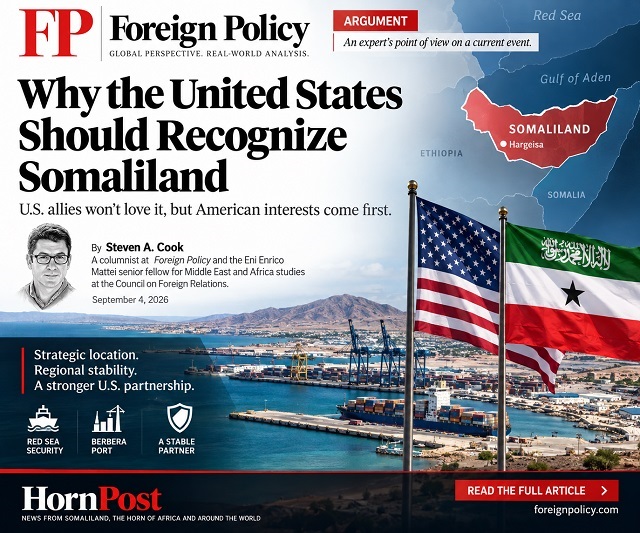
The article, “Why the United States Should Recognize Somaliland,” was published on September 4, 2026, by Steven A. Cook, a Foreign Policy columnist and senior fellow at the Council on Foreign Relations. Cook argues that Somaliland offers the United States a potentially important strategic partnership at a time of heightened security concerns involving Iran, the Houthis and maritime shipping routes.
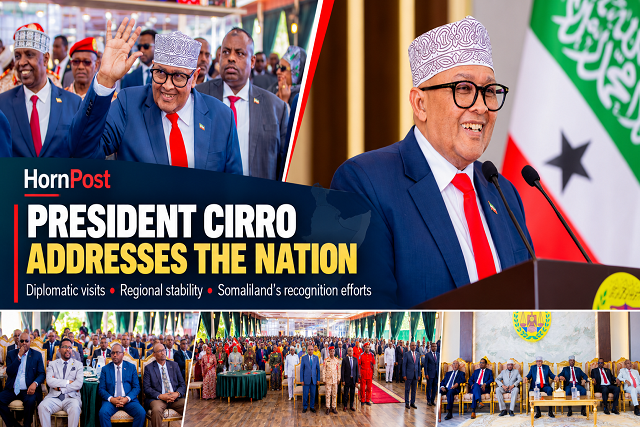
The analysis comes as Somaliland President Abdirahman Mohamed Abdullahi Irro travels to the United States on his first official working visit since taking office. Somaliland’s presidency has said the visit is intended to strengthen diplomatic relations, expand security and economic cooperation, attract investment and advance Somaliland’s international recognition campaign.
Foreign Policy: Somaliland Has Strategic Value for Washington
Cook argues that Somaliland’s location makes it particularly important to U.S. strategic interests.
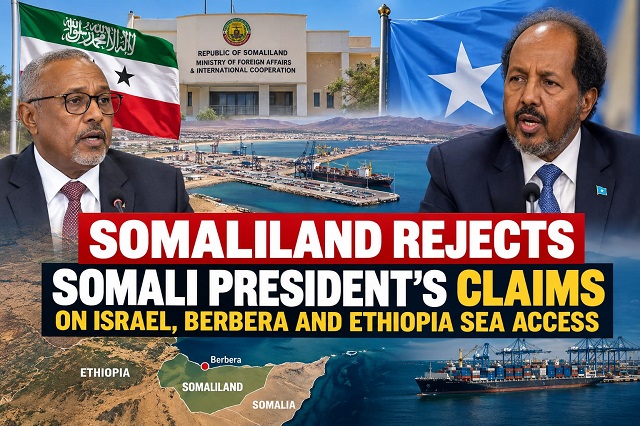
Somaliland sits on the southern side of the Gulf of Aden, near the Bab el-Mandeb Strait, a critical maritime chokepoint connecting the Red Sea with the Gulf of Aden and the wider Indian Ocean.
The article points to Somaliland’s Berbera port and adjacent airstrip as potential strategic assets for Washington, particularly as the United States confronts growing threats to maritime navigation from the Houthis and seeks ways to monitor developments across the Red Sea and Yemen.
According to Cook, Somaliland’s strategic position, its relationship with Israel, Ethiopia and the United Arab Emirates, and its stated willingness to develop closer ties with Washington make it a potential American partner in the Horn of Africa.
Recognition as a Strategic Decision
The Foreign Policy analysis argues that Washington should view recognition not simply through the traditional framework of Somalia’s territorial integrity, but through the broader strategic interests of the United States.
Cook notes that Somaliland has maintained its own political institutions, security forces and governmental structures since declaring the restoration of its independence in 1991.
He also highlights Somaliland’s 2024 presidential election, describing the peaceful transfer of power to the opposition as an important example of political stability.
The article acknowledges that Somaliland faces internal challenges, including political tensions and instability in parts of the east, but argues that these difficulties do not eliminate the strategic case for closer U.S. relations.
The Red Sea and Houthi Threat
One of the strongest arguments in the article concerns maritime security.
The analysis places Somaliland within the wider geopolitical competition surrounding the Red Sea, Gulf of Aden and Bab el-Mandeb.
The author argues that the security environment has become more important following attacks by Iran-backed Houthis on international shipping and the broader confrontation involving Iran.
From this perspective, Somaliland’s geographic position could provide Washington with another potential location from which to monitor developments around Yemen and the Red Sea.
Cook argues that Somaliland could potentially become a staging area for U.S. efforts to monitor and, when necessary, pressure the Houthis and Iran’s Islamic Revolutionary Guard Corps.
U.S. Recognition Would Face Regional Opposition
The proposal would not be without consequences.
The article acknowledges that recognizing Somaliland could anger several countries that maintain close relations with Washington, including Turkey, Egypt and Saudi Arabia.
Those governments have opposed Somaliland’s independence and have emphasized Somalia’s territorial integrity.
Cook nevertheless argues that these countries should not have the ability to determine U.S. policy when Washington’s own strategic interests are at stake.
The author specifically points to the competing interests of Turkey, Egypt and Saudi Arabia in the Horn of Africa and argues that Washington may have to accept diplomatic friction if it decides that recognition serves broader American interests.
A Significant Moment for Somaliland
The publication of the Foreign Policy argument comes at a particularly important moment for Somaliland.
President Irro’s visit to the United States gives Hargeisa an opportunity to present its diplomatic case directly to American officials and influential policy circles.
The Somaliland presidency has already identified recognition, security cooperation, economic relations and investment as key priorities for the trip.
The Foreign Policy article does not mean that the U.S. government has decided to recognize Somaliland.
Rather, it is an argument by a prominent foreign-policy analyst for why Washington should do so.
What This Could Mean
The significance of the new Foreign Policy article is therefore not that U.S. recognition has been announced.
Its significance is that the argument for recognition is increasingly being framed around American strategic interests rather than solely Somaliland’s long-standing diplomatic campaign.
The central argument is straightforward:
If Somaliland can provide the United States with strategic access and partnership near the Red Sea and Bab el-Mandeb, should Washington continue to prioritize Somalia’s territorial integrity over those interests?
That question is likely to become increasingly important as Somaliland seeks deeper engagement with Washington and as competition over the Horn of Africa and Red Sea continues to intensify.
For Hargeisa, the timing is significant.
For Mogadishu, it presents another diplomatic challenge.
And for Washington, it raises a strategic choice between maintaining its longstanding position on Somalia’s territorial integrity and potentially recognizing a territory that Foreign Policy argues could become an important U.S. partner in one of the world’s most strategically sensitive regions.
Source: Foreign Policy, “Why the United States Should Recognize Somaliland,” by Steven A. Cook, published September 4, 2026. Foreign Policy