
HARGEISA, Somaliland (HornPost) The Somalia-Somaliland dispute cannot be permanently resolved without examining the legal and political foundations of the 1960 union, its constitutional history, the 1961 referendum and Somaliland’s 1991 restoration of independence.
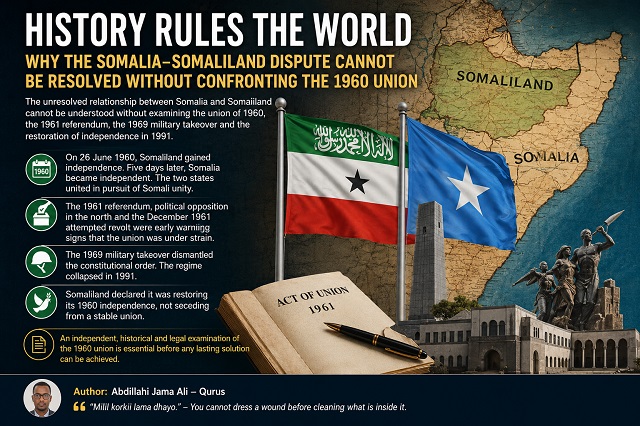
HISTORY RULES THE WORLD: Why the Somalia–Somaliland Dispute Cannot Be Resolved Without Confronting the 1960 Union Author: Abdillahi Jama Ali – Qurus
The Somalia-Somaliland dispute cannot be permanently resolved without examining the legal and political foundations of the 1960 union, its constitutional history, the 1961 referendum and Somaliland’s 1991 restoration of independence.
The Wound Beneath the Bandage
There is a Somali proverb that carries a profound political lesson:
“Milil korkii lama dhayo.”
You do not dress a wound while pus and harmful matter remain inside it. The wound must first be opened, cleaned and treated. Only then can it be properly dressed.
This is precisely the problem with the unresolved relationship between Somalia and Somaliland.
For more than three decades, the international community has attempted to manage the dispute through dialogue, reconciliation, constitutional arrangements and political compromise. Yet the central question remains largely untouched:
What exactly happened to the union created in 1960, and what is its legal and political meaning today?
The international community cannot intelligently mediate the future relationship between Somalia and Somaliland while treating the legal and political status of the 1960 union as a settled and unquestionable fact.
This is not an argument for recognising Somaliland, nor is it an argument for preserving Somalia’s position. It is an argument for something that should precede both: an impartial examination of the sovereignty question itself.
The Horn of Africa does not need another diplomatic bandage. It needs a diagnosis.
And that diagnosis must begin in 1960.
The Original Wound: 1960
On June 26, 1960, the State of Somaliland became independent from British rule. Five days later, on July 1, 1960, the former United Nations Trust Territory of Somalia became independent from Italian administration.
The two newly independent states then joined together in pursuit of a powerful political and emotional vision: Somali unity.
The aspiration was genuine and widely shared. Somali nationalism had long envisioned the political unification of Somali-inhabited territories, and the union of Somaliland and Somalia represented the realization of an important part of that broader aspiration.
But political aspirations and constitutional legality are not necessarily the same thing.
The legal arrangements surrounding the union were complex. Somaliland enacted its own Union Law in July 1960, while the constitutional arrangements of the new Somali Republic developed through a separate process.
The subsequent legal history became even more complicated, including the adoption of a new Act of Union in 1961.
This is not a minor technical dispute.
It goes to the heart of the question:
Was the union established through a sufficiently clear and mutually ratified constitutional process, or did political necessity move faster than the law?
The international community has never given this question the sustained historical and legal examination it deserves.
The First Warning Came Within a Year
The warning signs appeared almost immediately.
On June 20, 1961, a referendum was held on the constitution of the Somali Republic.
At the national level, the constitution was approved. But the political response in the former Somaliland territory was markedly different.
The leading northern political movement opposed the constitution and called for a boycott, while opposition among those who voted in the north was substantial.
The result should have triggered a serious political examination of the relationship between the two territories.
Instead, the problem was absorbed into the new state.
Later that year, the attempted revolt by northern military officers in December 1961 provided another warning that the political settlement was already under considerable strain.
The wound was bleeding.
But it was not cleaned.
Then the Constitutional Order Was Destroyed
In 1969, Major General Mohamed Siad Barre seized power. The constitutional democratic order was suspended and replaced by military rule.
This created another fundamental question that deserves greater attention.
If the constitutional and political arrangements of the original republic were subsequently dismantled by military rule, what exactly was being preserved when the international community later treated the territorial and political structure of the former republic as an unquestionable and permanent settlement?
The military regime eventually collapsed in 1991.
Somaliland then declared that it was restoring the independence it had possessed in 1960, rather than seceding from a successfully completed and permanently binding union.
One may agree or disagree with that interpretation.
But it cannot responsibly be dismissed without examining its historical and legal foundations.
The central issue is therefore not simply whether Somaliland declared independence in 1991. The deeper question is what political and legal status existed between 1960 and 1991, and what happened to that status when the Somali state collapsed?
That question remains central to understanding the dispute today.
The African Union Already Recognized the Uniqueness of the Case
The international community’s own record is particularly important here.
In 2005, the African Union sent a fact-finding mission to Somaliland.
The mission did not simply treat the issue as an ordinary secessionist dispute. Its findings described the Somaliland-Somalia union as having malfunctioned and regarded Somaliland’s case as historically distinctive, recommending that the African Union consider a special approach.
That observation deserves to be remembered.
The issue was not invented in Hargeisa yesterday.
The African Union itself examined the history and concluded that the case had unusual characteristics.
Yet that assessment did not become the starting point for the comprehensive examination that the situation requires.
The document became part of the history of the dispute — but not the beginning of its resolution.
Dialogue Is Not the Diagnosis
The international community is right about one thing:
Somalia and Somaliland should resolve their differences peacefully.
But dialogue is a method.
It is not a diagnosis.
The critical question is:
Dialogue about what?
If Somalia enters negotiations on the assumption that its sovereignty and territorial integrity over Somaliland are already legally settled, while Somaliland enters believing that the 1960 union failed and that it restored its sovereignty in 1991, then the two sides are not negotiating from the same premise.
Repeatedly placing them around a table does not resolve that contradiction.
It merely postpones it.
Dialogue cannot substitute for diagnosis.
Before negotiating the future, the parties must establish what they are actually negotiating.
When Sovereignty Becomes a Shield
The international system rightly protects the principles of sovereignty and territorial integrity. Without those principles, the international order could become dangerously unstable.
But sovereignty should not become a shield behind which an unresolved historical dispute can remain permanently frozen.
Nor should self-determination be treated as though it disappears whenever a state invokes territorial integrity.
These principles can come into tension.
The answer cannot simply be to repeat one of them louder.
The relevant questions are more difficult:
- How was the original union constituted?
- Was it properly ratified?
- What did the 1961 referendum actually demonstrate?
- What did the attempted revolt of 1961 signify?
- What happened to the constitutional order after 1969?
- What survived the collapse of the military regime in 1991?
- What is the present source of political consent?
- And, most importantly, what political arrangement can command the genuine consent of the people concerned today?
Those are questions of political diagnosis.
They are not slogans.
Self-Determination Cannot Be Permanently Deferred
The Horn of Africa has paid an enormous price for unresolved political disputes.
- Peacekeeping missions have come and gone.
- Governments have collapsed and been reconstructed.
- Constitutional conferences have multiplied.
- Reconciliation initiatives have been launched.
Billions of dollars in international assistance have been spent.
Yet the fundamental political dispute between Somalia and Somaliland remains unresolved.
This should force a reconsideration of the approach.
The objective of diplomacy should not be the preservation of an existing political formula simply because it appears on international maps.
The objective should be a durable political settlement based on genuine consent.
That does not mean that every demand for independence automatically creates a right to statehood.
It means something more fundamental:
A people’s political aspirations cannot be indefinitely subordinated to an assertion of sovereignty without examining the historical circumstances that produced the dispute.
If sovereignty becomes a mechanism for preventing the resolution of conflict, then sovereignty is being used against the very purpose of international order: peace and stability.
This Is Not an Argument for Taking Sides
The international community does not need to begin by recognizing Somaliland.
Nor does it need to begin by rejecting Somaliland.
It should begin by examining the dispute objectively.
That examination should be independent, historical and legal.
It should ask both sides difficult questions.
To Somalia:
- What is the legal foundation of the present claim to sovereignty over Somaliland?
- How does that foundation address the unresolved questions surrounding the formation and subsequent transformation of the union?
To Somaliland:
- What is the legal and political basis of the claim that independence was restored in 1991?
- How should that claim be reconciled with the international legal order of today?
And to both sides:
What political arrangement can command the consent of the people concerned?
These are not slogans.
They are the questions that must precede a final settlement.
The Danger of Perpetual Ambiguity
The greatest danger is not necessarily that the international community will make the wrong decision.
It may be that it continues refusing to confront the decision at all.
An unresolved political dispute does not remain frozen forever.
Instead:
- It hardens political positions.
- It creates generations that inherit grievances they did not create.
- It consumes diplomatic and financial resources.
- It produces recurring regional crises.
- And eventually, when peaceful political avenues appear exhausted, societies may begin looking for alternatives.
That is why conflict prevention sometimes requires more than preserving the status quo.
Sometimes the status quo is itself the problem.
The Future Cannot Be Built on an Unexamined Past
Somalia and Somaliland are discussing their future relationship.
That makes this question more urgent, not less.
The international community should encourage the two sides to negotiate. But it should also encourage them to confront the question beneath the negotiations.
The issue is not simply borders.
It is not simply federalism.
It is not simply constitutional reform.
It is not simply recognition.
At the heart of the dispute lies sovereignty — and the question of where that sovereignty came from.
Until that question is honestly examined, every negotiation risks becoming an exercise in managing disagreement rather than resolving it.
Clean the Wound
The Somali proverb remains relevant:
“Milil korkii lama dhayo.”
You cannot dress a wound before cleaning what is inside it.
For more than three decades, the international community has attempted to bandage the Somali political wound through dialogue, conferences, reconciliation and compromise.
Those efforts have their place.
But the Somalia-Somaliland dispute requires something deeper.
First, diagnose the wound.
Examine the history of 1960.
Examine the legal instruments of union.
Examine the constitutional developments that followed.
Examine the collapse of the old order in 1991.
Examine the African Union’s own assessment of the uniqueness of the case.
Then listen seriously to the people whose political future is at stake.
Only after that can meaningful negotiations about the future begin.
The Horn of Africa does not need another diplomatic bandage.
It needs surgery.
And the first step in that surgery is to stop pretending that the original wound no longer exists.
By Abdillahi Jama Ali – Qurus
Hargeisa, Somaliland