MOGADISHU —(HornPost) Somalia’s prolonged political dispute over the country’s electoral process and constitutional order is coming under renewed international pressure, with foreign partners urging President Hassan Sheikh Mohamud and opposition leaders to reach a comprehensive political agreement.
The dispute has centered on the interpretation of Somalia’s constitutional amendments, the timing and model of the next elections, and whether the government can continue operating without a broader political settlement.
International partners have repeatedly warned that continued political confrontation could undermine Somalia’s security, state-building efforts and international support.
International Community Calls for Dialogue
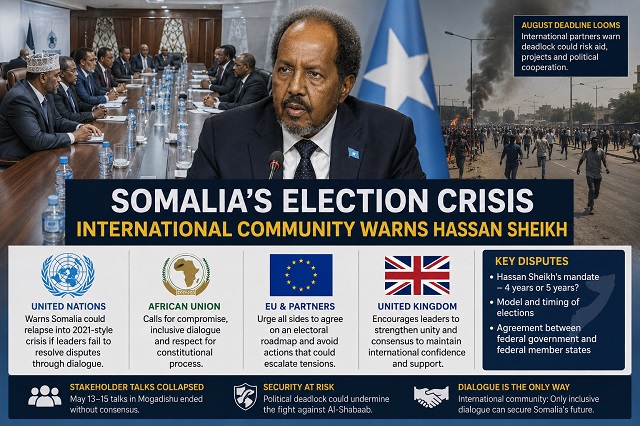
On June 1, a group of Somalia’s international partners, including the United Nations Transitional Assistance Mission in Somalia (UNTMIS), the European Union and several European governments, called on Somali political leaders to resume dialogue and reach agreement on an electoral roadmap.
The partners urged all sides to prioritize the national interest and avoid actions that could escalate tensions.
The warning followed the collapse of high-level talks between the Federal Government and representatives of the Somali Future Council in May.
The African Union Commission said on May 16 that the talks, held in Mogadishu from May 13 to 15, ended without consensus. The AU called for renewed negotiations, mutual compromise and adherence to constitutional order.
UN Warns Against Repeating the 2021 Crisis
The United Nations has expressed particular concern over the possibility of Somalia returning to the political confrontation witnessed in 2021, when disagreements over the electoral timetable contributed to serious tensions and violence.
On June 5, UNTMIS said the Secretary-General was alarmed by reports of violence in Mogadishu and called on Somali leaders to exercise maximum restraint and resolve political differences through dialogue.
The UN mission said international partners had repeatedly warned of the risk of repeating the 2021 electoral crisis.
The warning came after clashes in parts of Mogadishu between government forces and militias aligned with opposition figures. Reuters reported that the violence occurred amid tensions over President Hassan Sheikh Mohamud’s decision to remain in office after his previous four-year mandate was disputed by the opposition.
Dispute Over Hassan Sheikh’s Mandate
At the heart of the crisis is a disagreement over the constitutional changes adopted by Somalia’s parliament.
The Federal Government argues that constitutional amendments introduced a five-year presidential and parliamentary term and established a transition toward direct, one-person, one-vote elections.
The Somali government has officially reaffirmed its commitment to holding direct elections, saying the process will be free, fair, transparent and credible and conducted in accordance with the Constitution and national laws.
The Office of the Prime Minister has also published an explanation of the constitutional amendments, stating that the changes introduced universal suffrage, a multi-party system and five-year presidential and parliamentary terms.
Opposition leaders, however, dispute the government’s interpretation and argue that the constitutional changes were not reached through sufficient political consensus.
That disagreement has produced a broader political crisis over who has the authority to determine the country’s electoral timetable.
August Deadline and Growing Diplomatic Pressure
By late July, diplomatic sources cited by Somali media said some international partners had warned Somali leaders to reach a comprehensive political agreement before the end of August.
According to those reports, continued political deadlock could lead international partners to reconsider aspects of development support, project financing and political cooperation.
The reports have not been followed by a formal announcement that international assistance has been suspended.
Other reports said the United States and United Kingdom were exploring renewed diplomatic efforts to bring President Hassan Sheikh together with opposition and federal member-state leaders in an attempt to break the electoral deadlock.
The reports underline the increasing concern among Somalia’s international partners that political instability could undermine security and state-building gains achieved over the past two decades.
UK Urges Political Consensus
The pressure remained evident this week.
During a visit to Somalia, UK Minister for Development and Africa Kirsty McNeill met President Hassan Sheikh Mohamud and discussed Somalia’s political and security priorities.
The British government said the minister encouraged leaders across Somalia to engage in constructive dialogue, strengthen national unity and build consensus over the country’s political future.
The UK also said continued progress on political dialogue and Somalia’s security transition would be critical to maintaining international confidence and support.
Security Concerns Add to Political Pressure
The political dispute comes as Somalia continues its military campaign against Al-Shabaab and works with international partners to strengthen national security institutions.
International actors fear that prolonged political confrontation could divert attention and resources away from the fight against Al-Shabaab while weakening cooperation between the federal government and federal member states.
The June violence in Mogadishu demonstrated how quickly political disagreements can acquire a security dimension.
For international partners, the concern is therefore not simply about the date of Somalia’s next election. It is also about preserving constitutional stability, preventing renewed violence and maintaining the political consensus necessary for the country’s broader security transition.
What Happens Next?
The immediate challenge facing Somalia is whether President Hassan Sheikh Mohamud, opposition leaders and federal member-state authorities can reach a political settlement acceptable to the major stakeholders.
The international community has so far emphasized dialogue rather than imposing a specific electoral model.
The United Nations and African Union have called for compromise, while Western partners have increasingly linked political progress to continued international confidence and support.
With the end of August approaching, pressure on Somalia’s political leadership is likely to intensify.
The central question now is whether the country’s political actors can agree on an electoral roadmap before the dispute produces another cycle of confrontation — or whether Somalia will enter a deeper constitutional and political crisis.
For Somalia, the stakes extend beyond the next election. The outcome could shape the country’s political stability, federal relations, security transition and international partnerships for years to come.
Prepared by:
HornPost staff
info@hornpost.com
https://www.hornpost.com/
HARGEISA, Somaliland