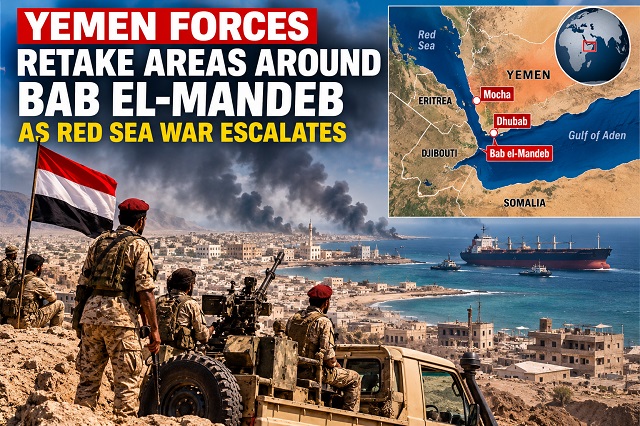
HARGEISA, Somaliland — (HornPost) — The escalating Houthi attacks in the Red Sea and around the Bab el-Mandeb Strait are raising a strategic question for the Horn of Africa:
could the disruption of one of the world’s most important shipping corridors create new economic and maritime-security opportunities for Somaliland, particularly for Berbera Port?
The answer is potentially yes — but the opportunity is neither automatic nor risk-free.
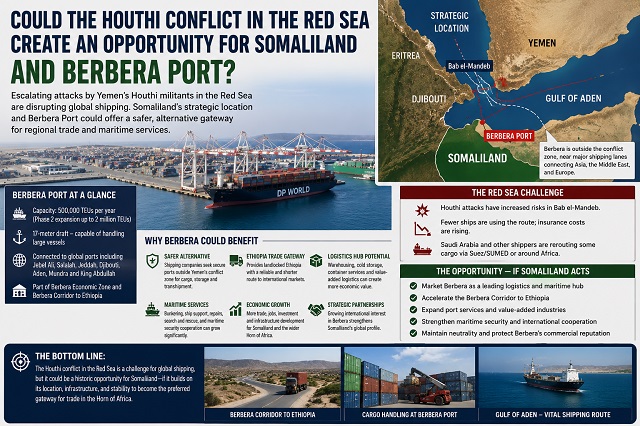
As shipping companies face higher security risks, insurance costs and disruptions around Yemen, Berbera’s location on the southern Gulf of Aden gives Somaliland an opportunity to strengthen its position as a regional logistics, trade and maritime-services hub.
Bab el-Mandeb Becomes a Higher-Risk Shipping Corridor
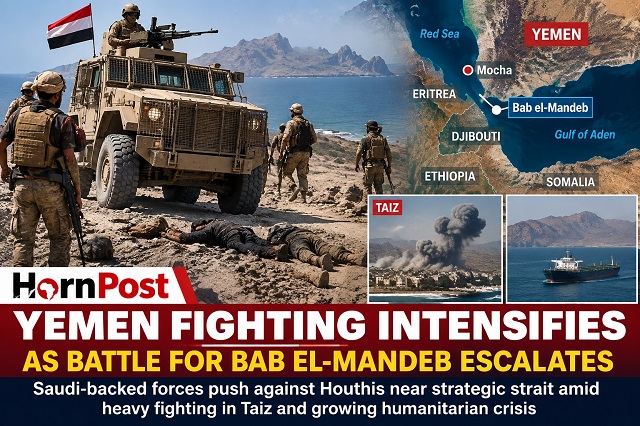
The security situation around Bab el-Mandeb has deteriorated sharply.
On August 11, the cargo vessel Tihamah was attacked near the strategic waterway. Six people were reported killed in the incident, making it one of the most serious recent attacks on commercial shipping in the Red Sea.
The attacks have already affected commercial shipping patterns. Vessel traffic through Bab el-Mandeb has fallen from pre-crisis levels, while some operators have rerouted vessels, switched off AIS tracking systems or avoided the area altogether.
Saudi Arabia has also redirected part of its crude exports through routes linked to the Suez Canal and SUMED, reducing its dependence on Red Sea routes exposed to Houthi attacks.
The result is a wider disruption involving shipping, insurance, energy transportation, logistics and maritime security.
Where Berbera Could Benefit
Berbera Port is strategically located on the southern side of the Gulf of Aden, close to the Bab el-Mandeb maritime corridor but outside Yemen’s conflict zone.
That geography could become increasingly valuable if companies seek secure logistics facilities and alternative regional gateways.
Berbera’s potential opportunities include:
- Container handling and regional distribution
- Warehousing and cargo storage
- Cold-chain logistics
- General cargo
- Livestock and agricultural exports
- Ship-support services
- Emergency logistics
- Regional feeder services
- Maritime security and search-and-rescue support
DP World says Berbera Port currently has capacity of approximately 500,000 TEUs annually and a 17-meter draft, while a planned expansion could eventually increase capacity to around 2 million TEUs.
Ethiopia Could Be the Biggest Opportunity
The strongest commercial opportunity may not come from vessels trying to avoid Bab el-Mandeb altogether.
It could come from Ethiopian cargo.
Ethiopia is landlocked and depends on maritime gateways for international trade. Berbera and the Berbera Corridor provide a strategic connection between the Gulf of Aden and markets in Ethiopia.
If Red Sea instability continues, logistics companies may increasingly value secure ports on the African side of the Gulf of Aden.
This could strengthen Berbera’s competition with other regional ports, particularly Djibouti.
The opportunity is therefore not simply about attracting ships. It is about capturing more of the entire logistics chain:
Berbera Port → Warehousing → Berbera Economic Zone → Berbera Corridor → Ethiopia and regional markets
That would generate more economic value than relying solely on port handling fees.
Maritime Security Could Become Another Opportunity
The Red Sea crisis is also increasing demand for maritime-security services.
Berbera could potentially develop greater capacity for:
- Maritime surveillance
- Search and rescue
- Coast guard cooperation
- Vessel security
- Emergency response
- Navigation support
- Maritime intelligence
- Ship-support services
This could strengthen Berbera’s position as a maritime-security and logistics hub in the Gulf of Aden.
The growing presence of international naval forces in the Gulf of Aden also highlights the strategic importance of the region.
But There Is a Major Risk
The opportunity comes with a serious security risk.
If Berbera becomes perceived as a direct military platform in the conflict with the Houthis, it could also become a target.
This creates a strategic dilemma for Somaliland.
Berbera needs to balance:
Commercial Port + Maritime Security
with
Avoiding direct military entanglement in Yemen’s conflict.
International maritime-security cooperation, search-and-rescue capabilities and protection of commercial shipping could strengthen Berbera’s reputation.
However, excessive militarization could increase the security risks facing the port, surrounding communities and commercial operators.
Can Berbera Replace Bab el-Mandeb?
No.
This distinction is critical.
Berbera cannot replace Bab el-Mandeb as a global shipping chokepoint.
A vessel sailing from the Indian Ocean toward the Suez Canal and Mediterranean still needs to pass through Bab el-Mandeb.
But Berbera can become an alternative regional gateway for:
- Ethiopia
- Somaliland
- the wider Horn of Africa
- regional cargo
- storage and redistribution
- feeder shipping
- emergency logistics
The opportunity is therefore not to replace Bab el-Mandeb, but to benefit from the economic disruption and risk created around it.
What Should Somaliland Do?
If Somaliland wants to convert the Red Sea crisis into a long-term economic opportunity, five priorities stand out.
1. Market Berbera as a logistics hub
Berbera should be promoted not simply as a port, but as a regional logistics platform.
2. Accelerate the Berbera Corridor
Improving road connectivity with Ethiopia is essential if Berbera wants to capture a larger share of regional cargo.
3. Expand value-added services
Warehousing, cold storage, bunkering, ship services and cargo consolidation could increase the economic value generated by the port.
4. Strengthen maritime security
Somaliland can work with international maritime organizations and shipping companies to strengthen surveillance, search and rescue, emergency response and navigational safety.
5. Protect Berbera’s commercial reputation
The port’s strongest asset may be its reputation as a stable and commercially reliable gateway.
Somaliland should therefore avoid actions that could unnecessarily transform Berbera from a commercial port into a direct military target.
The Strategic Question
The Houthi conflict in the Red Sea is creating a real strategic opportunity for Somaliland, but it is not a quick financial windfall.
The opportunity comes from the combination of:
Higher shipping risks + increased insurance costs + disrupted Bab el-Mandeb traffic + demand for secure logistics hubs + Ethiopia’s need for maritime access.
Berbera already has several important advantages: its strategic location on the Gulf of Aden, a modern port terminal, deep-water access and the Berbera Corridor linking the port with the wider Horn of Africa.
The key question is therefore not simply:
“Are the Houthis creating an opportunity for Berbera?”
The more important question is:
“Can Somaliland convert Red Sea instability into long-term commercial value while keeping Berbera secure, neutral and reliable?”
If Somaliland succeeds, the disruption around Bab el-Mandeb could become one of the most important strategic opportunities for Berbera since DP World’s expansion of the port.
HornPost Staff
info@hornpost.com
www.hornpost.com
HARGEISA, Somaliland