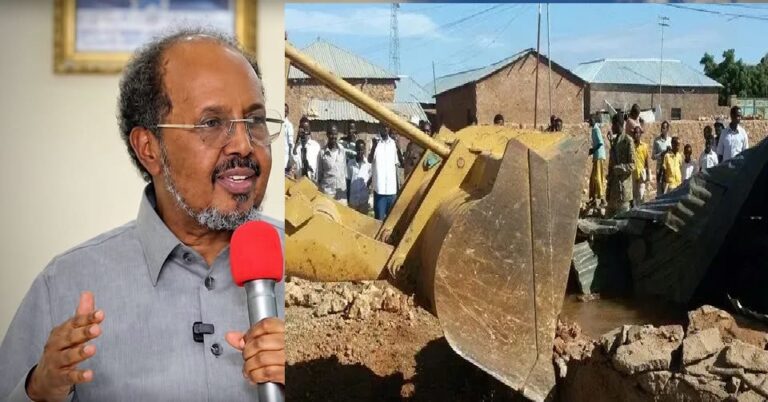
MOGADISHU, Somalia (HornPost)— A government-led eviction campaign in Mogadishu has renewed controversy over public land, the displacement of low-income families and the use of security forces during demolition operations.
Reports circulating on Thursday said Somali authorities were removing residents from land described as government property. Claims on social media and by local sources also alleged that civilians were killed during the operation.
The number of casualties and the circumstances surrounding the reported deaths could not be independently verified at the time of publication.
The latest developments have revived a broader dispute over land ownership in Somalia’s capital, where thousands of displaced and low-income families live on public or privately contested land.
Dispute Over Public Land
The government has previously defended evictions in Mogadishu as part of efforts to reclaim public property, improve urban planning and reorganize the capital.
However, residents, opposition politicians and civil society voices have accused authorities of forcibly removing vulnerable families without adequate consultation, compensation or alternative housing.
A May 2026 report by the European Union Agency for Asylum found that government-led evictions in Mogadishu had increased, with some operations involving security forces and protests that resulted in arrests, injuries and fatalities.
The EUAA also reported that forced evictions in Somalia are frequently connected to urban development and real-estate projects, while government authorities have sought to clear informal settlements located on government or government-adjacent property.
Allegations Against Hassan Sheikh’s Government
President Hassan Sheikh Mohamud’s administration has faced allegations from displaced residents and opposition figures that public land is being transferred or sold to private developers and businessmen.
Those allegations have not been independently established as fact.
In previous cases, affected families accused the government of taking land that they had occupied for years and subsequently transferring it to private interests. Opposition politicians have also criticized the government over alleged land seizures and forced evictions.
The government, however, has maintained that reclaiming public land and reorganizing Mogadishu are legitimate state functions rather than a campaign to dispossess poor residents for private gain.
A Recurring Crisis in Mogadishu
The latest controversy comes amid a much wider displacement crisis.
According to the EUAA, the Norwegian Refugee Council recorded more than 192,000 evictions across Somalia in 2024, with Banadir among the areas most affected. The agency said government-led evictions in Mogadishu increased during 2025-26.
Human Rights Watch has also documented continued forced evictions in Mogadishu, highlighting the vulnerability of civilians already affected by conflict and displacement.
International guidelines on evictions emphasize that reclaiming public land may be lawful under certain circumstances, but authorities should follow legal procedures, provide adequate notice and consultation, and avoid leaving affected people homeless or exposed to further rights violations.
Political Pressure on the Government
The land dispute has increasingly become a political issue in Somalia.
Opposition figures have previously accused the administration of using state security forces to clear valuable urban land and have called for greater transparency over land transactions.
The government’s position that the operations are part of urban development and the recovery of public property has not fully resolved concerns among affected communities.
The central question now is whether Mogadishu’s urban redevelopment can proceed without disproportionately burdening poor families and internally displaced people who have limited alternatives.
HornPost Assessment
The Mogadishu land dispute is no longer simply a question of urban planning. It has become a broader test of property rights, government accountability, civilian protection and the rule of law.
Any allegation that civilians were killed during the latest operation requires an independent investigation and clear disclosure of what happened. Likewise, claims that public land is being transferred to private businessmen should be supported by verifiable land records and transaction documents rather than political accusations alone.
For the Somali government, the challenge is to demonstrate that the recovery and development of public land are being conducted transparently, lawfully and with adequate safeguards for vulnerable residents.
For affected families, the issue is more immediate: whether the government can reclaim land while protecting their homes, livelihoods and basic rights.
Sources:
extra Source: NRC, EU, Human rights, Ecoi,