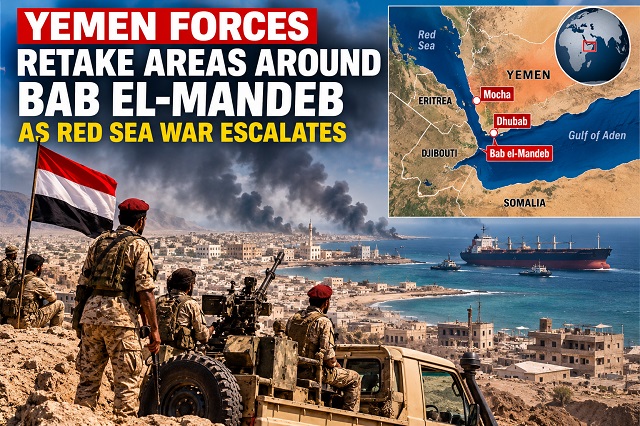
HARGEISA, Somaliland — (Horn Post) Houthi attacks and threats against Saudi-linked shipping are increasing risks around Bab el-Mandeb, with major security and economic implications for Somaliland, Djibouti, Somalia and global trade.
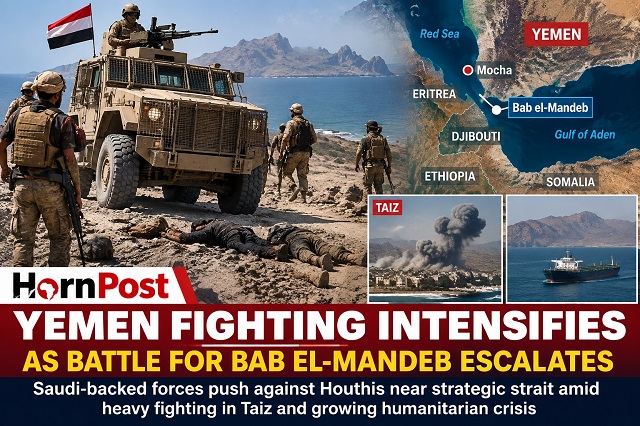
The security situation around the Bab el-Mandeb Strait, Red Sea and Gulf of Aden is entering a more dangerous phase as Houthi attacks and threats increasingly affect commercial shipping and Saudi-linked energy vessels.
The latest escalation raises a broader question for international shipping: is Bab el-Mandeb becoming a maritime chokepoint that companies may increasingly choose to avoid rather than simply navigate with additional security measures?
That question is particularly important for Somaliland, Djibouti and Somalia, whose coastlines sit along the African side of one of the world’s most strategically important maritime corridors.
Tihamah Attack Raises Commercial Shipping Risk
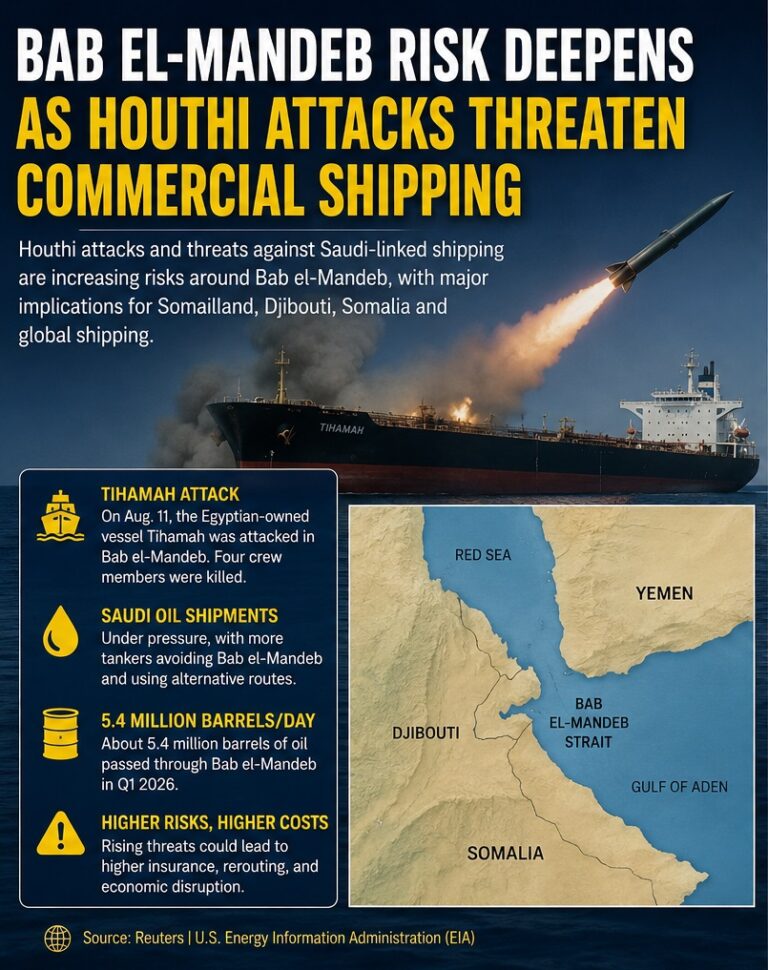
On Aug. 11, an Egyptian-owned cargo vessel, the Tihamah, was attacked in the Bab el-Mandeb Strait. Four crew members were killed, including three Pakistanis and one Indonesian, according to Reuters.
The Houthis said the vessel was carrying Saudi military equipment. That claim has not been independently verified. citeturn0search63
The significance of the incident goes beyond the loss of life.
If vessels can become targets because of their ownership, cargo, commercial relationships or perceived links to Saudi Arabia, the risk assessment for international shipping becomes considerably more complicated.
The issue is particularly serious for tanker operators, insurers and shipping companies that must determine whether the cost of transiting Bab el-Mandeb remains commercially acceptable.
Saudi Oil Shipments Face Growing Pressure
The Houthi campaign has also increasingly focused on Saudi-linked maritime and energy interests.
Reuters reported Aug. 12 that Saudi crude exports from Red Sea ports were increasingly being moved without visible AIS tracking as tanker operators sought to reduce their exposure. Some large crude carriers were also avoiding the Bab el-Mandeb Strait because of the heightened security threat.
Saudi Arabia has responded by moving more oil through alternative routes, including northward through the Suez Canal and the SUMED pipeline. citeturn0news5
This development is strategically important because shipping disruptions do not need to result in a formal closure of the strait to produce economic consequences.
Higher war-risk insurance premiums, longer alternative routes and declining vessel traffic can make the waterway commercially unattractive even while ships technically remain able to pass through it.
Bab el-Mandeb Is a Global Energy Chokepoint
The strategic importance of Bab el-Mandeb extends far beyond the Horn of Africa.
The strait connects the Gulf of Aden and Arabian Sea with the Red Sea and, ultimately, the Suez Canal, making it a critical link between Asian, Middle Eastern and European markets.
U.S. Energy Information Administration data indicate that about 5.4 million barrels per day of oil moved through Bab el-Mandeb during the first quarter of 2026. citeturn0search1
That figure illustrates why sustained disruption could have consequences for energy markets, shipping costs and global supply chains.
The previous Red Sea crisis demonstrated how quickly commercial operators can respond to security threats. Rather than accepting the risks around Bab el-Mandeb, many shipping companies diverted vessels around the Cape of Good Hope, adding significant distance, fuel consumption and sailing time.
The current situation could produce a similar pattern if attacks against commercial vessels continue.
The Strategic Importance for Somaliland
For Somaliland, the development carries both security risks and strategic opportunities.
Somaliland’s coastline extends along the Gulf of Aden, while the Port of Berbera is positioned close to the major maritime route connecting the Red Sea with the wider Indian Ocean.
A sustained deterioration around Bab el-Mandeb could increase the strategic importance of secure ports on the Gulf of Aden. Berbera could potentially benefit from companies seeking alternative logistics arrangements, regional supply hubs or secure maritime infrastructure.
But the same geography creates exposure.
If commercial shipping traffic declines sharply across the wider Gulf of Aden, the economic benefits associated with maritime connectivity could also weaken. Higher insurance premiums and security costs could affect shipping operators, port users and regional logistics investments.
The strategic calculation for Somaliland is therefore broader than the question of whether Houthi attacks directly reach its coastline.
The real issue is how the changing security environment alters the economic and geopolitical value of the Gulf of Aden coastline.
Djibouti’s Position Becomes More Strategic
Djibouti occupies one of the most sensitive positions in the Bab el-Mandeb system.
The country’s location at the entrance to the Red Sea has made it a major regional logistics and military hub, hosting international military facilities and serving as a gateway for trade into the Horn of Africa.
A prolonged maritime security crisis could increase demand for Djibouti’s port, logistics and security infrastructure.
At the same time, however, Djibouti would remain exposed to the consequences of reduced shipping activity, regional military escalation and higher maritime security costs.
The country’s strategic value could therefore rise at the same time that the risks surrounding its geographic position increase.
Somalia Faces a Wider Gulf of Aden Security Challenge
Somalia’s long coastline along the Gulf of Aden and Indian Ocean also places it within the wider security environment created by the Red Sea conflict.
The country has previously faced major maritime security challenges, particularly piracy, although piracy levels have declined substantially from their peak.
A prolonged Houthi campaign could complicate that environment by bringing together several risks: missile and drone attacks, military operations, commercial rerouting, increased armed security activity and residual piracy concerns.
For international shipping, this creates a more complicated security map extending from the southern Red Sea into the Gulf of Aden and toward the Somali Basin.
Shipping Traffic Is Already Responding
One of the clearest signs that the threat is affecting commercial behavior is the decline in vessel traffic.
Reuters reported Aug. 6 that only one vessel passed through Bab el-Mandeb, compared with 20 the previous day, following Houthi claims of attacks on Saudi oil tankers. Saudi Arabia did not confirm the attacks. citeturn0search21
The significance of this change should not be underestimated.
A maritime chokepoint does not necessarily have to be physically closed to become economically disruptive.
If shipping companies begin avoiding the route because of insurance costs, security risks or uncertainty over targeting, the practical effect can resemble a partial blockade.
The Critical Question: Will the Target List Expand?
The most important issue to watch is whether the Houthis maintain a relatively narrow definition of maritime targets or expand attacks to a wider range of commercial vessels.
Three developments would indicate that the crisis is entering a significantly more dangerous phase:
First, repeated attacks on commercial vessels that are not directly connected to Israeli interests.
Second, a sustained increase in oil tanker diversions around the Cape of Good Hope.
Third, continued reductions in vessel traffic through Bab el-Mandeb accompanied by rising war-risk insurance premiums.
If those trends continue, the economic consequences could extend well beyond Yemen and Saudi Arabia.
What It Means for the Horn of Africa
For Somaliland, Djibouti and Somalia, the Bab el-Mandeb crisis is not simply another Middle Eastern security problem.
It is directly connected to the security and economic future of the Gulf of Aden and Horn of Africa.
Somaliland’s Berbera port, Djibouti’s international logistics infrastructure and Somalia’s extensive coastline all sit within a maritime environment whose strategic importance is increasing.
The paradox is that greater insecurity can simultaneously make the region more strategically important and more economically vulnerable.
For Somaliland in particular, this could strengthen the argument for greater international cooperation on maritime surveillance, port security, search-and-rescue capabilities and protection of commercial shipping.
Hornpost Assessment
The central concern is no longer whether Bab el-Mandeb is dangerous. It is whether the risk becomes sufficiently high that international shipping companies begin treating the strait as a route to avoid rather than a route to manage.
The Tihamah attack, combined with continuing Houthi threats against Saudi-linked shipping and the reported decline in vessel traffic, suggests that commercial operators are already adjusting their behavior.
If this trend continues, Bab el-Mandeb could evolve from a regional military flashpoint into a high-cost global maritime chokepoint.
For the Horn of Africa, that would have consequences far beyond security. It could affect port competitiveness, shipping insurance, energy costs, regional trade, logistics investment and the geopolitical importance of Somaliland, Djibouti and Somalia’s coastlines.
Horn Post Staff
info@hornpost.com
www.hornpost.com
HARGEISA, Somaliland