
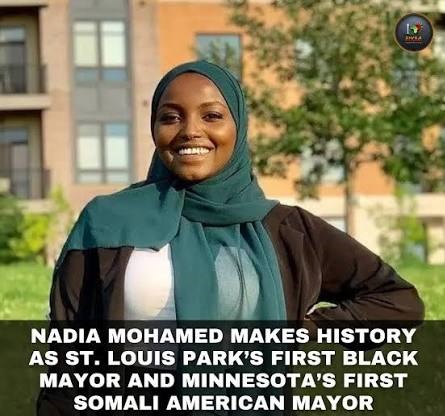
ST. LOUIS PARK, Minn. — (HornPost) — St. Louis Park Mayor Nadia Mohamed is urging Somali Americans to remain informed and vigilant as political tensions surrounding Minnesota’s Somali community intensify following President Donald Trump’s renewed attacks on Somalis and his announcement that his administration would seek to end Temporary Protected Status for Somalis living in Minnesota.
Mohamed’s message comes as Somali communities across Minnesota face growing uncertainty following a series of statements by Trump targeting the state’s large Somali population.
Trump announced Nov. 21 that he intended to terminate Temporary Protected Status, or TPS, for Somalis in Minnesota, describing the state as a center of fraud and accusing “Somali gangs” of causing problems. The announcement immediately drew criticism from Minnesota officials, immigrant-rights advocates and Somali community leaders.
The move has generated particular concern because Minnesota is home to the largest Somali American community in the United States, with tens of thousands of residents of Somali heritage. Most Somali Americans in Minnesota are U.S. citizens, while only a relatively small number are protected under TPS.
Mohamed emerges as a prominent Somali American voice
Mohamed, who was elected mayor of St. Louis Park in November 2023, became the first Somali American believed to have been elected mayor of a U.S. city. She won 58.4% of the vote and began her four-year term in January 2024.
Her election was widely viewed as a milestone for Somali Americans and Minnesota’s growing immigrant communities.
By late 2025, however, Mohamed’s position had taken on additional significance as political debate over immigration and the Somali community intensified.
Rather than focusing solely on national political disputes, Mohamed has emphasized community cohesion, civic participation and ensuring that residents understand their rights.
Trump’s TPS announcement raises concern
The immediate trigger for the latest concerns was Trump’s announcement that he intended to end TPS protections for Somalis in Minnesota.
TPS is a federal immigration program that allows eligible nationals of designated countries to remain legally in the United States when conditions in their home countries make safe return difficult.
Somalia has been covered by TPS since 1991, and the designation had been extended under previous administrations. As of 2025, only several hundred Somalis nationwide were estimated to hold TPS, meaning that ending the program would directly affect a relatively small portion of Minnesota’s Somali population.
The broader concern, however, extends beyond TPS holders.
Community advocates warned that the president’s rhetoric could increase suspicion and hostility toward Somali Americans generally, including U.S. citizens and permanent residents who are not subject to deportation.
The Minnesota Star Tribune reported Nov. 26 that Minnesota’s Somali community was facing increased scrutiny following Trump’s attacks and the administration’s immigration policies.
Concerns over immigration enforcement
By Nov. 30, reports of federal immigration enforcement activity in Minnesota were already contributing to anxiety in immigrant communities.
The issue was particularly sensitive because Somali community leaders feared that heightened federal attention could lead to people being targeted because of their ethnicity or immigration status rather than because of individual violations of immigration law.
Immigration advocates urged residents to understand their legal rights and seek advice from qualified attorneys rather than relying on rumors circulating on social media.
The distinction between immigration status and citizenship is particularly important in Minnesota, where a large majority of Somali Americans are citizens or lawful permanent residents.
A community facing political pressure
The controversy has also created a broader political debate about the place of Somali Americans in Minnesota.
Somalis began arriving in significant numbers in Minnesota during the 1990s after the outbreak of civil war in Somalia. Over subsequent decades, the community established businesses, mosques, community organizations and professional networks across Minneapolis, St. Paul and surrounding suburbs.
Minnesota is now home to one of the most established Somali American communities in the United States.
The political response to Trump’s comments has therefore extended beyond immigration policy.
Minnesota Attorney General Keith Ellison, the state’s first Muslim attorney general and the son of Somali immigrants, said his office was monitoring the situation and exploring legal options after Trump’s TPS announcement.
Community organizations similarly argued that individual cases of fraud or criminal wrongdoing should be handled through the justice system rather than used to characterize an entire ethnic community.
Why the issue matters beyond TPS
The political significance of the controversy is larger than the number of people directly affected by TPS.
Ending TPS would primarily affect people who rely on that status for legal protection and work authorization. But the political rhetoric surrounding the announcement has raised broader questions about discrimination, immigration enforcement and the treatment of Somali Americans.
For Mohamed, the challenge is particularly significant because she represents a city where immigrant communities form an important part of the local population while also serving as a prominent Somali American political leader.
Her election in 2023 demonstrated the growing political participation of Somali Americans in Minnesota. Two years later, the debate surrounding immigration policy is testing how that community responds to increased national political attention.
Mohamed’s message: stay informed and united
The broader message from Somali community leaders has been one of caution rather than panic.
Residents are being encouraged to understand their immigration status, keep important documents accessible, communicate with trusted legal professionals and avoid relying on unverified information.
Community leaders have also stressed the importance of distinguishing between federal immigration policy and local government responsibilities.
That distinction is important because cities such as St. Louis Park and Minneapolis do not control federal immigration law. Immigration enforcement is primarily a federal responsibility, while local governments remain responsible for public safety and municipal services.
A pivotal moment for Minnesota’s Somali community
The developments of November 2025 mark another important moment in the political evolution of Minnesota’s Somali American community.
Nadia Mohamed’s election two years earlier demonstrated the community’s growing political influence and integration into American civic life. The current immigration debate, however, has placed that community under an unusually intense national spotlight.
The immediate question is whether the Trump administration will be able to legally implement its proposed changes to TPS for Somalis in Minnesota and how courts, state officials and community organizations will respond.
For Somali Americans, the debate has become about more than immigration status.
It is also about political representation, civil rights and whether the actions or alleged wrongdoing of individuals can be used to characterize an entire community.
As the debate develops, Minnesota’s Somali American leaders are likely to remain at the center of the national conversation.
HornPost Staff
HornPost Authors
HornPost Staff is the editorial byline of HornPost.com, used for collaborative newsroom reporting, editorial content, and reports published by the Horn Post editorial team. HornPost covers Somaliland, the Horn of Africa, Africa, the Middle East, and major international developments, with reporting focused on politics, governance, diplomacy, security, business, economics, and breaking news. HornPost is committed to accurate, fair, independent, and responsible journalism.