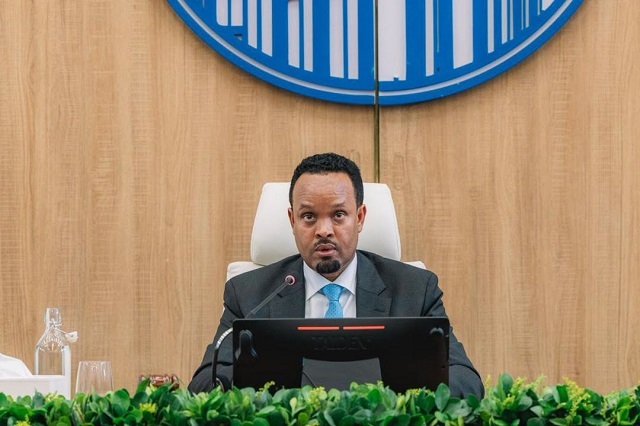

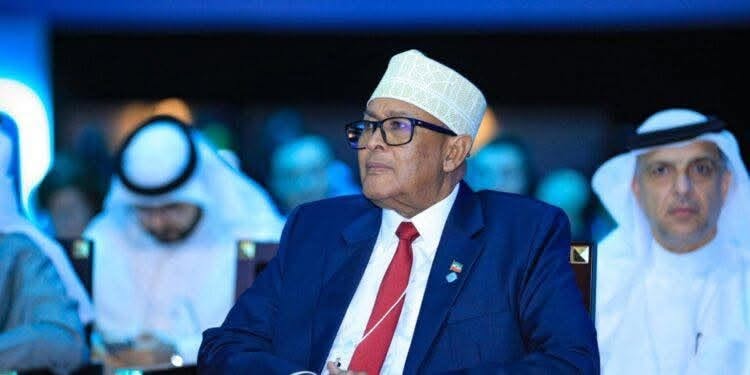
DUBAI, United Arab Emirates (HornPost) — The President of the Republic of Somaliland Abdirahman Mohamed Abdillahi “Irro” has used a major investment forum in the United Arab Emirates to promote Somaliland as a stable destination for international capital, placing particular emphasis on the strategic role of Berbera Port in expanding trade between Africa, the Middle East and global markets.
Somaliland President Irro Highlights Berbera Port and Investment Opportunities at UAE Forum
Speaking at Africa Debate UAE 2025, a high-level forum focused on ports, trade and investment opportunities in East Africa, Irro presented Somaliland’s political stability, geographic position and infrastructure development as key advantages for investors.
The president said Berbera’s location on the Gulf of Aden gives Somaliland an opportunity to become an important gateway for trade connecting East Africa with the Arabian Peninsula, the Indian subcontinent and international shipping routes.
He also portrayed Somaliland as a relatively stable and democratic political system in a region affected by conflict and political instability, arguing that its record of elections and peaceful transfers of power strengthens its case for international investment and diplomatic recognition.
Irro: Somaliland seeks recognition
Irro used the forum to renew Somaliland’s longstanding appeal for international recognition.
“I hope Somaliland will soon join the community of recognized nations,” he said.
The president described Somaliland as a “reliable and democratic partner” and urged the international community to consider what he described as more than three decades of political stability and multiparty democratic development.
Somaliland declared independence from Britain on June 26, 1960, before joining with the former Italian-administered territory of Somalia in a union days later. After the collapse of Somalia’s central government and years of conflict, Somaliland declared that it was restoring its sovereignty in May 1991.
Somaliland has since maintained its own government, security institutions, currency and electoral system, although it remains internationally unrecognized as a sovereign state. Somalia continues to regard Somaliland as part of its federal territory.
That unresolved political status remains one of the central challenges for Somaliland’s international economic ambitions.
Berbera emerges as Somaliland’s economic centerpiece
At the heart of Irro’s presentation was Berbera Port, which has undergone a major transformation following investment by Dubai-based logistics company DP World.
The port and associated infrastructure are intended to provide Somaliland with a modern maritime gateway capable of handling growing regional trade. The development also includes the Berbera Economic Zone and the Berbera Corridor, which connects the port to inland markets and is particularly important to Somaliland’s ambitions to serve Ethiopia and other parts of the Horn of Africa.
Irro praised DP World for investing in Berbera when, he said, many international companies remained hesitant to enter Somaliland.
He argued that the investment demonstrated the commercial potential of the territory and helped encourage other investors to consider Somaliland.
One example he cited was the Pharo Foundation’s $20 million agricultural investment, which he presented as evidence that infrastructure development around Berbera could generate investment beyond the port itself.
The broader strategy is to turn Berbera from a national port into a regional logistics and investment hub.
Berbera’s location gives it strategic significance
The port’s location is one of its biggest commercial advantages.
Berbera sits along the Gulf of Aden, close to the maritime route linking the Indian Ocean with the Red Sea and the Suez Canal. Ships traveling between Asia, the Middle East and Europe pass through the broader maritime corridor near the Bab el-Mandeb Strait, making the area strategically important to international trade.
Sultan Ahmed Bin Sulayem, chairman and CEO of DP World, also participated in the forum and highlighted Berbera’s geographic advantages.
Bin Sulayem said DP World invested in Berbera because of its potential, government support and confidence in the local community. He also pointed to plans to expand the port’s capacity as trade volumes increase.
For Somaliland, the development represents more than a port modernization project. It is the centerpiece of a broader attempt to establish Berbera as an alternative trade gateway for the landlocked markets of the Horn of Africa.
A potential India-Africa trade gateway
Irro also highlighted Berbera’s potential to facilitate trade between India and Africa, particularly as demand grows for alternative logistics routes across the region.
The combination of the port, the economic zone and industrial facilities could allow Somaliland to attract companies involved in logistics, manufacturing, agriculture, warehousing and processing.
The strategic proposition is straightforward: cargo arriving at Berbera could move through Somaliland toward regional markets, while companies could use the economic zone as a base for processing and distribution.
But turning that opportunity into a large-scale regional trade network will depend on several factors, including road infrastructure, customs arrangements, political stability, security and access to international financial systems.
Somaliland’s lack of international recognition can also complicate relationships with multinational companies, banks and governments that require formal state-to-state arrangements.
Somaliland rejects piracy concerns
Irro also sought to address concerns about maritime security and piracy, which have historically affected the Gulf of Aden.
President Irro said Somaliland has secured its approximately 850-kilometer coastline and argued that piracy is not currently a threat in Somaliland-controlled waters.
The issue is important for Berbera because shipping companies make investment and routing decisions based heavily on perceptions of maritime security.
A stable and secure port can become a significant competitive advantage in a region where instability, piracy and attacks on commercial shipping have periodically disrupted trade.
The wider Red Sea and Gulf of Aden security environment, however, remains volatile, meaning Somaliland’s maritime security claims will continue to be assessed alongside broader regional developments.
Recognition and investment are closely linked
Irro also made a direct connection between Somaliland’s political status and its economic prospects.
“If Somaliland receives recognition, its strategic importance will double, and many more international companies will want to invest,” he said.
The argument reflects one of Somaliland’s central foreign-policy objectives: that formal recognition would reduce political and financial uncertainty and enable the territory to establish broader diplomatic, commercial and financial relationships.
Recognition could potentially make it easier for Somaliland to negotiate bilateral agreements, access international institutions and attract investors seeking sovereign guarantees and conventional state-to-state relations.
At the same time, Somaliland has already attracted major international commercial interest despite its unrecognized status. The DP World investment in Berbera is the most prominent example, demonstrating that commercial actors can operate in Somaliland even without formal international recognition.
The question is whether the Berbera model can be expanded significantly while the political dispute between Hargeisa and Mogadishu remains unresolved.
Berbera and the future of the Horn of Africa
The development of Berbera is taking place as competition intensifies over infrastructure and trade routes across the Horn of Africa and the Red Sea.
Ports in Djibouti, Somalia, Somaliland, Kenya and Sudan compete for access to regional cargo, while Ethiopia’s growing demand for reliable maritime trade routes has increased the strategic importance of ports along the Red Sea and Gulf of Aden.
For Somaliland, Berbera offers an opportunity to capitalize on its location while positioning itself as a commercial partner for landlocked Ethiopia and other regional markets.
The success of that strategy will depend not only on the port itself but also on the efficiency of the entire logistics chain — roads, customs, warehousing, border crossings, industrial facilities and regional trade agreements.
Somaliland’s investment pitch
Irro’s appearance at Africa Debate UAE 2025 therefore served two purposes.
The first was economic: to present Somaliland as a destination for investors and promote Berbera as a growing logistics and trade hub.
The second was diplomatic: to use an international business platform to reinforce Somaliland’s argument that its political institutions, security environment and economic potential justify greater international engagement.
The challenge for Somaliland is converting its geographic advantage into sustained economic growth while navigating the political consequences of its unresolved status.
For DP World and other investors, Berbera offers access to a strategically located coastline and an emerging regional logistics corridor.
For Somaliland, the stakes are considerably larger. The government is seeking to demonstrate that economic development, democratic governance and strategic geography can strengthen its case for deeper international engagement — and ultimately for recognition.
HornPost Staff Reporter
Dubai, United Arab Emirates
Abdikarim Saed Salah
Abdikarim Saed Salah is Editor-in-Chief and Founder of HornPost.com, an independent Hargeisa-based news platform covering Somaliland, the Horn of Africa, East Africa, the Red Sea and international affairs. A journalist, television presenter, producer and geopolitical analyst, he has more than 15 years of experience in broadcast journalism, digital media, reporting and diplomacy. He works with Horn Cable TV and focuses on politics, elections, security, foreign policy and conflict. He holds a BA in Journalism and an MA in International Relations.