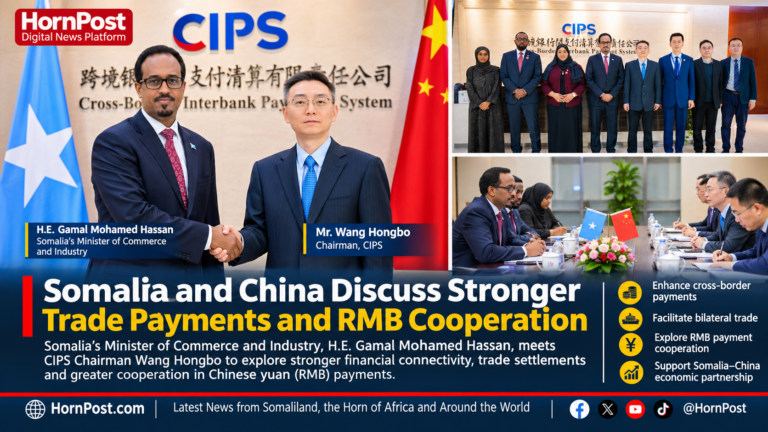
BEIJING, China (HornPost) – Somalia is exploring opportunities to strengthen its financial links with China through improved cross-border payment arrangements, as the two countries seek to expand trade and economic cooperation.
Somalia’s Minister of Commerce and Industry, H.E. Gamal Mohamed Hassan, held discussions with Wang Hongbo, Chairman of China’s Cross-Border Interbank Payment System (CIPS), focusing on ways to make international trade payments more efficient and accessible for Somali businesses.
The meeting addressed financial connectivity, trade settlements and opportunities to expand the use of China’s currency, the renminbi (RMB), in commercial transactions between the two countries.
The discussions come as China remains an important source of imports for Somalia, supplying a wide range of goods used by Somali businesses and consumers. These include electronics, machinery, construction materials, textiles and household products.
As commercial exchanges continue to develop, reliable payment channels have become increasingly important for importers, exporters and financial institutions operating between the two markets.
Somalia Explores Access to China’s Cross-Border Payment Network
CIPS, or the Cross-Border Interbank Payment System, is China’s financial infrastructure for processing and settling international payments in renminbi.
Launched in 2015, the system provides participating banks and financial institutions with a channel for handling cross-border transactions involving China’s currency.
It supports payments connected to international trade, investment and other financial activities. Its development also forms part of China’s efforts to strengthen the international use of the renminbi.
For Somalia, greater cooperation with CIPS could create additional opportunities for businesses seeking to conduct transactions with Chinese suppliers and commercial partners.
The discussions focused on exploring ways to make trade settlements more accessible, reduce payment difficulties and strengthen financial connections between the two countries.
However, the practical benefits will depend on the participation of banks and financial institutions serving Somali businesses, as well as the development of the necessary banking arrangements.
Potential Benefits for Somali Importers and Exporters
China is a major commercial partner for Somali traders. Businesses across Somalia rely on Chinese suppliers for products ranging from consumer electronics and solar equipment to vehicles, machinery and construction materials.
Many importers depend on international banking arrangements and intermediary financial institutions to complete payments to overseas suppliers.
Improved cross-border payment channels could help simplify these transactions and provide businesses with more options for settling invoices.
Greater access to renminbi payments could also help Somali companies dealing directly with Chinese manufacturers and exporters.
For Somali exporters, stronger financial connectivity could support efforts to access the Chinese market and receive payments from international buyers.
Somalia is also seeking to expand opportunities for its locally produced goods to reach international markets. More efficient payment arrangements could therefore support trade in both directions.
Nevertheless, any reduction in transaction costs or settlement delays would depend on the payment services made available by participating banks.
CIPS and the Growing International Role of the Chinese Yuan
China has continued developing its cross-border financial infrastructure as it seeks to expand the international use of the renminbi.
CIPS provides a dedicated settlement channel for financial institutions conducting transactions in the Chinese currency.
The system is particularly relevant to countries with growing trade relationships with China, as businesses increasingly seek efficient ways to pay suppliers and receive international payments.
For Somalia, exploring cooperation with CIPS could provide an opportunity to diversify its international payment arrangements.
The discussions also come amid wider efforts by countries to improve financial connectivity and facilitate trade using different currencies.
However, cooperation with CIPS would not automatically mean that Somalia or its commercial banks have joined the system. Any formal participation would require appropriate banking arrangements and regulatory processes.
Somalia’s Financial Infrastructure Modernisation
The engagement with CIPS also comes as Somalia continues developing its domestic financial infrastructure.
The Central Bank of Somalia launched the National Payment System in July 2021, connecting licensed commercial banks through a unified digital payment infrastructure.
The country subsequently introduced the Somali Instant Payment System (SIPS) in January 2025. The platform enables real-time transfers between participating banks, mobile wallets and point-of-sale terminals.
These developments form part of broader efforts to modernise Somalia’s financial sector, improve payment efficiency and strengthen financial inclusion.
Connecting domestic financial infrastructure with international payment networks could further support the country’s economic integration and cross-border commercial activities.
However, international connectivity requires cooperation between domestic banks, foreign financial institutions and relevant regulatory authorities.
Somalia and China Seek to Deepen Economic Partnership
The meeting reflects broader efforts by Mogadishu and Beijing to strengthen their economic and commercial relationship.
China has remained an important partner in Somalia’s development and trade engagement. Both countries have expressed interest in expanding cooperation across economic sectors and creating opportunities for businesses.
Somalia’s delegation included the country’s Ambassador to China, Dr. Hodan Osman Abdi, and Deputy Permanent Secretary in the Office of the Prime Minister, Abdirisak Ali Ibrahim, alongside other officials.
The Ministry of Commerce and Industry has identified improved trade facilitation and stronger commercial connections as important areas of engagement with China.
Expanding access to the Chinese market could also create opportunities for Somali producers and exporters, particularly as the country seeks to diversify its economy and increase international trade.
The discussions with CIPS Chairman Wang Hongbo therefore highlight the growing importance of financial infrastructure in supporting Somalia’s international economic relations.
For Somali businesses, the potential value of stronger cooperation will ultimately depend on whether the discussions lead to practical payment arrangements that make international transactions faster, more accessible and more reliable.
HornPost Staff Reporter
Email: info@hornpost.com
Website: https://www.hornpost.com