
HARGEISA, Somaliland —(HornPost) Saudi Arabia is widely regarded as one of the Middle East’s most powerful states. It possesses enormous financial resources, advanced weapons systems, a sophisticated air force, substantial military capabilities and considerable diplomatic influence.
It also occupies a unique position in the Muslim world as custodian of Mecca and Medina.
By almost every conventional measure, Saudi Arabia is a major regional power.
Yet a more difficult strategic question deserves attention:
How much of Saudi Arabia’s enormous power can Riyadh convert into lasting influence over the strategic environment immediately surrounding the Kingdom?
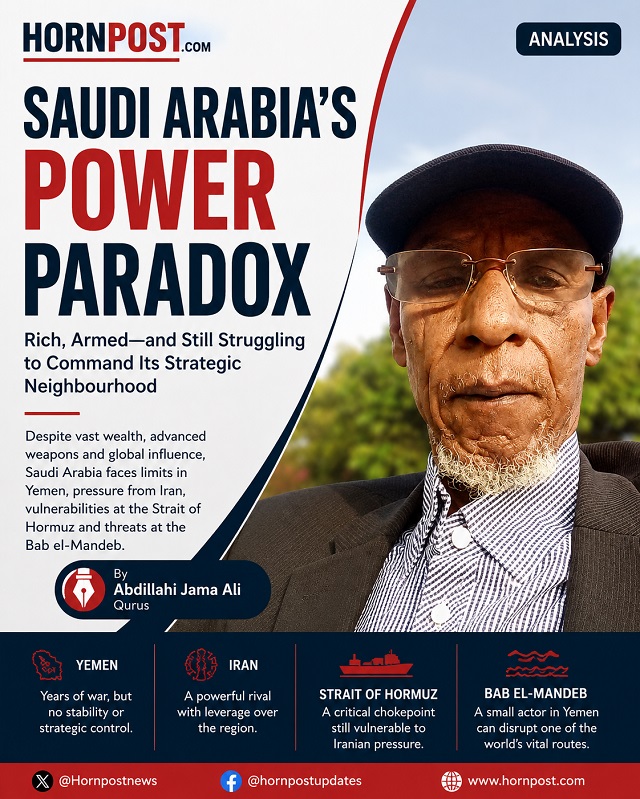
The answer, as examined in this analysis, is considerably more complicated than Saudi Arabia’s wealth and military capabilities might suggest. Yemen remains unresolved, Iran remains a formidable rival, the Strait of Hormuz remains vulnerable to Iranian pressure, and the Bab el-Mandeb continues to demonstrate how a much smaller actor can create significant risks for regional shipping.
The issue, therefore, is not whether Saudi Arabia is powerful.
It clearly is.
The deeper question is whether Riyadh has consistently succeeded in transforming that power into strategic leverage.
Yemen Is the Most Revealing Test of Saudi Power
If there is one country that might naturally have been expected to fall within Saudi Arabia’s strategic sphere of influence, it is Yemen.
Yemen is Saudi Arabia’s immediate southern neighbor. Its society, history, tribal structures and economy have long been connected to the Kingdom. For decades, Riyadh built political, tribal and economic relationships inside Yemen, supported successive governments and political actors, and ultimately intervened militarily on a large scale.
Yet years of intervention did not produce a stable Yemeni political order reliably aligned with Saudi strategic interests.
Instead, the Houthis emerged as a powerful and independent force.
That experience illustrates an important limitation of conventional power:
Money, military capability and geographic proximity do not automatically produce strategic control.
According to the analysis, the issue became even more visible in July 2026, when the Houthis announced a blockade targeting shipping connected to Saudi ports. Several vessels reportedly turned around following warnings, including two tankers carrying Saudi crude from Yanbu, with the vessels reportedly carrying a combined 2.8 million barrels of oil.
The significance extends beyond the individual ships.
Saudi Arabia possesses vastly greater financial and military resources than the Houthis. Yet a much smaller movement operating from Yemen was able to influence the calculations of shipowners, insurers and energy companies while imposing costs on one of the world’s largest oil exporters.
That does not amount to a conventional military defeat.
But it demonstrates the power of asymmetry: a smaller actor can exploit geography and vulnerability to impose costs on a much larger state.
Bab el-Mandeb Exposes Another Strategic Vulnerability
The geography of Saudi Arabia’s security dilemma makes the problem even more significant.
Saudi Arabia’s western coastline stretches along the Red Sea, and its oil infrastructure at Yanbu provides an important alternative route for energy exports when the Persian Gulf becomes insecure.
But that alternative route depends on a southern gateway:
Bab el-Mandeb.
The narrow maritime passage separates Yemen from the Horn of Africa and connects the Gulf of Aden with the Red Sea. According to the source analysis, approximately 4.1 billion barrels of crude oil and refined petroleum products passed through Bab el-Mandeb in 2024, representing roughly 5% of global petroleum flows.
This creates a striking strategic contradiction.
Saudi Arabia has the resources to maintain one of the region’s most sophisticated military establishments. Yet it cannot simply guarantee the security of every maritime corridor upon which its Red Sea strategy depends.
The Houthis do not need to occupy Bab el-Mandeb.
They do not need a navy comparable to Saudi Arabia’s.
They only need to create enough uncertainty and risk to change the decisions of commercial shipping companies.
That is the essence of asymmetric power.
Two Strategic Chokepoints, One Kingdom
The same problem arises when looking east.
Across the Arabian Peninsula lies Iran, Saudi Arabia’s major regional strategic rival. The Strait of Hormuz is one of the world’s most important energy chokepoints, and Iran retains the ability to exert pressure around it.
Saudi Arabia may have greater financial resources, powerful armed forces and extensive relationships with Western powers, but it cannot simply dictate Iranian behavior.
This creates a remarkable geographic dilemma.
At one end of the Arabian Peninsula, Iran can threaten Hormuz.
At the other hand, the Houthis can threaten Bab el-Mandeb.
Saudi Arabia sits between the two.
The analysis argues that recent developments around Hormuz have reinforced the importance of alternative export routes and Red Sea infrastructure. Dependence on a single maritime chokepoint creates enormous strategic exposure.
For Riyadh, the eastern maritime gateway is vulnerable to Iranian pressure while its western alternative depends on a southern gateway vulnerable to Houthi disruption.
For a country of Saudi Arabia’s wealth and military strength, that is an extraordinary strategic vulnerability.
Wealth Does Not Automatically Produce Leadership
For decades, Saudi Arabia has possessed one of the most powerful instruments of international influence available to a state:
money.
The Kingdom has funded governments, supported political movements, financed development projects, helped and cultivated relationships throughout the Arab and Muslim worlds.
But money has limits.
Money can purchase access without producing obedience.
It can generate goodwill without guaranteeing loyalty.
It can create dependency without producing genuine strategic alignment.
And it can make a country financially important without necessarily making it strategically decisive.
This distinction is critical.
Governments may welcome Saudi financial assistance while simultaneously pursuing their own national interests.
That is not necessarily strategic influence.
Sometimes it is simply transactional diplomacy.
The “Sugar Daddy” Problem
This is where the provocative description of Saudi Arabia as the region’s “sugar daddy” becomes revealing.
Many governments understand the value of Saudi financial support. They cultivate relationships with Riyadh, maintain diplomatic ties and welcome Saudi investment and assistance.
But that does not necessarily mean they will follow Saudi Arabia’s strategic preferences.
They have their own national interests.
The distinction is uncomfortable but important:
Saudi Arabia can buy friends. But can it produce followers?
That is a very different question.
And it goes directly to the heart of the Kingdom’s power paradox.
The UAE Offers a Different Model
The United Arab Emirates provides an important comparison.
The UAE is considerably smaller than Saudi Arabia in population and territorial scale. Yet Abu Dhabi and Dubai have developed a different approach to convert financial resources into strategic influence.
The UAE has invested heavily in ports, logistics, infrastructure, commercial networks and strategic geographic positions.
Berbera is one of the clearest examples.
DP World, the Dubai-based ports and logistics company, has invested in the development of Berbera Port in Somaliland, helping expand the port’s capacity and establishing a broader logistics and economic platform.
The strategic value goes beyond the amount of capital invested.
It creates:
- A port;
- A logistics platform;
- A commercial corridor;
- Connectivity toward Ethiopia and the wider Horn of Africa;
- A strategic position overlooking the Gulf of Aden.
DP World’s shipping connection between Jebel Ali and Berbera further strengthens the port’s role as a Gulf-Horn logistics gateway.
The broader lesson is that the UAE did not simply deploy money.
It converted money into assets, access and geography.
The UAE Turned Money into Geography
This may be the most important comparison for Riyadh.
Saudi Arabia had the money.
It had religious standing.
It had geographic proximity.
It had enormous interest in the Red Sea.
But the UAE moved aggressively to establish tangible commercial and strategic positions around some of the maritime routes leading toward the Red Sea and Gulf of Aden.
The difference can be summarized simply:
The UAE turned money into geography.
Saudi Arabia, by contrast, has often used its financial resources primarily through patronage and assistance.
The distinction matters because strategic power is not simply about possessing resources.
It is about placing those resources where they can influence the behavior of other actors.
Saudi Arabia’s Red Sea Blind Spot
It would be unfair to argue that Saudi Arabia has ignored the Red Sea.
The Kingdom has major interests along its western coastline and has invested heavily in Red Sea ports and infrastructure.
But developing a country’s own coastline is not the same as developing strategic depth beyond its territorial waters.
The Red Sea does not begin at Jeddah.
Its security extends much farther south, toward Bab el-Mandeb, the Gulf of Aden and the Horn of Africa.
That means Saudi strategic thinking cannot stop at its own borders.
Yemen matters.
The Horn of Africa matters.
Berbera matters.
Djibouti matters.
Eritrea matters.
The Gulf of Aden matters.
Other regional powers, particularly the UAE, have moved aggressively to establish commercial and strategic positions in these spaces.
Saudi Arabia has sometimes appeared more comfortable investing heavily at home than building equivalent strategic depth abroad.
That could become increasingly costly in a region where geography is becoming as important as military capability.
Geography Is Power
Consider the wider maritime system surrounding Saudi Arabia:
Persian Gulf → Strait of Hormuz → Arabian Sea → Gulf of Aden → Bab el-Mandeb → Red Sea → Suez Canal → Mediterranean
These waterways should not be viewed as isolated points on a map.
They form one interconnected strategic system.
A disruption in one location can alter the importance of another.
A threat to Hormuz increases the strategic value of the Red Sea.
A threat to Bab el-Mandeb increases the importance of alternative Gulf routes.
A crisis in Yemen affects Saudi Arabia.
A crisis in the Horn of Africa can affect Red Sea security.
And developments around the Horn can ultimately influence the security and economic calculations of the Arabian Peninsula.
This is why geography cannot simply be treated as background.
Geography is power.
A state that understands geography can sometimes achieve more through a port, a corridor or a strategic partnership than another state can achieve by spending billions on weapons.
Religious Leadership Is Not the Same as Geopolitical Leadership
Saudi Arabia possesses an asset no other Arab state can replicate: Mecca and Medina.
Its custodianship of Islam’s two holiest cities gives the Kingdom extraordinary religious prestige and influence.
That influence should not be underestimated.
But religious leadership and geopolitical leadership are not identical.
Respect does not automatically produce political obedience.
Religious authority does not automatically translate into strategic alignment.
A government can deeply respect Saudi Arabia while simultaneously pursuing policies that Riyadh opposes.
This distinction has become increasingly important as Middle Eastern states diversify their partnerships and pursue more independent foreign policies.
What Is the Real Measure of Power?
This brings the analysis to the central question:
What is power?
Is it the size of a defense budget?
The number of fighter aircraft?
The size of sovereign wealth?
The ability to finance other governments?
The possession of advanced weapons?
Or is power ultimately the ability to shape the behavior of other actors?
If the final definition is the most meaningful, Saudi Arabia’s record becomes considerably more complicated.
A country can be extraordinarily wealthy and still struggle to influence its neighbor.
It can possess sophisticated weapons and still struggle to secure a maritime corridor.
It can possess immense religious prestige and still fail to command political loyalty.
And it can spend billions defending itself while smaller actors exploit geography to impose costs upon it.
Saudi Arabia Is Not Weak
None of this means Saudi Arabia is weak.
It is not.
Saudi Arabia remains one of the most important states in the Middle East. Its economic weight, energy resources, military capabilities, diplomatic reach and religious importance make it impossible to ignore.
The argument is different.
Saudi Arabia possesses enormous power. But possessing power and effectively using power are not the same thing.
The real question is whether Riyadh has converted enough of its resources into durable strategic leverage.
Yemen presents one limitation.
Iran presents another.
Bab el-Mandeb exposes another.
And the changing strategic environment around the Gulf of Aden and Horn of Africa demonstrates that smaller actors can sometimes exploit geography more effectively than much larger states.
The Saudi Lesson: From Wealth to Strategic Depth
The lesson for Riyadh is not that Saudi Arabia needs more money.
It already has enormous financial resources.
Nor does it necessarily need more weapons. It already possesses formidable military capabilities.
What it needs is strategic conversion.
The process can be expressed in five stages:
Money must become infrastructure.
Infrastructure must become access.
Access must become partnerships.
Partnerships must become strategic depth.
Strategic depth must become influence.
That is how wealth becomes power.
Otherwise, wealth remains wealth.
The Real Saudi Power Paradox
Saudi Arabia possesses extraordinary advantages:
- Extraordinary wealth;
- Extraordinary military resources;
- Extraordinary religious standing;
- Extraordinary geographic importance.
Yet its ability to command the strategic environment immediately surrounding it remains surprisingly limited.
Iran can threaten the Kingdom’s eastern maritime gateway.
The Houthis can disrupt its southern maritime gateway.
Yemen remains unresolved.
And across the Gulf of Aden, other powers have established strategic positions that Riyadh may have been able to exploit more decisively.
The paradox, therefore, is not that Saudi Arabia is weak.
The paradox is that Saudi Arabia is powerful without always being strategically decisive.
The implications extend beyond Saudi Arabia.
The emerging Middle East increasingly rewards states that know how to connect money, infrastructure, geography, partnerships and security.
The UAE has demonstrated one version of that strategy.
Iran has demonstrated another.
The Houthis, despite possessing vastly fewer resources, have demonstrated how geography and asymmetric capabilities can generate disproportionate strategic effects.
The question for Riyadh is whether it will adapt.
Saudi Arabia’s future influence will not be determined simply by how much wealth, military equipment or diplomatic capital it possesses.
It will be determined by what that power can accomplish.
That is the real Saudi power paradox.
Author by Abdillahi Jama Ali – Qurus
Hargeisa, Somaliland