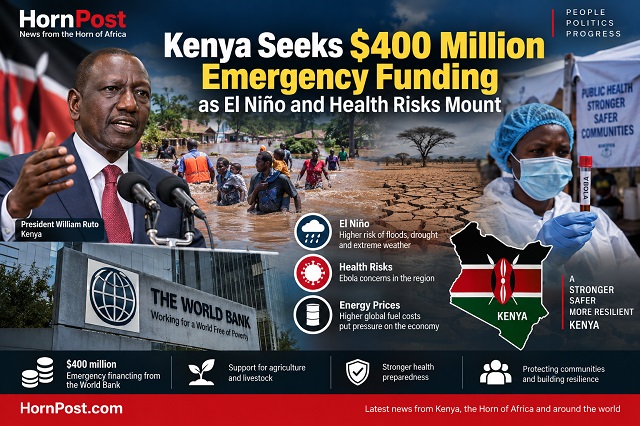
NAIROBI, Kenya —(HornPost) Kenya is preparing to access about $400 million in emergency financing from the World Bank as the country faces a combination of climate, public health and economic risks, including a potentially severe El Niño event, an Ebola outbreak in the region and elevated energy costs.
The emergency financing, expected to become available within about six weeks, is being arranged through the World Bank’s Rapid Response Option, according to a source familiar with the process cited by Reuters. The funding is intended to give Kenya additional resources to respond quickly to shocks affecting the economy and essential public services. Reuters
The financing package comes as international climate agencies warn that El Niño is strengthening and could produce significant disruptions to rainfall and temperature patterns over the coming months.
The World Meteorological Organization said on Sept. 3 that El Niño was firmly established and expected to intensify into a very strong event, with risks including flooding, drought and extreme heat. The WMO said there was a nearly 100% likelihood that El Niño would persist through February 2027. World Meteorological Organization
Kenya prepares for severe climate impacts
Kenya is particularly vulnerable to changes in rainfall patterns because large parts of its economy depend on agriculture and livestock.
Heavy rainfall can cause flooding, damage roads and bridges, displace communities and destroy crops. At the same time, changing rainfall patterns can create drought conditions in other parts of the country, putting additional pressure on food and water supplies.
The government has already begun preparations for the expected weather risks.
Kenya’s Agriculture and Livestock Development Ministry has announced a 2.1 billion Kenyan shilling plan aimed at protecting livestock from the expected effects of El Niño, including flooding, disease outbreaks and livestock losses. People Daily
The preparations reflect concerns that extreme weather could compound existing economic pressures and increase demand for emergency assistance.
The WMO’s latest forecast indicates that El Niño is likely to become particularly strong during the September-November period, with the phenomenon expected to peak around November and December. The agency also expects a positive Indian Ocean Dipole to develop during the same period, adding another climate factor that could influence weather patterns in East Africa. World Meteorological Organization
Regional health concerns
Kenya is also monitoring public health risks following Ebola outbreaks in neighboring parts of East and Central Africa.
The World Bank emergency financing is expected to help Kenya respond to multiple risks simultaneously, including the possibility of increased health emergencies.
An Ebola outbreak in the region has increased concerns about cross-border transmission, particularly because Kenya is a major transportation and trade hub connecting East Africa to international markets.
Nairobi’s international airport and the country’s extensive road networks carry millions of passengers and large volumes of goods across the region each year. Kenya therefore has an interest in strengthening surveillance, preparedness and emergency response capacity.
The combination of climate-related displacement and disease risks could further increase pressure on Kenya’s health system if communities affected by flooding or other disasters require additional medical assistance.
Energy prices add economic pressure
Emergency financing was initially linked to economic pressures caused by higher global energy prices following the escalation of conflict in the Middle East.
Higher fuel prices can affect Kenya across the economy, increasing transportation costs and putting pressure on electricity generation, manufacturing and food distribution.
For households, higher energy and transportation costs can contribute to increased prices for basic goods.
Kenya is also dealing with significant fiscal pressures, including debt-service obligations. The additional World Bank financing would therefore provide the government with greater flexibility as it responds to external shocks.
The World Bank has already approved a few projects for Kenya, with more than $7 billion in total projects and about $3 billion already committed, according to Reuters. The proposed emergency financing would use resources from Kenya’s undisbursed World Bank portfolio to respond to the immediate risks. Reuters
A test for Kenya’s resilience
The challenges facing Kenya are interconnected.
Extreme weather can damage infrastructure and agriculture, forcing the government to increase spending on emergency relief and reconstruction. Disease outbreaks can create additional pressure on hospitals and public health agencies, while higher energy prices can raise the cost of responding to disasters and maintaining essential services.
For the government of President William Ruto, the coming months could therefore become an important test of Kenya’s ability to manage several external shocks at the same time.
The country’s experience with previous floods and droughts has highlighted the economic costs of inadequate preparation. Early-warning systems, emergency financing and coordinated government response could help reduce the impact of the next major climate event.
The World Bank’s Rapid Response Option is designed to provide countries with faster access to financing when they face major shocks. For Kenya, the proposed $400 million package would provide additional resources at a time when climate, health and economic risks are converging.
As El Niño strengthens, Kenyan authorities are expected to continue monitoring rainfall forecasts, preparing vulnerable communities and protecting agricultural and livestock production.
The wider implications extend beyond Kenya. Severe weather, disease outbreaks and higher energy costs in East Africa can affect regional food markets, trade and cross-border movement, making Kenya’s preparedness important for the broader East African economy.
For now, the focus is on ensuring that emergency resources are available before the most severe impacts arrive.
Prepared by
Hornpost staff
info@hornpost.com
www.hornpost.com