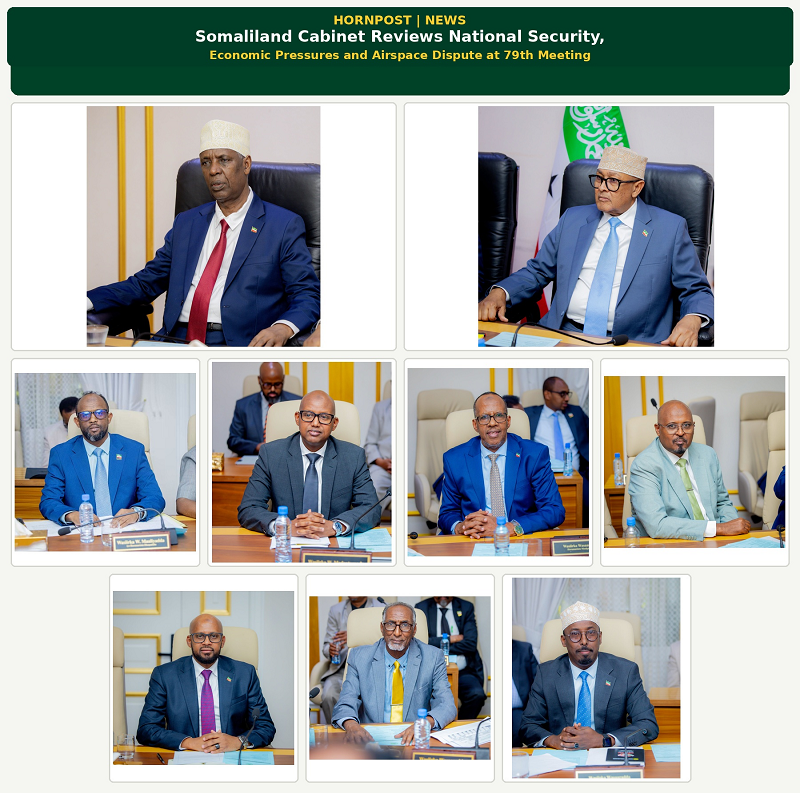
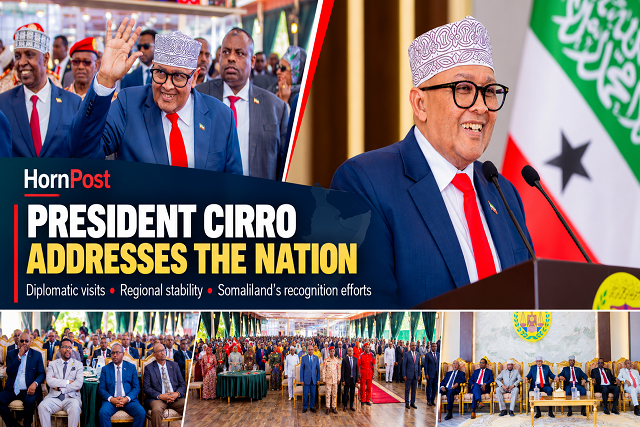

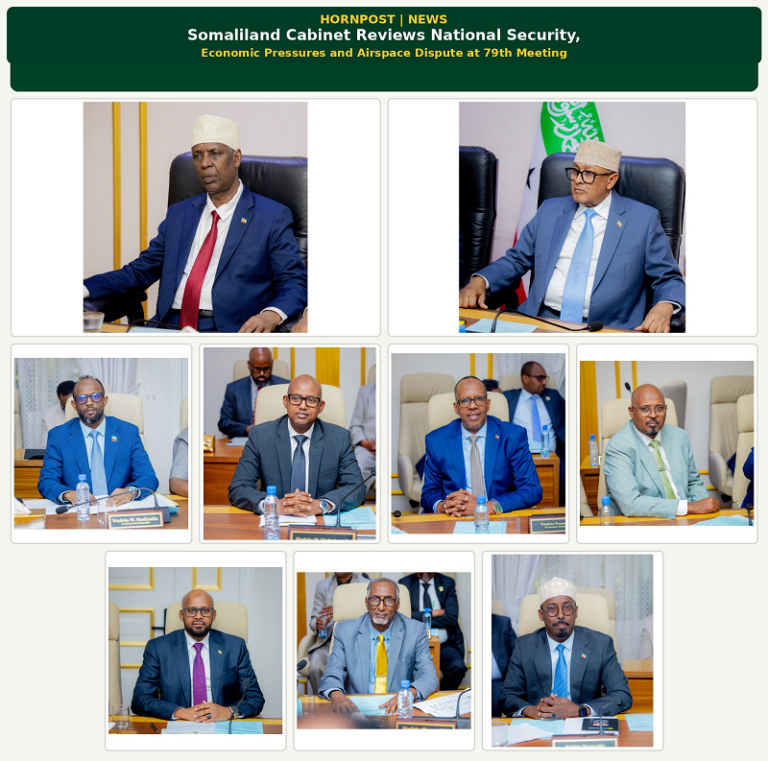
HARGEISA, Somaliland (HornPost) Somaliland’s Cabinet has reviewed national security, economic pressures, aviation disputes, education funding and government accountability during its 79th meeting, chaired by President Abdirahman Mohamed Abdilahi (Irro).
Vice President Mohamed Ali Aw Abdi also attended the meeting, which took place at the Presidential Palace in Hargeisa.
According to a government statement, ministers discussed eight main agenda items. These included the impact of tensions in the Middle East on Somaliland’s economy, efforts to secure control over its airspace, and measures to strengthen public services and government institutions.
The Cabinet also reviewed a proposed law governing the Custodial Corps. In addition, President Irro announced that his government had issued implementation directives for four national policies previously approved by the Cabinet.
1. Cabinet Reviews National Security and Stability
Minister of Interior and National Security Abdalle Mohamed Arab briefed the Cabinet on the country’s security situation.
He outlined government efforts to protect public safety, maintain stability and strengthen law and order. He also stressed the importance of cooperation among national security institutions.
According to the government statement, the minister called for stronger coordination between security agencies and greater public participation in preserving peace.
He emphasized that national security remains essential to Somaliland’s stability and development. The government also views security as a foundation for maintaining its institutions and strengthening public confidence.
2. Middle East Tensions Raise Economic Concerns
State Minister for Finance and Economic Development Ismail Mawlid Abdillahi presented an overview of Somaliland’s economic situation.
He focused on the effects of tensions in the Middle East on global economic growth and international trade. In particular, he highlighted rising costs that could affect businesses, importers and consumers.
According to the minister, these pressures include higher fuel prices, increased costs for basic commodities and more expensive maritime freight.
He also cited rising shipping insurance premiums as another concern for international trade.
These developments can increase the cost of transporting goods and importing essential products. Consequently, businesses may face higher operating expenses, while households could experience reduced purchasing power.
The minister stressed the importance of monitoring changes in the global economy. He said the government must assess how international developments affect Somaliland’s domestic markets.
He also highlighted the need to strengthen the national economy’s resilience. Maintaining market stability and protecting the public interest remain important priorities, according to the government statement.
3. Somaliland Reasserts Its Position on Airspace Management and IATA’s BSP System
Minister of Civil Aviation and Airports Development Fu’aad Ahmed Nuuh briefed the Cabinet on his recent working visit to Canada and the United Arab Emirates.
He reported on meetings with international partners, aviation stakeholders and various organizations. The discussions focused on Somaliland’s efforts to address airspace management, e-visa disputes and alleged disruptions to civilian aviation.
The minister also presented the results of meetings held in Montreal with parties involved in the legal and technical discussions surrounding Somaliland’s aviation rights.
Montreal is home to the headquarters of the International Civil Aviation Organization (ICAO) and the International Air Transport Association (IATA). Both organizations play important roles in international civil aviation, although they have different mandates.
Government Objects to IATA Billing and Settlement Plan
A major issue discussed at the meeting was the IATA Billing and Settlement Plan (BSP), which the Somaliland government says was announced by Somalia’s federal authorities in Mogadishu.
According to the Somaliland government statement, Fu’aad told ministers that the system does not apply to Somaliland and will not be implemented at airports under Somaliland’s administration.
The minister said the Ministry of Civil Aviation and Airports Development issued a formal directive on October 25, 2026. The directive reportedly took effect immediately.
Under the order, airlines operating in Somaliland have been instructed not to use the BSP system associated with the Mogadishu administration.
The directive also states that tickets issued through that system will not be accepted for departures from Somaliland’s airports. According to the ministry’s announcement, the restriction applies even when passengers purchased their tickets outside Somaliland.
The government statement says the restriction also covers return tickets issued through the system.
Furthermore, the ministry has instructed airlines to communicate the directive to their agents and ticket sales offices.
The announcement represents the Somaliland government’s stated position on the matter. Airlines, ticketing agents and passengers may need to seek clarification from the relevant authorities before making travel arrangements.
Somaliland Pursues Legal and Diplomatic Action
Fu’aad told the Cabinet that Somaliland continues to pursue legal and diplomatic efforts to secure its position on airspace management.
He said the government is engaging with friendly countries and international organizations to support these efforts.
Airspace management is a significant issue for Somaliland because it affects aviation operations, international connectivity and the authority responsible for regulating flights.
The dispute also raises practical questions for airlines and passengers who travel through the region.
The government has presented its position as part of a broader effort to protect Somaliland’s interests in international aviation. However, the outcome will depend on further engagement with relevant international bodies and aviation stakeholders.
4. Somaliland Reviews National Education Financing Conference
Minister of Education, Science and Childhood Development Professor Ismail Ducaale Yusuf briefed the Cabinet on the National Education Financing Conference held in Hargeisa on October 26 and 27, 2026.
The conference brought together Vice President Mohamed Ali Aw Abdi, cabinet ministers, members of the House of Representatives and mayors from major cities.
International organizations, universities, business representatives and members of the education sector also attended.
The conference aimed to strengthen education financing and improve the quality of education across Somaliland. Participants also discussed ways to expand educational opportunities for students throughout the country.
Funding Challenges and Education Access
The minister said participants examined financial and technical challenges facing the education sector.
These challenges affect the government’s ability to expand educational services, improve standards and ensure equal access to learning opportunities.
In particular, the conference considered how financing gaps could limit the education ministry’s capacity to deliver services and improve the quality of teaching.
The minister presented a nine-point communiqué adopted at the conference to the Cabinet.
The government statement did not detail all nine points. However, it identified education financing, quality improvement and broader access as central themes of the meeting.
The conference forms part of the government’s wider efforts to address education sector needs. The effectiveness of these efforts will depend on how the recommendations are translated into budgets, programmes and measurable improvements for students.
5. Cabinet Examines Government Vehicle Registration and Security Risks
Minister of Transport and Roads Development Osman Ibrahim Nur, known as Afgaab, presented a report on registration plates used by government vehicles.
He briefed ministers on the risks associated with vehicle registration practices that do not comply with national regulations.
The minister emphasized the importance of protecting public assets and ensuring that government vehicles can be properly identified.
He also called for stronger administrative controls and monitoring systems. These measures, according to the government statement, would help prevent the unlawful use of government vehicle registration plates.
Improved oversight could also strengthen accountability and public confidence in government institutions.
The report highlighted the need for clear procedures to track government vehicles and ensure that their use complies with applicable laws and regulations.
However, the statement did not identify specific cases of misuse or announce individual enforcement actions.
6. Government Prepares Performance Reports for 2025 and 2026
Minister of the Presidency Khadar Hussein Abdi briefed the Cabinet on plans to prepare and coordinate government performance reports for 2025 and 2026.
The reports are intended to document the work carried out by ministries and government institutions during the current administration’s time in office.
The minister explained the proposed approach for collecting, organizing and presenting information from different government bodies.
He stressed the importance of reliable data and a consistent reporting process. These measures would help ensure that the final reports present a clear picture of government activities and progress.
The initiative is also intended to improve transparency by providing a structured account of government performance.
According to the statement, the reports should show progress against national priorities and highlight the work undertaken by individual ministries and institutions.
Their value will depend on the quality of the data, the clarity of the performance indicators and the extent to which the published findings allow the public to assess government results.
7. Cabinet Debates Draft Custodial Corps Law
The Cabinet discussed a draft law governing the Somaliland Custodial Corps.
The proposed legislation is intended to establish a legal framework for the corps’ structure, responsibilities and duties.
Ministers considered the importance of defining the institution’s mandate through a clear legal framework.
The draft law remains under discussion. According to the government statement, the Cabinet will continue its deliberations next week.
The statement did not announce final approval of the legislation. Therefore, further discussion is expected before the Cabinet reaches a final decision.
8. President Irro Announces Implementation of Four National Policies
At the conclusion of the meeting, President Irro informed ministers that he had issued implementation directives during the week for four national policies previously approved by the Cabinet.
The policies cover education, youth affairs, land administration and livestock feed.
They are:
- National Education Policy
- National Youth Policy
- Land Administration Policy
- Livestock Feed Policy
President Irro instructed the Cabinet and the relevant government institutions to implement the approved policies.
He also called on ministries and agencies to translate them into national action plans and practical programmes.
The aim, according to the government statement, is to ensure that the policies produce tangible benefits for Somaliland and its population.
The implementation directives mark a step towards putting the policies into practice. Their impact will depend on the resources allocated, the responsibilities assigned to government institutions and the monitoring of progress.
Government Priorities Span Security, the Economy and Public Services
The 79th Cabinet meeting addressed several areas central to Somaliland’s administration, from national security and economic stability to aviation, education and public sector accountability.
The discussions also highlighted the government’s concerns about external economic pressures and its continuing efforts to assert its position on airspace management.
Meanwhile, the education financing conference and the preparation of government performance reports point to broader priorities involving public services and institutional oversight.
The Cabinet’s continued review of the Custodial Corps bill shows that some legislative matters remain under consideration.
By contrast, the four national policies identified by President Irro have moved into the implementation phase, according to the government statement.
The next steps will determine how these discussions translate into policy enforcement, public services and measurable results.
HornPost Staff Reporter
info@hornpost.com
www.hornpost.com
Hargeisa, Somaliland
Abdikarim Saed Salah
Abdikarim Saed Salah is Editor-in-Chief and Founder of HornPost.com, an independent Hargeisa-based news platform covering Somaliland, the Horn of Africa, East Africa, the Red Sea and international affairs. A journalist, television presenter, producer and geopolitical analyst, he has more than 15 years of experience in broadcast journalism, digital media, reporting and diplomacy. He works with Horn Cable TV and focuses on politics, elections, security, foreign policy and conflict. He holds a BA in Journalism and an MA in International Relations.