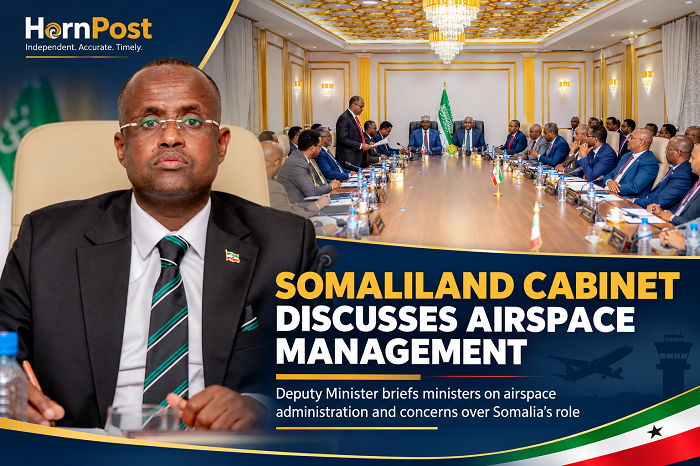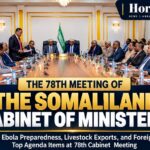
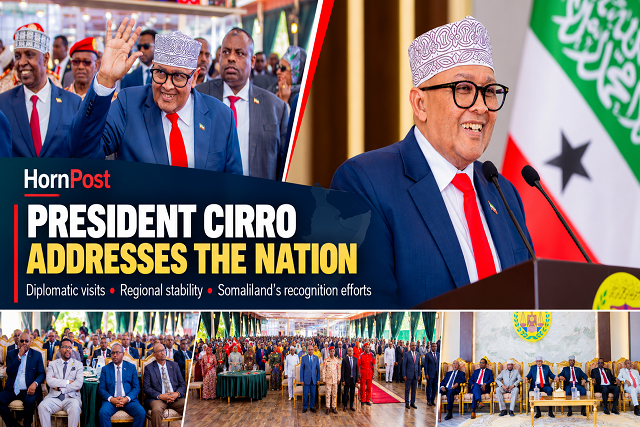

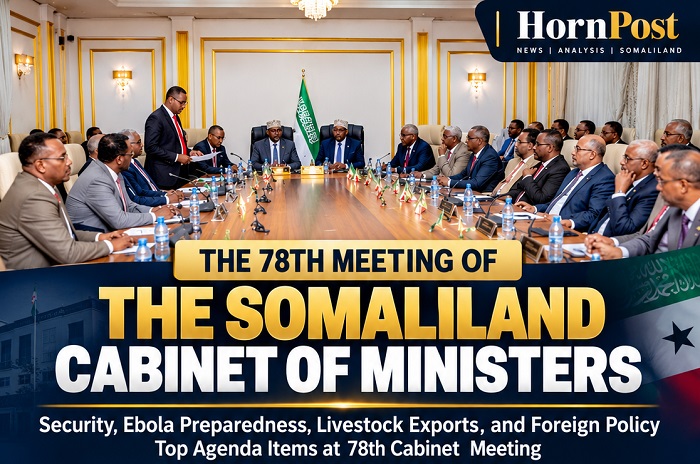
HARGEISA, Somaliland (HornPost) Somaliland’s Council of Ministers held its 78th session at the Presidential Palace, chaired by President Abdirahman Mohamed Abdullahi, known as Irro, and attended by Vice President Mohamed Ali Aw Abdi. The meeting reviewed national security, preparations against the Ebola virus, livestock development and exports, foreign policy, airspace administration and proposed legislation governing the Somaliland Custodial Corps.
The session brought together reports from several ministries, with officials outlining the government’s assessment of the country’s security situation, measures to strengthen public health preparedness, proposals to improve the competitiveness of livestock exports and concerns over the administration of Somaliland’s airspace.
The Cabinet also continued its review of a draft law governing the Custodial Corps, which is responsible for correctional services.
1. Government Reports Stable Security Situation
Minister of Interior and National Security Abdalle Mohamed Arab briefed the Council on the overall security situation, describing conditions across Somaliland as good and saying there were no security incidents posing a general threat to the country.
According to the minister’s report to the Cabinet, the country’s security institutions remain prepared to protect peace, public order and national security.
Arab also emphasized the importance of continued coordination among security agencies and greater public vigilance, describing cooperation between the public and security institutions as essential to maintaining peace and stability.
The briefing placed particular emphasis on cooperation between the various national security bodies and the role of communities in identifying and preventing potential threats.
The government’s assessment, as presented during the meeting, was that the overall security situation remained stable. The statement did not provide detailed incident figures or a breakdown of security conditions by region.
2. Somaliland Strengthens Preparedness for Ebola Threat
Health Minister Dr. Hussein Bashir Hirsi briefed the Cabinet on the country’s public health situation, focusing on the risk posed by Ebola caused by the Bundibugyo virus.
The minister referred to the outbreak in the Democratic Republic of the Congo (DRC), which the government statement said began in May 2025 and resulted in numerous deaths.
Hirsi told ministers that no Ebola cases had been recorded in Somaliland at the time of the briefing. However, he warned that the outbreak posed a potential public health threat to the wider Horn of Africa, particularly because of air travel and cross-border movement.
He said the situation required heightened national vigilance, sustained preparedness and coordination among government institutions.
The minister outlined several measures undertaken by the Ministry of Health Development to strengthen prevention and response capacity.
These include:
Establishing a standing committee: The ministry has activated a permanent committee responsible for Ebola prevention and preparedness.
Training health personnel: Medical staff are receiving training related to Ebola prevention, control and response.
Strengthening airport and border health services: The ministry is reinforcing health personnel working at Hargeisa airport and in border towns to improve preparedness and monitoring.
Improving interagency coordination: The ministry is strengthening cooperation with government institutions whose responsibilities are directly or indirectly connected to public health preparedness.
The institutions identified in the statement include the ministries responsible for interior affairs, civil aviation, information, religious affairs and education, as well as the Immigration Department, the governor of Maroodi Jeex region and the mayor of the capital.
The measures are intended to improve coordination between health officials and agencies responsible for travel, border management, public communication and local administration.
The minister’s briefing underscored the importance of preparedness even in the absence of a reported case within Somaliland. Airport screening, trained personnel, communication between institutions and the ability to respond rapidly to suspected infections are important components of public health protection during regional outbreaks.
The Cabinet statement did not provide further details on screening protocols, laboratory capacity, isolation facilities or the timetable for implementing the measures.
3. Livestock Development and Exports: Minister Calls for Dedicated Berbera Terminal
Minister of Livestock Development and Rural Development Dr. Omar Shu’ayb Mohamed presented a report on progress under the Banka Qoolcaday project and its contribution to rural development, livestock livelihoods and the national economy.
The project was discussed in the context of the government’s wider efforts to support pastoral communities and strengthen the livestock sector, which is a major source of income and economic activity in Somaliland.
The minister also briefed the Cabinet on the progress of livestock vaccination and treatment campaigns carried out by the ministry in the eastern regions of the country.
The campaigns form part of government efforts to protect animal health, reduce livestock disease risks and support the livelihoods of pastoralist communities, many of whom depend on livestock production and exports.
Mohamed further reported a noticeable increase in livestock exports and stressed the need for a comprehensive national plan to improve livestock production, animal health, productivity and welfare.
He said the livestock trade directly affects the livelihoods of a substantial section of Somaliland’s population and argued that the sector requires an approach that goes beyond traditional livestock-rearing practices.
The minister emphasized the need for Somaliland to prepare strategically for increasing competition in international livestock markets. Improving animal health, production standards, export infrastructure and the quality of livestock reaching overseas markets would be important elements of that effort.
Call for a dedicated livestock export terminal in Berbera
One of the key proposals presented during the briefing was the urgent construction and equipping of a dedicated livestock export terminal in Berbera.
The minister, according to the government statement, argued that a specialized facility would help improve the quality and competitiveness of Somaliland’s livestock exports.
A dedicated livestock terminal could provide infrastructure specifically designed for the handling, inspection, treatment and preparation of animals for export. Its development would also need to be considered alongside veterinary certification, animal welfare requirements, shipping arrangements and the demands of importing markets.
The proposal reflects the importance of Berbera as a maritime outlet for Somaliland’s livestock trade and the broader need to strengthen infrastructure connecting pastoral production areas with export markets.
The Cabinet statement did not specify the proposed terminal’s estimated cost, construction schedule, financing arrangements or whether a formal project plan had been approved.
The minister’s recommendation nevertheless placed livestock export infrastructure among the issues raised in the government’s discussion of rural livelihoods and economic development.
4. Foreign Minister Reports Increased International Interest in Somaliland
Foreign Minister and International Cooperation Minister Abdirahman Dahir Adan Bakal briefed the Cabinet on the implementation of Somaliland’s foreign policy and what he described as growing international interest in the territory.
His report addressed Somaliland’s diplomatic profile, international reputation and engagement with foreign governments and institutions.
The minister highlighted what he characterized as diplomatic gains from President Irro’s working visit to the United States, with particular attention to remarks by the U.S. president distinguishing Somaliland from Somalia.
According to the Somaliland government’s account, the remarks increased international attention toward Somaliland and helped create opportunities for new international relationships.
Minister Bakal told ministers that these developments supported Somaliland’s efforts to advance its national interests and diplomatic objectives.
The government statement presented the remarks as an important development in Somaliland’s international engagement. It did not, however, identify specific new agreements or formal diplomatic commitments resulting directly from the U.S. visit.
The foreign minister’s briefing also focused on the procedures governing official overseas travel by senior Somaliland officials.
New diplomatic protocol procedures under preparation
Foreign Minister Bakal informed the Cabinet that the ministry was preparing formal guidelines to regulate diplomatic protocol for senior government officials travelling abroad on official assignments.
The proposed procedures are intended to establish a consistent framework for official representation, ensuring that overseas visits follow an agreed protocol and reflect the dignity, status and interests of Somaliland.
Formal travel and diplomatic procedures can cover matters such as coordination with host governments, official representation, communication between government institutions and the handling of diplomatic engagements.
The ministry’s initiative, as described in the statement, is aimed at improving the organization and consistency of official foreign visits.
The Cabinet statement did not provide a timetable for issuing the guidelines or details of the procedures that will be included in the final framework.
The discussion comes as Somaliland continues to prioritize international engagement and efforts to expand its diplomatic and economic relationships.
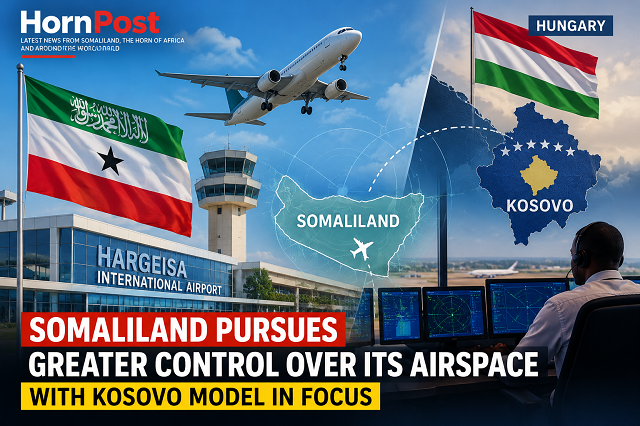
5. Somaliland Reasserts Position on Airspace Administration and IATA-BSP
Deputy Minister of Civil Aviation and Airport Development Yusuf Keyse Abdullahi briefed the Council on the IATA Billing and Settlement Plan (BSP) system and Somaliland’s position on the independent administration of its airspace and aviation arrangements.
The deputy minister emphasized the government’s opposition to any intervention, measure or arrangement that it considers an obstruction to Somaliland’s administration of its airspace, flight systems and aviation-related interests.
He argued that the administration of Somaliland’s airspace should be treated in line with what the government regards as its rights and responsibilities concerning its land, maritime and air boundaries.
The briefing also highlighted flight safety, the protection of national interests and the government’s stated responsibility to safeguard the interests of Somaliland’s citizens.
Abdullahi told the Cabinet that Somaliland would take measures it considers necessary to protect its administration and security of its airspace.
Following the presentation, the Council agreed that the Somaliland government should take appropriate steps in response to what it described as interference and disruption by Somalia in Somaliland’s airspace administration.
The statement did not specify the measures being considered, whether diplomatic or technical discussions had taken place, or whether a particular new policy had been adopted during the session.
The significance of IATA-BSP
The IATA Billing and Settlement Plan is an industry system used to facilitate financial transactions between participating travel agents and airlines. Its mention at the Cabinet meeting places the issue within the wider discussion of aviation administration and the systems supporting air travel.
The government’s statement focused primarily on its position regarding the administration of Somaliland’s airspace and aviation interests. It did not provide technical details about the specific BSP arrangements discussed or outline changes to the system.
The issue remains politically significant because airspace administration, flight coordination and aviation systems involve questions of institutional authority, international coordination and operational safety.
The Cabinet’s position, as presented in the statement, was that the government would pursue appropriate measures to protect its claimed authority over Somaliland’s airspace and respond to actions it views as interference.
6. Cabinet Continues Second Reading of Custodial Corps Bill
The Council of Ministers began the second reading of the draft Somaliland Custodial Corps Act, legislation intended to establish a clearer legal framework for the administration and operation of the correctional service.
Justice Minister Younis Ahmed Younis briefed the Cabinet on the bill’s objectives and significance, saying the ministry had completed its preparation of the draft.
According to the minister, the Custodial Corps had long required a dedicated legal framework, and the proposed law was intended to address that need in accordance with Article 124 of Somaliland’s Constitution, as cited in the government statement.
The legislation is designed to regulate the administration of the Custodial Corps and define its organizational structure, powers, duties and responsibilities.
It would also address the rights of personnel, promotion procedures and disciplinary measures applicable to members of the service.
A clear legal framework can establish the responsibilities of correctional institutions, clarify the authority of their personnel and set out formal procedures governing recruitment, career progression and discipline.
The minister asked Cabinet members to study the draft in detail and submit their recommendations before a vote at a future session.
The second reading therefore represents a continuing stage in the government’s consideration of the bill rather than confirmation that the legislation has been finally approved.
The government statement did not provide a date for the next reading or a timetable for the bill’s eventual adoption.
Broader Focus on Security, Public Health and Economic Development
The 78th Cabinet session covered a wide range of issues, from immediate public safety concerns to longer-term economic and institutional priorities.
The security briefing presented the government’s assessment that Somaliland remained stable, while the health ministry outlined preparations intended to reduce the risk of Ebola reaching the territory.
The livestock discussion focused on protecting pastoral livelihoods, improving animal health and strengthening export competitiveness, including through a proposed dedicated livestock terminal in Berbera.
On foreign policy, the government highlighted its diplomatic engagement with the United States and the preparation of formal guidelines for official overseas visits. The aviation discussion reaffirmed the administration’s position on Somaliland’s airspace, while the review of the Custodial Corps bill continued the process of developing a legal framework for correctional services.
Taken together, the agenda reflected the government’s stated priorities in security, institutional administration, public health preparedness, export development and international engagement.
The Cabinet statement did not announce final approval of the Custodial Corps bill, provide a budget or construction schedule for the proposed Berbera livestock terminal, or detail specific new agreements resulting from the foreign-policy briefing.
Further information on implementation, funding, timelines and follow-up decisions would be needed to assess how the proposals discussed at the meeting will translate into concrete policy outcomes.
Editorial note
The report preserves all six agenda items and the main details in the supplied statement. The Ebola background should be checked carefully before publication: the source statement refers to an outbreak in the Democratic Republic of the Congo beginning in May 2025, while recent reporting in October 2026 describes a Bundibugyo virus outbreak and cases reported in Kenya.
Prepared by:
HornPost staff
HornPost Authors
HornPost Staff is the editorial byline of HornPost.com, used for collaborative newsroom reporting, editorial content, and reports published by the Horn Post editorial team. HornPost covers Somaliland, the Horn of Africa, Africa, the Middle East, and major international developments, with reporting focused on politics, governance, diplomacy, security, business, economics, and breaking news. HornPost is committed to accurate, fair, independent, and responsible journalism.