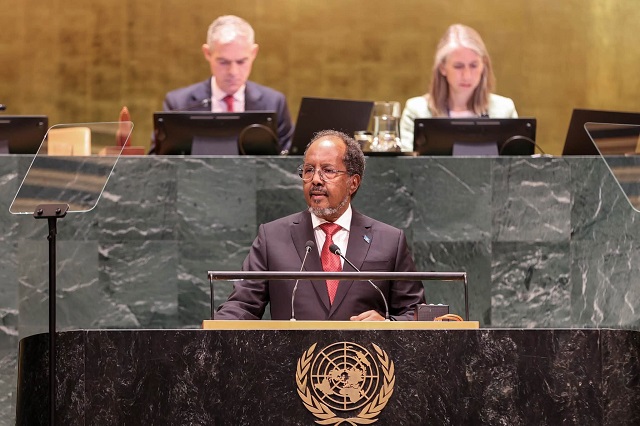
NEW YORK —(HornPost) — Somalian President Hassan Sheikh Mohamud called for reforms to the United Nations, greater African representation on the Security Council and stronger national ownership of development and security programs during his address to the 81st session of the UN General Assembly.
Mohamud said the international system was facing growing conflict, geopolitical rivalry, humanitarian pressures and weakening confidence in multilateral institutions, urging governments to move beyond declarations and focus on delivering measurable results.
“Trust in the UN will not be restored through declarations alone,” Mohamud said. “It will be restored when institutions act consistently, uphold international law and produce results that people can see and experience.”
Somalia Calls for Greater African Representation
A major focus of the president’s address was reform of the UN Security Council.
Mohamud said the council should become more representative, transparent and effective, arguing that Africa remains underrepresented among its permanent members.
“This historical injustice against the 54 sovereign states cannot be postponed indefinitely,” he said.
Somalia supports the common African position calling for meaningful African representation in both the permanent and non-permanent categories of the Security Council, Mohamud said.
He argued that reform was necessary to strengthen the legitimacy of the United Nations and ensure that its institutions reflect contemporary global realities.
“Reform is not an attack on the United Nations,” Mohamud said. “Reform is necessary to protect its legitimacy, renew confidence in its institutions, and ensure that it remains capable of responding to the realities of our time.”
Somalia Seeks Greater National Ownership of UN Assistance
Mohamud also called for changes to the way international assistance is delivered in Somalia.
He said much of the United Nations’ assistance had been delivered through parallel structures, fragmented projects and off-budget arrangements, making it difficult for the Somali government to coordinate resources, measure results and strengthen institutions.
“Somalia is not calling for the United Nations to withdraw,” he said. “We are simply calling for a more accountable, strategic and results-oriented partnership where Somali institutions are in the lead when it comes to implementation.”
The president said international assistance should reinforce rather than replace national leadership, while national institutions should be strengthened rather than bypassed.
He also rejected what he described as an outdated assumption that countries such as Somalia lack the capacity to manage their own development.
“We now have capable people, institutions, policies that are proudly guiding our national transformation agenda,” he said.
Somalia Highlights Constitutional and Political Reforms
Mohamud also used the address to highlight Somalia’s ongoing political reforms.
He said the government was working toward universal suffrage, accountable institutions and a multiparty political system, describing the process as a major political transformation.
“For over five decades, our people have dreamed of choosing their leaders through their vote,” he said.
Mohamud said Somalia’s last democratic election was held in 1969 and that the government was seeking to change that history through constitutional reform.
He said political leaders, federal member states, civil society, women’s groups, youth groups and members of the diaspora had been engaged in the process.
“Our aim is to become an effective democracy where differences are resolved through dialogue, law and elections, not violence,” he said.
He called on the United Nations and international partners to support Somalia’s democratic transition while respecting Somali ownership of the process.
President Calls for Continued Support Against Terrorism
The president said Somalia was continuing to confront terrorism while strengthening national security institutions, force generation and intelligence capabilities.
He also highlighted expanded security cooperation with neighboring countries and international partners.
“The fight against terrorism in Somalia must not be understood as a Somalia responsibility alone,” Mohamud said, describing Somalia as being on the front line of a struggle with regional and international security implications.
He called for predictable and sustainable support for Somalia’s security transition, including adequate financing for the African Union mission in Somalia.
Mohamud said the transition toward full Somali security responsibility needed to be properly resourced and supported by capable national institutions.
Economy Faces Regional and Global Pressures
Mohamud said Somalia’s economy continued to grow despite global shocks and regional instability, citing real GDP growth of 3.1% for the year.
He said the government was strengthening public financial management, increasing domestic revenue, improving budget transparency and working to create a stronger investment environment.
The president also linked regional tensions and disruptions to maritime trade with economic pressures inside Somalia.
He said Somalia’s dependence on imports and its reliance on the Middle East for much of its food, fuel and trade had exposed the country to rising prices, inflation, transportation costs and insurance costs.
Mohamud said drought linked to climate change was affecting more than six million people in Somalia and said disruptions to maritime trade had contributed to an estimated 40% decline in customs-based revenue.
He stressed the importance of maintaining freedom of navigation through key maritime routes for vulnerable economies such as Somalia.
Climate Change and Disaster Prevention
Climate change featured prominently in the president’s address.
Mohamud said Somalia remained particularly vulnerable to climate shocks and argued that governments and international institutions should invest more in prevention, resilience and early action rather than focusing primarily on responding after disasters occur.
He cited a UN Office for Disaster Risk Reduction estimate that every $1 invested in proactive measures, resilient infrastructure or anticipatory action could save between $3 and $15 in future damages and response costs.
The president also warned that strengthening El Niño conditions could bring another period of significant climate stress, with developing countries such as Somalia facing disproportionate effects.
“We must learn from what has happened before and be better prepared,” he said.
Somalia Reaffirms Support for Palestinian Statehood
Mohamud also reaffirmed Somalia’s support for the Palestinian people and their right to self-determination and statehood.
He said Somalia supported a just and lasting peace based on a two-state solution, with an independent Palestinian state along the 1967 borders.
“A just resolution of the Palestinian question remains essential to the lasting peace and stability in the Middle East and beyond,” he said.
Somalia Calls for Reform of Global Financial Institutions
The president also called for reform of the international financial architecture.
He argued that international financial institutions should better reflect current economic and environmental realities and provide developing countries with relevant, affordable and accessible financial products that can be delivered in a timely manner.
Mohamud highlighted Somalia’s regional and international integration, including its membership in the East African Community, participation in African initiatives and efforts toward accession to the World Trade Organization.
A Call for a More Effective Multilateral System
In his closing remarks, Mohamud said Somalia was seeking to play an active role in global stability while rebuilding its economy and advancing what he described as people-centered development.
He called on African countries and the wider international community to support Somalia’s efforts and urged UN member states to work together on Security Council reform, stronger UN-AU cooperation, development financing and climate action.
“Let us move beyond promises and towards performance,” Mohamud said.
“Let us invest not only in managing crisis but also in preventing them.”
He concluded by calling for a United Nations system that delivers more effectively for all member states and people.
Editor’s note:
This report is based on President Hassan Sheikh Mohamud’s address to the 81st United Nations General Assembly, as published by the United Nations. Statistics and external claims cited by the president are attributed to him or to the sources referenced in his speech.
HornPost Staff is the editorial byline of HornPost.com, used for collaborative newsroom reporting, editorial content, and reports published by the Horn Post editorial team.
HornPost covers Somaliland, the Horn of Africa, Africa, the Middle East, and major international developments, with reporting focused on politics, governance, diplomacy, security, business, economics, and breaking news.
HornPost is committed to accurate, fair, independent, and responsible journalism.