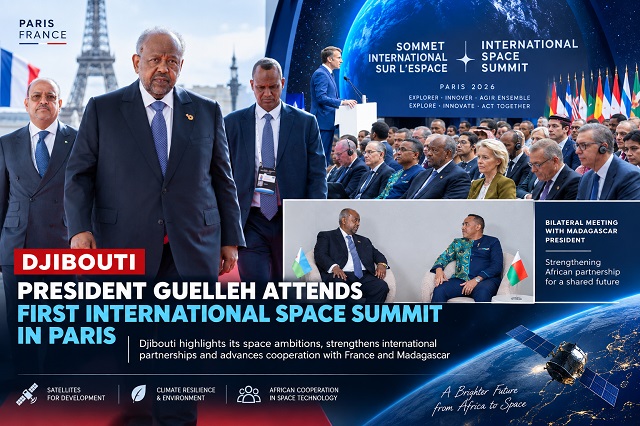
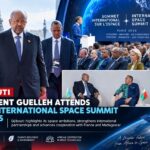
PARIS —(HornPost) Djibouti President Ismaïl Omar Guelleh on Thursday participated in the first International Space Summit in Paris, joining heads of state and government, scientists, space-sector executives and representatives of international organizations from more than 120 countries.
Guelleh attended the Sept. 10 proceedings at the invitation of French President Emmanuel Macron, according to a statement issued by the Djibouti presidency.
The two-day summit, held in Paris on Sept. 9-10, is designed to create a broad international dialogue on the future of space, including its scientific, technological and economic applications. France said the meeting brings together governments, international and regional organizations, scientists, astronauts, military representatives, private-sector decision-makers and civil society.
For Djibouti, however, the summit represents more than a diplomatic gathering. The government is using its participation to highlight the country’s emerging space program and its effort to develop practical applications of satellite technology for national development.
Djibouti links space technology to national development
In its statement, the Djibouti presidency said the country does not view space technology as a distant or purely scientific ambition. Instead, it sees satellite technology as a tool that can support national priorities, particularly environmental monitoring, water management, climate-related challenges and infrastructure planning.
Djibouti launched its national space program in 2020, with an emphasis on developing domestic expertise rather than simply purchasing finished satellite systems.
The country’s official space program says one of its main objectives is to transfer technology and develop local expertise in nanosatellite systems, while creating practical applications for environmental protection and the national economy.
The program was developed in partnership with the University of Montpellier in France. Djibouti sent a group of students and engineers to France for specialized training in space systems and satellite development.
That approach has allowed Djibouti to begin building technical capabilities inside the country while working with French academic and technical institutions.
DJIBOUTI-1A and DJIBOUTI-1B satellites
Djibouti’s space ambitions reached a major milestone with the launch of DJIBOUTI-1A, the country’s first satellite, in November 2023.
The satellite was launched aboard a SpaceX Falcon 9 rocket from Vandenberg Space Force Base in California. The mission was developed as part of Djibouti’s HYDROSAT program, which is designed to collect environmental and hydrological data from stations across the country.
Djibouti subsequently launched DJIBOUTI-1B on Dec. 21, 2024, also expanding the country’s satellite-based data collection capabilities. The official Djibouti space program says the second satellite was designed to complement DJIBOUTI-1A and provide more frequent coverage of Djibouti.
Satellite tracking data confirms the launch of DJIBOUTI-1B on Dec. 21, 2024, aboard a Falcon 9 mission from Vandenberg.
The satellites are intended to support the collection of data related to climate, rainfall and water resources.
For a country such as Djibouti, where water scarcity, drought and climate variability pose significant challenges, the ability to collect environmental information from space has practical implications for planning and disaster management.
New National Geospatial Center planned
The Djibouti government is also preparing, with French support, to establish a National Geospatial Center, according to the presidential statement.
The proposed center would strengthen the country’s capacity to analyze and use Earth-observation data collected through satellites.
The government says such data could be used to monitor water resources, droughts and floods, track the effects of climate change, protect the environment and support urban planning and infrastructure development.
The initiative reflects a broader shift in the way developing countries are approaching space technology.
Rather than viewing satellite programs solely as symbols of technological prestige, governments are increasingly looking at Earth observation, satellite communications and geospatial data as tools that can directly support agriculture, water management, disaster preparedness and public infrastructure.
For Djibouti, the strategy is particularly relevant because of the country’s geography and its exposure to climate and environmental pressures.
Djibouti seeks a role in Africa’s space ambitions
President Guelleh’s participation in the Paris summit also gives Djibouti an opportunity to position itself within Africa’s growing space sector.
The Djibouti presidency said the country wants to contribute to strengthening scientific and technological capabilities across the African continent.
The government argues that experience gained through its satellite program can contribute to broader efforts to develop African engineers, scientists and space-related technical expertise.
That ambition comes as African countries increasingly invest in space programs, satellite technology and Earth-observation systems.
For many African governments, satellites are becoming important tools for monitoring agriculture, mapping territory, managing natural resources, improving telecommunications and responding to climate-related disasters.
Djibouti’s emphasis on training therefore forms a central part of its strategy.
The country’s space program says the objective is not simply to place satellites in orbit but to acquire knowledge and technical expertise that can be maintained and expanded domestically.
France and Djibouti deepen space and technology cooperation
Guelleh’s presence in Paris also comes against the backdrop of longstanding relations between Djibouti and France.
French President Emmanuel Macron received Guelleh at the Élysée Palace on Sept. 9, on the sidelines of the International Space Summit. The two leaders discussed bilateral relations and cooperation in areas including defense and security, education, research, training and economic development, according to the Djibouti presidency.
France has played an important role in Djibouti’s emerging space capabilities through academic and technical cooperation.
The partnership with the University of Montpellier helped train Djiboutian engineers and students in satellite development and space systems.
The International Space Summit therefore provides a high-level platform for Djibouti to present the results of that cooperation while seeking opportunities for further technological partnerships.
Guelleh meets Madagascar’s president
On the sidelines of the summit, Guelleh also held bilateral talks with Madagascar President Col. Michael Randrianirina.
According to the Djibouti presidency, the meeting focused on bilateral relations and ways to strengthen cooperation between the two African countries.
The two leaders also exchanged views on regional and continental issues of common interest.
Randrianirina became Madagascar’s president in October 2025 after a military takeover that followed weeks of youth-led protests. Reuters reported at the time that he pledged to oversee a transitional government before elections.
The meeting with Guelleh adds an African diplomatic dimension to the Djiboutian president’s participation in the Paris summit.
The Djibouti delegation included Foreign Affairs and International Cooperation Minister Abdoulkader Houssein Omar, Higher Education and Research Minister Nabil Mohamed Ahmed, and Djibouti’s ambassador to France, Ayeid Mousseid Yahya, according to the presidential statement.
Why Djibouti’s participation matters
The Paris summit is taking place at a time when space is becoming increasingly important to national security, communications, climate monitoring and economic development.
European countries are debating how to strengthen their own space capabilities, while the United States, China and private companies continue to expand their presence in orbit.
Reuters reported that the summit has also highlighted Europe’s desire to improve coordination among national satellite programs and strengthen strategic autonomy in space.
Against that backdrop, Djibouti’s participation demonstrates how smaller developing countries are seeking to become part of the rapidly expanding global space economy.
For Djibouti, the objective is not simply to compete with major space powers. Its strategy is focused on developing local expertise and using satellite data to address practical challenges on the ground.
The launch of DJIBOUTI-1A and DJIBOUTI-1B, the planned National Geospatial Center and the training of young engineers form the foundations of that strategy.
Guelleh’s participation in the first International Space Summit therefore represents both a diplomatic engagement with the global space community and an opportunity for Djibouti to showcase its growing technological ambitions.
As space technology becomes increasingly connected to climate resilience, economic development and national security, Djibouti is seeking to establish its place in a sector that was once dominated almost entirely by major global powers.
Prepared by
Hornpost staff
info@hornpost.com
HARGEISA, Somaliland