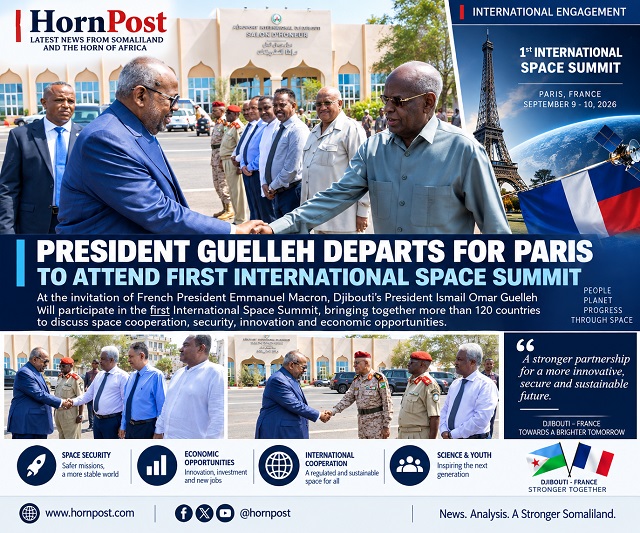
PARIS — (HornPost) Djibouti President Ismail Omar Guelleh joins more than 120 countries in Paris for the first International Space Summit, focusing on space security, economic opportunities and global cooperation.
Djibouti President Ismail Omar Guelleh has traveled to Paris to attend the first International Space Summit, hosted by French President Emmanuel Macron on Sept. 9–10, as governments, scientists, private-sector leaders and international organizations gather to discuss the future of space cooperation.
Guelleh departed Djibouti on Tuesday, Sept. 8, at Macron’s invitation. The summit is being held at the Grand Palais and is expected to bring together delegations from more than 120 countries, including heads of state and government, scientists, astronauts, defense officials, business leaders and representatives of civil society.
The meeting comes as space is becoming increasingly important not only for scientific research and exploration but also for communications, navigation, Earth observation, economic development and national security.
Djibouti Joins Global Space Dialogue
For Djibouti, Guelleh’s participation places the country within a broader international discussion about how nations can cooperate in an increasingly strategic space environment.
France says the summit is designed to promote a broad dialogue covering space governance, industry, science and defense, while encouraging a stronger multilateral framework for the sustainable and secure use of outer space.
The summit will focus on four major areas: space security and defense, the economic opportunities of the space sector, international regulation and governance, and the role of space science in inspiring and educating younger generations.
These issues have become increasingly important as governments and private companies expand satellite networks, launch capabilities and commercial space activities.
Space Economy Takes Center Stage
The economic dimension of the summit is particularly significant.
The global space sector is no longer limited to government-funded exploration programs. Satellites and space-based services now support telecommunications, navigation, weather forecasting, agriculture, disaster management, financial systems and environmental monitoring.
France has emphasized the need to develop a stronger international framework capable of balancing commercial expansion with responsible and sustainable use of outer space. The French government says the summit will seek to connect governments, international organizations, industry, investors, researchers and civil society around these challenges.
With global economic growth facing uncertainty, the space economy is also increasingly viewed as a source of technological innovation, investment and new employment opportunities.
Security and Governance
Security is another central theme of the Paris summit.
As more countries and private companies deploy satellites and other space infrastructure, governments face growing questions about the protection of space assets, orbital congestion, satellite communications and the management of radio frequencies.
France has argued that space should be governed through stronger international cooperation and rules designed to preserve safe and sustainable access to outer space.
The issue has broader geopolitical implications because satellite systems are now closely connected to military communications, intelligence, navigation and civilian infrastructure.
Guelleh Leads a Senior Delegation
President Guelleh is accompanied by a senior Djiboutian delegation that includes Nabil Mohamed Ahmed, minister of higher education and research, and Abdoulkader Houssein Omar, minister of foreign affairs and international cooperation.
Djibouti’s ambassador to France, Ayeid Mousseid Yahya, is also part of the presidential delegation.
Guelleh’s participation therefore gives Djibouti an opportunity to engage directly with political leaders, researchers and private-sector actors involved in the rapidly developing global space economy.
Why the Summit Matters Beyond Space
Although the summit is focused on outer space, its agenda reflects a much broader geopolitical transformation.
Space-based infrastructure has become essential to modern economies and national security. Satellite communications, Earth observation and navigation systems increasingly influence how governments manage borders, respond to disasters, monitor climate change and protect critical infrastructure.
The summit is also taking place amid growing competition among major powers over technological sovereignty and access to space. France has been pushing for greater European strategic autonomy in the sector while maintaining international cooperation.
The presence of more than 120 national delegations gives the Paris meeting an important multilateral dimension.
Djibouti’s Strategic Position
Djibouti’s participation also carries significance because of the country’s broader strategic position in the Horn of Africa.
Located near the Bab el-Mandeb Strait and major international shipping routes, Djibouti has long played an important role in regional security, logistics and international connectivity.
Its engagement in discussions about satellite technology and space-based infrastructure could eventually have relevance for areas such as maritime surveillance, communications, environmental monitoring and disaster preparedness.
For a country whose economy and strategic importance are closely linked to its geographic position, developments in satellite technology could provide additional tools for monitoring and managing its maritime and territorial environment.
A New Era of International Space Cooperation
The Paris summit is intended to strengthen international dialogue at a time when the space sector is undergoing rapid technological and commercial change.
French officials say the event will bring together public and private actors to address the scientific, technological, economic, environmental and security challenges facing the sector.
For Djibouti, President Guelleh’s participation represents an opportunity to engage with that emerging global agenda and explore how smaller states can participate in the benefits of the space economy.
The summit runs from Sept. 9 to 10, 2026, with France seeking to use the meeting to give new momentum to international governance and cooperation in space.
Prepared by:
HornPost staff
info@hornpost.com
www.hornpost.com
DJIBOUTI CITY, Djibouti