Djibouti (HornPost) President of the Republic of Djibouti Ismail Omar Guelleh has warned against foreign interference in his country’s internal affairs, declaring that Djibouti’s sovereignty and independent decision-making are not negotiable.
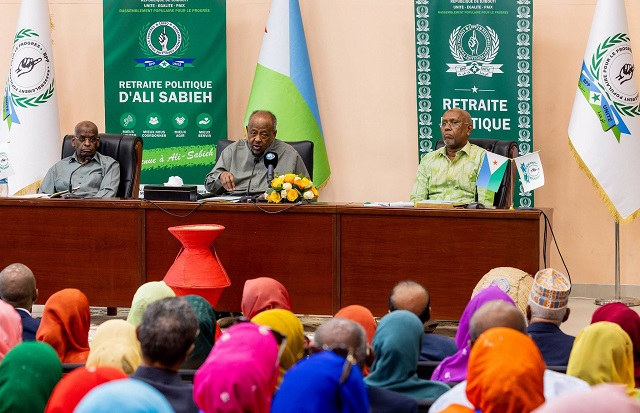
The statement, delivered in Ali Sabieh at the conclusion of a three-day political conference of the ruling People’s Rally for Progress (RPP), comes at a sensitive moment for the Horn of Africa and the Red Sea, where regional states are increasingly caught between competing political, economic and security interests.
Guelleh did not identify any particular country or organization as the target of his warning. But the timing of his remarks is significant.
Djibouti sits at one of the world’s most strategically important maritime crossroads, close to the Bab el-Mandeb Strait, connecting the Red Sea with the Gulf of Aden. Its geographic position has made the country a critical hub for international shipping, military operations and regional diplomacy.
The question, therefore, is not simply why Djibouti is warning against foreign interference.
It is who Djibouti believes may be attempting to influence the country’s political and strategic choices — and why.
Djibouti’s Strategic Position
Djibouti’s importance extends far beyond its relatively small territory and population.
The country hosts military facilities belonging to several major powers, including the United States, France and China, while also serving as a major gateway for Ethiopia’s international trade.
That combination has made Djibouti one of the most strategically valuable countries in the Horn of Africa.
The country’s location near the Bab el-Mandeb also places it at the center of growing international concern over Red Sea security, maritime trade and military competition.
For Djibouti, however, strategic importance comes with a cost.
The more valuable its geography becomes, the greater the interest of outside powers in its political stability, ports, military facilities and foreign-policy decisions.
Guelleh’s latest remarks can therefore be interpreted as an assertion of political sovereignty at a time when the strategic competition surrounding Djibouti is becoming increasingly intense.
A Warning Without Naming a Target
One of the most important aspects of Guelleh’s statement is what he did not say.
He did not name the United States, France, China, Ethiopia, Somalia, Somaliland, the Gulf states or any other foreign actor.
That ambiguity may be deliberate.
By avoiding the naming of a specific country, Djibouti preserves diplomatic flexibility while sending a broader message: foreign partnerships are welcome, but external powers should not dictate Djibouti’s internal political choices.
The president emphasized national unity, social cohesion and internal security as important defenses against external pressure. He also linked the country’s future resilience to investment in education, skills and the capacity of Djiboutian citizens.
This suggests that the message is not necessarily a rejection of foreign cooperation.
Rather, it is an attempt to establish the limits of that cooperation.
The Horn of Africa Is Becoming More Competitive
The Horn of Africa is no longer simply a collection of neighboring states dealing with local disputes.
It has become an increasingly important arena for competition involving Africa, the Middle East, Europe, the United States and China.
The Red Sea crisis has increased the strategic value of ports and military facilities along the Gulf of Aden and Bab el-Mandeb.
At the same time, competition over ports, trade corridors, military access and diplomatic partnerships has intensified.
Somaliland’s growing international engagement, Ethiopia’s search for reliable access to the sea, Somalia’s efforts to defend its territorial claims and the interests of Gulf and global powers are all contributing to a more complicated regional environment.
Djibouti is located directly in the middle of this competition.
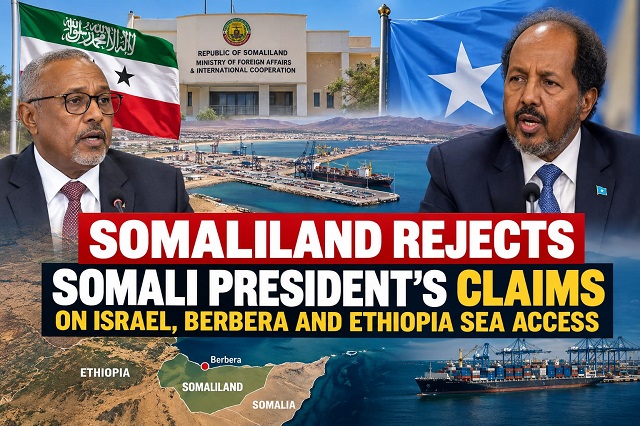
Somaliland Adds Another Layer
Djibouti’s warning is particularly relevant because of the changing relationship between Somaliland, Somalia, Ethiopia and international powers.
Somaliland has increasingly sought direct relations with major international actors, while Somalia continues to oppose moves that could strengthen Somaliland’s international position.
Ethiopia’s strategic interest in maritime access has also added another dimension to the regional competition.
For Djibouti, these developments matter because Ethiopia has historically relied heavily on Djibouti’s ports for access to international markets.
Any major change in the regional balance of ports and trade routes could therefore have economic and strategic consequences for Djibouti.
This helps explain why Djibouti’s leadership is particularly sensitive to developments that could alter the region’s existing strategic equilibrium.
Foreign Military Bases: Protection or Pressure?
Djibouti has successfully used its geography to attract major international military powers.
This has provided the country with economic benefits and enhanced its strategic importance.
But it also creates a difficult balancing act.
When multiple powerful countries maintain military interests in the same small country, the host government must constantly manage competing expectations.
The presence of foreign military bases can strengthen national security while simultaneously increasing the possibility that external powers will seek political influence.
Djibouti’s challenge is therefore to maintain the benefits of international partnerships without allowing those partnerships to compromise its independent decision-making.
That appears to be the central message behind Guelleh’s latest warning.
Guelleh’s Domestic Political Context
The statement also comes after Djibouti’s 2026 presidential election, in which Guelleh secured another term with 97.01% of the vote, according to the Djibouti Constitutional Council.
Guelleh has been president since 1999 and is now beginning another term in office.
His government therefore faces a dual challenge: maintaining domestic political stability while navigating an increasingly competitive international environment.
The emphasis on national unity and social cohesion in his latest speech reflects that concern.
The government argues that internal cohesion is essential to protecting Djibouti from external pressure.
Critics of the government, however, have raised broader concerns about political competition, civic space and the concentration of power in the presidency.
That creates an important tension.
A government can legitimately defend national sovereignty from foreign interference while also being expected to maintain strong domestic institutions, political accountability and space for independent voices.
Both issues matter.
Why This Matters for the Region
Djibouti’s warning should not be viewed as an isolated political statement.
It comes at a time when almost every major development in the Horn of Africa has a strategic dimension.
A dispute over a port can become a geopolitical issue.
A security agreement can become a diplomatic issue.
A political disagreement can become a regional competition.
And a country’s internal political choices can attract the attention of outside powers because of its geographic position.
This is particularly true for Djibouti.
The country controls access to one of the world’s most important maritime corridors while sitting next to Ethiopia, Somalia and Somaliland.
Its decisions can therefore have consequences well beyond its borders.
The Bigger Question
The central issue is not whether Djibouti should cooperate with foreign powers.
It already does — and that cooperation has been fundamental to its strategic importance.
The bigger question is:
Can Djibouti maintain strategic partnerships with powerful foreign states while preserving genuine independence in its political and security decisions?
That is becoming increasingly difficult as competition in the Horn of Africa intensifies.
Djibouti’s leadership understands the value of its geography.
It also understands the risks that come with being strategically indispensable.
Guelleh’s latest warning therefore appears to be a message of strategic caution:
Djibouti wants foreign investment, security cooperation and international partnerships — but it does not want those relationships to become political dependency.
For a country positioned at the intersection of the Red Sea, Gulf of Aden and Horn of Africa, maintaining that balance may become one of the most important challenges of the next several years.
Prepared by:
HornPost staff
info@hornpost.com
www.hornpost.com
DJIBOUTI CITY, Djibouti