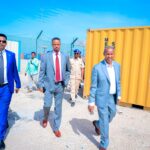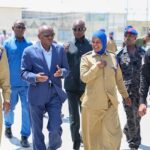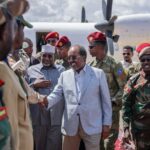
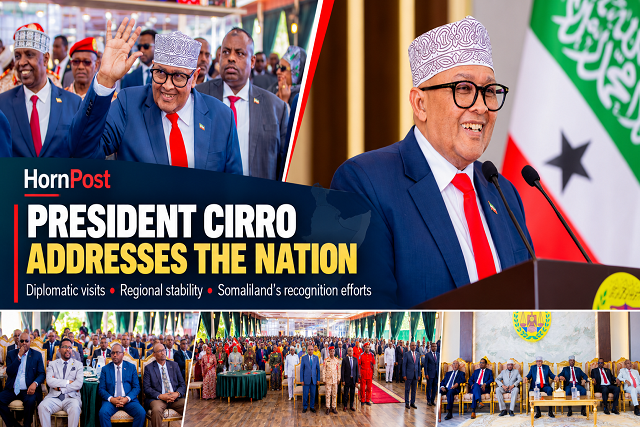

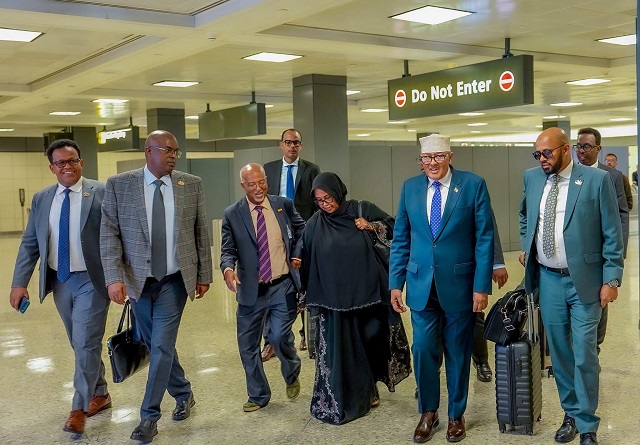
WASHINGTON, D.C. (HornPost) — President of the Republic of Somaliland Abdirahman Mohamed Abdullahi Irro and a delegation accompanying him have arrived in Washington, D.C., for a visit focused on advancing Somaliland’s push for international recognition and strengthening its relationship with the United States.
The visit comes as the Horn of Africa and the Red Sea gain increasing strategic importance for security, trade and regional diplomacy.
The President of the Republic of Somaliland is accompanied on the trip by the First Lady of the Nation, H.E. Farduus Sh. Mohamed and other members of the Presidential delegation, including the following officials:
1. Minister of Foreign Affairs and International Cooperation
2. Minister of Aviation and Airport Development
3. Minister of Defense
4. Senior Advisor to the President on Economic Affairs
5. Senior Advisor to the President on Foreign Affairs and International Cooperation.
The president’s arrival has drawn attention in Somaliland, among U.S. policymakers and across the region. The main expectation in Hargeisa is that the visit will give Washington a deeper understanding of Somaliland’s case while creating opportunities for formal cooperation in security, trade, democracy and development.
Why Washington Matters to Somaliland’s Recognition Bid
Washington is at the center of U.S. foreign-policy decision-making. Engagement with the State Department, Congress and major policy institutions can influence how policymakers understand Somaliland’s political status and strategic importance.
President Irro’s visit provides his delegation with an opportunity to present Hargeisa’s position directly to American policymakers and other influential stakeholders.
However, individual meetings, expressions of support or policy discussions should not automatically be interpreted as U.S. recognition. Any major diplomatic development would require confirmation through official channels.
The U.S. Role in the Horn of Africa
The United States has significant interests in the stability of the Horn of Africa, counterterrorism efforts and the security of maritime routes connecting the Red Sea, Gulf of Aden and wider Indian Ocean.
International shipping through the region has made the waters surrounding Somaliland increasingly important to discussions about maritime security and regional stability.
Washington also places importance on political stability, human rights and the strength of government institutions. Somaliland is therefore likely to emphasize its record of political development, relative stability and potential contribution to regional security.
Somaliland Recognition and Washington’s Position
Political support, formal cooperation and state recognition are three different stages of diplomatic engagement.
The United States could expand cooperation with Somaliland or give greater attention to its political status without immediately extending formal recognition.
However, if Washington gives greater diplomatic weight to Somaliland’s case, it could increase Hargeisa’s international standing and strengthen its position in future diplomatic negotiations.
A decision on recognition would ultimately depend on U.S. foreign policy, regional considerations and Washington’s assessment of its broader national interests.
Recognition at the Center of Somaliland’s U.S. Visit
President Irro’s arrival in Washington comes as Somaliland continues to make international recognition the central objective of its foreign policy.
The Somaliland presidency and Foreign Ministry have long argued that Somaliland possesses its own political institutions, defined territory and governing structures and should be treated as a sovereign state.
For Hargeisa, the Washington visit offers an opportunity to reinforce that argument with U.S. policymakers and explain the historical and political foundations of Somaliland’s position.
The effectiveness of that effort will depend partly on the clarity of the message delivered by the delegation and the evidence presented to American policymakers.
Somaliland’s Case for Statehood
Somaliland bases its case partly on its history as a former British protectorate that gained independence on June 26, 1960, before entering into a union with Somalia.
It also points to its declaration of restored independence in 1991 and the subsequent development of its own political institutions.
Presidential and parliamentary elections, a constitutional framework and a multiparty political system are among the institutions Somaliland presents as evidence of its political development.
Hargeisa also emphasizes domestic stability and public support for its statehood aspirations, although political disputes and disagreements over elections and governance remain challenges.
Political Obstacles to Recognition
Somalia continues to regard Somaliland as part of its sovereign territory and has consistently opposed international recognition of Somaliland as an independent state.
The African Union has generally emphasized the principle of respecting borders inherited at independence, making Somaliland’s case particularly sensitive within the region.
Some governments in the region also fear that recognition of Somaliland could influence other separatist or self-determination movements.
For Somaliland, the diplomatic challenge is therefore to demonstrate that its case is rooted in its distinct historical circumstances and the aspirations of its population rather than an attempt to create new regional instability.
Somaliland and the United States Seek a New Framework
Even if President Irro’s visit does not produce immediate recognition, it could establish a deeper political relationship between Hargeisa and Washington.
Regular consultations, institutional contacts and sustained diplomatic engagement could create greater trust and provide both sides with a framework for cooperation.
Somaliland is also seeking to present itself as a practical and reliable partner in the Horn of Africa.
That effort, however, will require tangible cooperation and clearly documented agreements. Unannounced arrangements or informal discussions should not be presented as confirmed outcomes.
Security and Regional Strategy
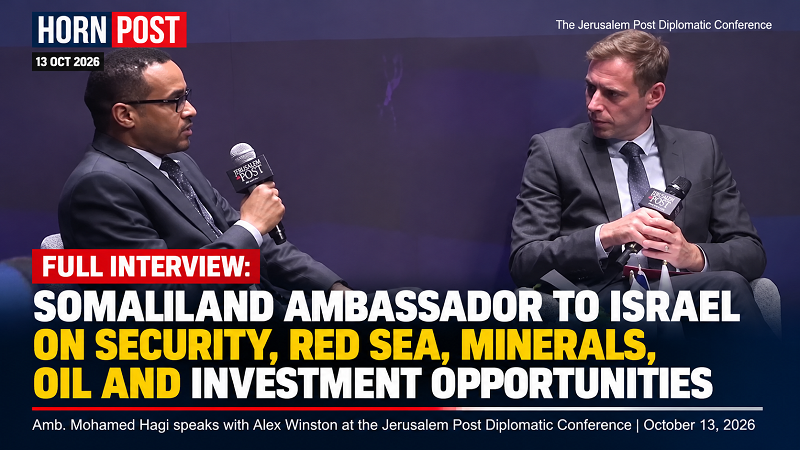
Potential areas of cooperation include maritime security, port protection, countering organized crime and promoting stability around the Red Sea and Gulf of Aden.
Somaliland’s long coastline and the development of Berbera make maritime security an important part of its strategic argument.
Still, any claims of a new security agreement or specific military arrangement should be based on official confirmation from the parties involved.
Such cooperation would also require clear legal frameworks, defined objectives and consideration of the interests of local communities.
Trade, Investment and Berbera Port
The development of Berbera Port and the Berbera Economic Zone is central to Somaliland’s efforts to expand trade and regional connectivity.
DP World has played a major role in the development of the port, while the Berbera Corridor is intended to strengthen links with Ethiopia and wider East African markets.
Stronger U.S.-Somaliland relations could potentially encourage American investment, logistics partnerships and private-sector engagement.
The scale of those opportunities, however, will depend on regulatory certainty, security, infrastructure and clear information about companies interested in operating in Somaliland.
Education, Development and People-to-People Relations
Cooperation could also extend beyond diplomacy and security.
Education, health care, technology and institutional development could provide additional areas for engagement between Somaliland and the United States.
The Somaliland diaspora in the United States may also play a role in strengthening people-to-people relations and communicating Somaliland’s priorities.
Such engagement is likely to be most effective when supported by consistent messaging, reliable information and constructive cooperation with U.S. institutions.
Washington Meetings and Somaliland’s Message
The central message from the Somaliland delegation is expected to be that Hargeisa wants a relationship with Washington based on mutual interests, respect and formal recognition.
Regional peace, democracy, maritime security and economic development are also likely to feature prominently in the broader diplomatic agenda.
Meetings with U.S. officials, members of Congress, policy experts and research institutions could give Somaliland an opportunity to explain its position directly.
The names, locations and outcomes of specific meetings should, however, be based on verified official announcements.
The Role of Congress and Policy Institutions
Members of the U.S. House of Representatives and Senate can influence foreign-policy debates through legislation, resolutions, hearings and public statements.
Think tanks and research institutions can also shape policy discussions by producing analysis that influences policymakers and the wider foreign-policy community.
Support from individual members of Congress could increase the visibility of Somaliland’s recognition campaign, but such support would not by itself represent a change in official U.S. policy.
How Should the Visit Be Measured?
The success of President Irro’s Washington visit should ultimately be measured through concrete outcomes.
Official statements, confirmed meetings, formal agreements and clearly defined follow-up mechanisms will be more significant than photographs or meetings without publicly disclosed results.
Another important indicator will be whether Somaliland’s political status receives greater attention within U.S. congressional and foreign-policy discussions.
If Washington and Hargeisa establish sustained channels of communication, the visit could have an impact well beyond the immediate trip.
Potential Impact on Somaliland and the Region
Within Somaliland, the visit could raise public confidence and expectations for stronger international support.
It may also place greater pressure on the government to maintain a unified foreign-policy message and provide the public with accurate information about diplomatic developments.
Somalia and other regional governments may respond politically to any expansion of U.S.-Somaliland engagement. Their reactions, however, should be assessed through official statements and verified diplomatic developments.
The long-term impact will depend largely on what Washington and Hargeisa do after the visit.
Opportunities and Diplomatic Risks
The potential opportunities include stronger political relations, expanded security cooperation, increased international visibility and greater economic engagement.
The risks include excessive public expectations, misinterpretation of diplomatic discussions and stronger political reactions from Somalia and other regional actors.
Clear communication will therefore be critical.
The Somaliland government will need to distinguish carefully between what has been agreed, what has been discussed and what remains an objective of its foreign policy.
What Comes After Washington?
Following President Irro’s arrival in Washington, the next stage will be diplomatic follow-up.
If agreements or understandings are reached, the government will need to explain who will implement them, when implementation will begin and what results are expected.
The recognition campaign will also require sustained engagement involving the presidency, Foreign Ministry, Parliament and Somaliland’s diaspora.
Consistent messaging, congressional outreach and regular diplomatic engagement could prove more important than a single high-profile visit.
For the public, transparency will be equally important. Claims about meetings, agreements or commitments should be verified through the Somaliland presidency, the U.S. State Department, Congress and credible media organizations.
Conclusion: Washington Visit Tests Somaliland’s Diplomatic Strategy
President Abdirahman Mohamed Abdullahi Irro’s visit to Washington represents an important opportunity for Somaliland to strengthen its case for international recognition and deepen relations with the United States.
Washington has significant strategic interests in the Horn of Africa, the Red Sea and the region’s maritime routes, while Somaliland is seeking to position itself as a stable and potentially valuable partner.
The immediate outcome should not be judged solely by whether recognition is announced.
Greater political engagement, expanded cooperation and sustained attention from U.S. policymakers could themselves represent significant steps forward.
For Somaliland, the challenge now is to combine diplomatic ambition with accurate information, institutional coordination and long-term engagement.
Ultimately, the importance of the Washington visit will be determined not simply by what happens during the trip, but by what follows after the president leaves the U.S. capital.
Prepared by:
HornPost staff
www.hornpost.com
HARGEISA, Somaliland

Abdikarim Saed Salah
Abdikarim Saed Salah is Editor-in-Chief and Founder of HornPost.com, an independent Hargeisa-based news platform covering Somaliland, the Horn of Africa, East Africa, the Red Sea and international affairs. A journalist, television presenter, producer and geopolitical analyst, he has more than 15 years of experience in broadcast journalism, digital media, reporting and diplomacy. He works with Horn Cable TV and focuses on politics, elections, security, foreign policy and conflict. He holds a BA in Journalism and an MA in International Relations.