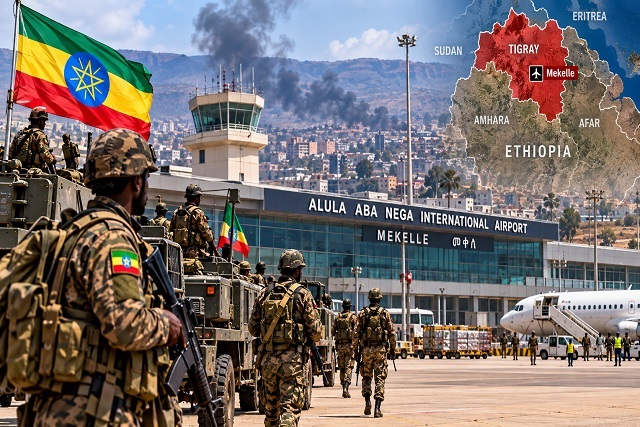
ADDIS ABABA, Ethiopia (HornPost)— Ethiopian federal forces have regained control of Alula Aba Nega International Airport in Mekelle, the capital of the Tigray region, according to multiple sources cited by Reuters and residents who spoke to the Associated Press, in the latest major development in the renewed conflict in northern Ethiopia.
The airport had been seized by Tigrayan forces on September 23, when fighting erupted again between the federal government and an opposition alliance led by the Tigray People’s Liberation Front (TPLF). The latest fighting represents the most serious escalation in Tigray since the 2020–2022 war.
Reuters said three sources reported that federal forces had regained the airport, including a source familiar with events in Mekelle and a humanitarian source. A resident of the city also said government forces had taken control of the facility. AP separately reported that residents said federal forces had retaken the airport.
However, the exact timing and circumstances of the takeover remain unclear. Communications networks in Tigray have been severely disrupted, limiting independent verification of developments on the ground. Neither the Ethiopian government nor the TPLF had officially commented on the airport’s reported recapture when the reports were published.
Why the Airport Matters
Alula Aba Nega Airport, also known as Mekelle Airport, is the principal airport serving Mekelle and is located about 10 kilometers southeast of the city. Its seizure by Tigrayan forces last month disrupted commercial air services to the region. Wikipedia
The airport’s location gives it logistical importance because it provides air access to the regional capital. Control of the facility also carries political significance during the current fighting because it is one of the key pieces of infrastructure around Mekelle.
The African Union said on September 23 that the seizure of the airports in Mekelle, Axum and Shire had disrupted civilian air services and expressed concern over the renewed military escalation.
What We Know About Mekelle
Reports from Mekelle suggest that Tigrayan fighters and some TPLF leaders have been leaving parts of the city as federal and allied forces advance.
AFP, cited by Al Jazeera, reported that a local journalist and residents had seen TPLF fighters and leaders retreating from the city. One resident expressed concern about possible looting of government and public property, while another warned of a potential breakdown in security. Those reports could not be independently confirmed by Al Jazeera.
Reported by Reuters recapture of the airport does not establish that federal forces have captured the entire city of Mekelle. Reuters said it could not independently verify all battlefield claims, while the communications blackout has made it difficult to establish the precise positions of opposing forces.
Wider Tigray Conflict
The latest fighting began in late September after years of relative calm following the Pretoria Agreement, signed in November 2022 to end the previous Tigray war.
The conflict has since spread beyond Tigray into parts of Afar and Amhara, with both government and opposition-aligned forces claiming advances.
The TPLF is leading a broader opposition alliance involving several armed and political groups. The federal government has launched a counteroffensive, while the two sides have traded competing claims about territorial control.
The African Union has warned that the renewed fighting risks reversing progress made under the 2022 peace agreement and has called for restraint and immediate de-escalation.
Humanitarian Situation
The renewed conflict has disrupted essential services and communications across parts of northern Ethiopia.
AP reported that residents in Mekelle have faced shortages of cash and fuel, while communications disruptions have made it difficult for people to obtain information or communicate with relatives. AP also reported that more than 16,000 displaced people were in camps amid fears of further displacement.
Earlier reports from humanitarian organizations indicated a sharp increase in people seeking medical treatment for war-related injuries, but the extent of casualties from the latest fighting remains difficult to establish independently because access to affected areas is limited.
The communications blackout also complicates humanitarian operations and independent reporting.
Ethiopia–Eritrea Tensions Escalate
The renewed Tigray conflict has coincided with a major deterioration in relations between Ethiopia and Eritrea.
Ethiopia closed its embassy in Asmara and expelled 10 Eritrean diplomats after accusing Eritrea of supporting the opposition alliance led by the TPLF. Eritrea rejected the accusations and announced on October 1 that it was severing diplomatic relations with Ethiopia.
Ethiopian officials have also accused Sudan and Egypt of supporting forces opposed to Addis Ababa. Those allegations have been denied by the countries concerned.
The African Union has urged Ethiopia, Eritrea and Egypt to exercise restraint and avoid actions or rhetoric that could further destabilize the region.
Pretoria Peace Agreement Under Pressure
The Pretoria Agreement, signed on November 2, 2022, ended the previous two-year war between Ethiopia’s federal government and the TPLF.
The African Union continues to regard the agreement as the foundation for lasting peace and reconciliation in Ethiopia. The AU has called for an immediate reduction in tensions and a return to peaceful political engagement.
The renewed fighting, however, has placed the post-war settlement under significant pressure.
Regional Implications
The latest escalation has implications beyond Tigray.
Eritrea’s diplomatic break with Ethiopia adds another layer of tension along Ethiopia’s northern border, while accusations involving Sudan and Egypt have increased concerns about the conflict’s regional dimension. Reuters has reported that the overlapping rivalries could increase the risk of instability spreading beyond Ethiopia.
The conflict also matters for Djibouti and the wider Red Sea region because Afar is strategically important to Ethiopia’s transport links with Djibouti.
Fighting in Afar therefore has the potential to affect Ethiopia’s security and logistics environment, although there is currently no basis to state that Ethiopia’s main Djibouti trade corridor has been disrupted.
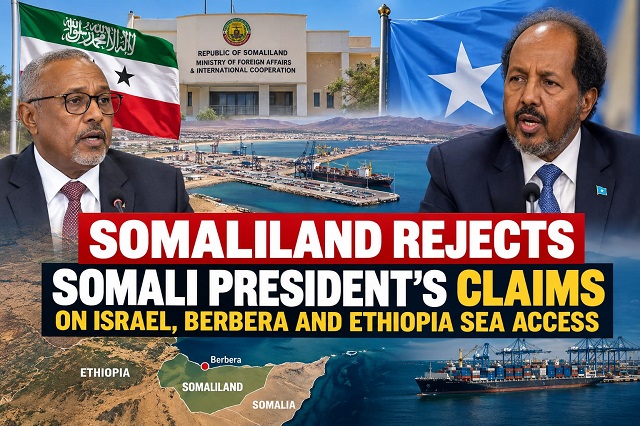
For Somaliland and Berbera, any prolonged instability affecting Ethiopia’s northern and eastern transport networks could increase regional attention on alternative trade routes, although the practical impact would depend on security conditions, infrastructure and commercial arrangements.
What Happens Next
The reported recapture of Mekelle’s airport gives Ethiopia’s federal forces an important position near the Tigrayan capital, but it does not by itself determine control of Mekelle or the wider Tigray region.
The immediate questions are whether federal forces will enter and establish control across the city, whether Tigrayan forces will regroup elsewhere in the region, and whether diplomatic efforts can prevent the renewed conflict from expanding.
For now, communications restrictions and limited access to the battlefield mean that several key developments remain difficult to independently verify.
HornPost will continue to update this story as additional verified information becomes available.
Primary sources: Reuters report · Associated Press report · African Union statement
Prepared by:
HornPost staff
info@hornpost.com
www.hornpost.com