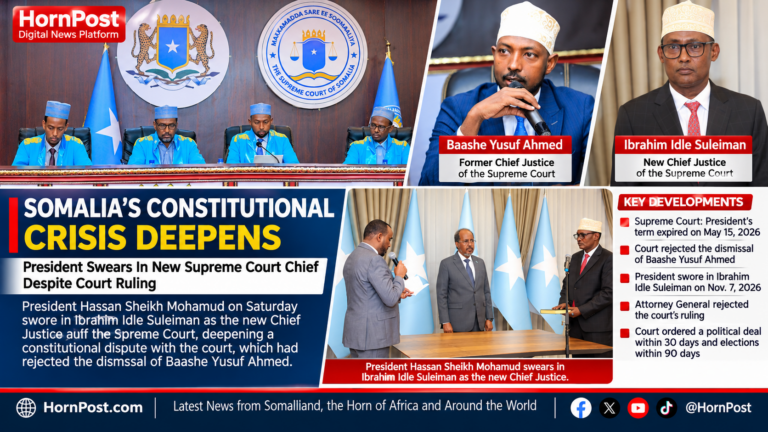
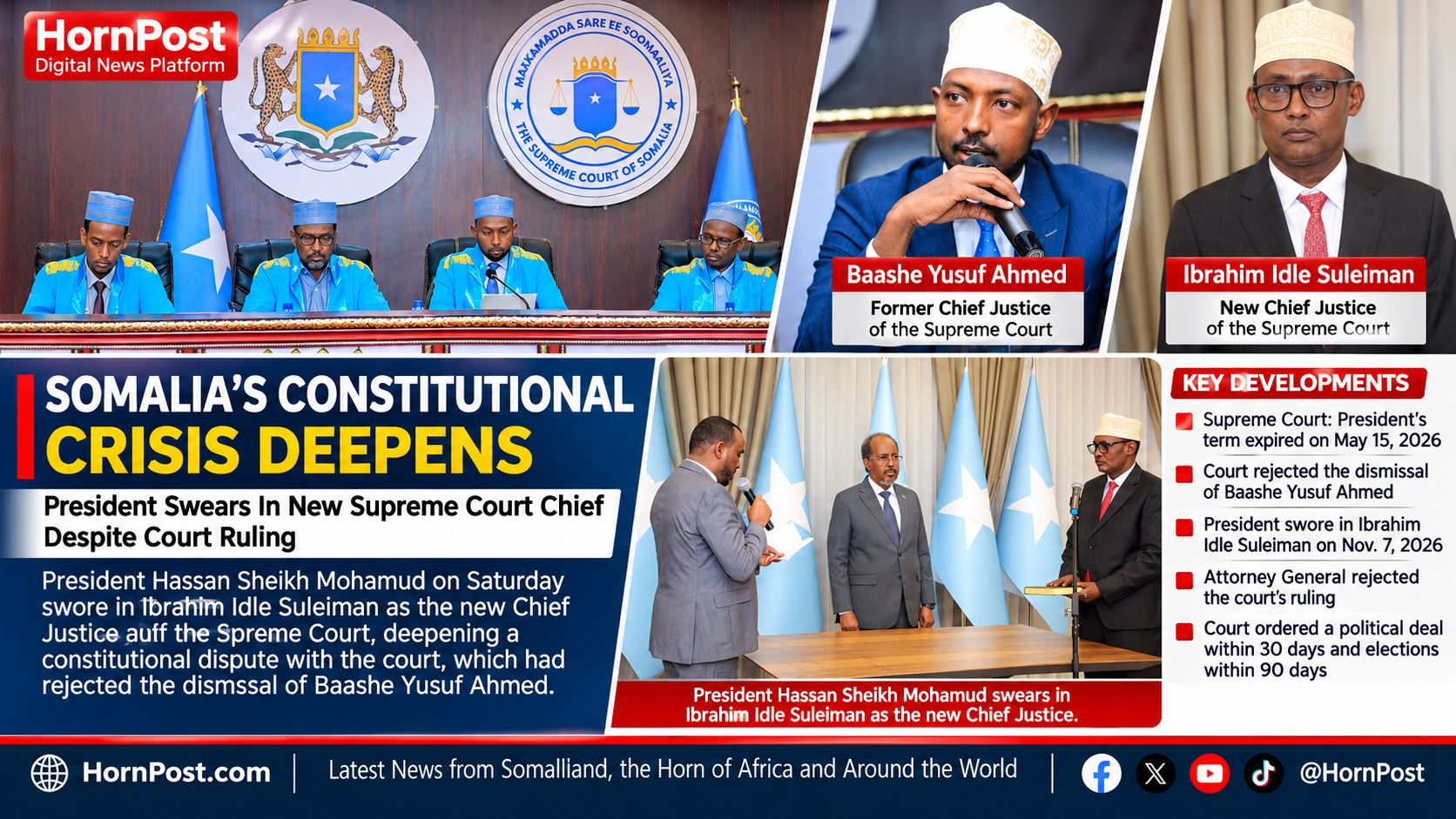
MOGADISHU, Somalia (HornPost) – Somalia’s constitutional crisis has intensified after President Hassan Sheikh Mohamud swore in Ibrahim Idle Suleiman as the new Chief Justice of the Supreme Court, despite a court ruling rejecting the dismissal of his predecessor.
The swearing-in ceremony took place in Mogadishu on Saturday, November 7, in the presence of senior government officials, including the speaker of the House of the People, the first deputy speaker of the Upper House, Prime Minister Hamza Abdi Barre and Justice Minister Hassan Maalim.
The appointment comes amid an escalating dispute between the presidency and the judiciary over the legality of the president’s continued stay in office, the authority to remove the chief justice and the constitutional procedures governing federal institutions.
The confrontation has raised serious questions about judicial independence, the separation of powers and the future of Somalia’s electoral process.
Supreme Court Rules President’s Mandate Has Expired
The latest dispute follows a landmark ruling issued on November 5 by five judges of the Supreme Court’s Constitutional Division.
The court declared that President Hassan Sheikh Mohamud’s constitutional mandate expired on May 15, 2026. It also ruled that the mandates of both houses of the Federal Parliament ended on April 14, 2026.
The ruling rejected the government’s interpretation of constitutional amendments adopted in March 2026, which extended presidential and parliamentary terms from four to five years.
The judges said the amendments did not explicitly state that the extended terms would apply to officials already holding office when the changes were adopted.
Consequently, the court ruled that the original four-year mandates remained applicable to the current president and parliament.
The court also declared that government actions taken after the expiration of those mandates were unconstitutional and legally invalid.
However, it allowed the federal government to continue performing routine administrative duties as a caretaker administration.
The judges directed political stakeholders to agree on an electoral framework within 30 days and hold elections within 90 days.
The ruling followed a constitutional petition filed by former President Sharif Sheikh Ahmed, who challenged the legal consequences of the constitutional amendments and their impact on federal institutions.
President Appoints Ibrahim Idle Suleiman as Chief Justice
The leadership dispute within the judiciary escalated on November 4, when President Hassan Sheikh removed Chief Justice Bashe Yusuf Ahmed and appointed Ibrahim Idle Suleiman as his replacement.
The presidency said the decision followed complaints from judges, judicial staff and legal professionals about the administration of justice.
It also announced plans for broader judicial reforms aimed at improving transparency, fairness and public confidence in the country’s justice system.
However, the announcement did not identify specific allegations against Bashe or explain whether the required constitutional procedures for his removal had been followed.
Ibrahim Idle Suleiman previously served as Somalia’s chief justice before former President Mohamed Abdullahi Farmajo removed him in May 2018 and appointed Bashe Yusuf Ahmed.
Suleiman later served as a legal adviser to President Hassan Sheikh Mohamud.
On Saturday, the president attended Suleiman’s swearing-in ceremony and urged him to perform his constitutional responsibilities with integrity, transparency and accountability.
According to the state-run Somali National News Agency (SONNA), Suleiman also formally assumed office following a handover ceremony.
The agency reported that he received the responsibilities from outgoing Chief Justice Abdalle Haji Mohamed. This account differs from other reports describing Suleiman’s appointment as the replacement of Bashe Yusuf Ahmed, highlighting the need for further clarification about the formal leadership transition.
Supreme Court Rejects Bashe’s Dismissal
The Supreme Court responded to the president’s decision on November 5, declaring Bashe Yusuf Ahmed’s dismissal null and void.
The judges argued that the president could not remove the chief justice through a unilateral decision.
They cited constitutional provisions governing the appointment and removal of senior judicial officials, including the role of the Judicial Service Commission and parliamentary approval.
The court also accused the presidency of interfering with an ongoing constitutional case concerning the president’s mandate and the legal status of federal institutions.
According to the court’s statement, the removal of Bashe came while the judiciary was considering a petition challenging the constitutional amendments.
The judges said the decision undermined judicial independence and the separation of powers.
The presidency, however, has defended its decision, citing concerns about judicial administration and the need for institutional reform.
The competing positions have created uncertainty over who has the lawful authority to lead the country’s highest court.
Attorney General Rejects Supreme Court Ruling
The Office of the Attorney General also challenged the Supreme Court’s November 5 decision.
In a statement issued on November 6, the office argued that the ruling had no legal effect and questioned the composition and procedures of the judicial panel.
The Attorney General raised concerns about the court’s handling of preliminary objections and the absence of the chief justice from the panel that issued the decision.
The office also questioned whether the judges had followed the proper judicial procedures when considering the constitutional petition.
The disagreement has added another layer to the crisis, with the judiciary, presidency and Attorney General advancing competing interpretations of constitutional authority.
As of November 7, the presidency had not publicly announced a decision to comply with the Supreme Court’s ruling.
Dispute Raises Questions About Judicial Independence
The confrontation has placed the independence of Somalia’s judiciary at the center of the country’s political debate.
Under the constitutional framework, the judiciary is expected to operate independently of the executive and legislative branches.
The dispute over Bashe’s removal raises questions about the extent of presidential authority over judicial appointments and disciplinary procedures.
It also highlights the importance of the Judicial Service Commission in protecting the independence of the courts.
For Somalia, where political disagreements have frequently involved disputes over constitutional interpretation and electoral arrangements, the current confrontation presents a major institutional challenge.
The question is no longer limited to who leads the Supreme Court. It also concerns whether the country’s institutions can resolve disagreements through established legal procedures.
Electoral Dispute Adds to Political Uncertainty
The constitutional crisis is unfolding against the backdrop of a wider disagreement over Somalia’s electoral future.
President Hassan Sheikh’s administration has supported constitutional reforms and a transition towards direct elections.
However, opposition leaders and several federal member states have challenged the government’s approach, arguing that major constitutional and electoral decisions require broader political agreement.
The dispute has also involved Puntland and Jubaland, which have raised objections to aspects of the federal government’s political and constitutional agenda.
The Supreme Court’s order requiring political agreement within 30 days and elections within 90 days has added pressure on the competing political sides.
However, implementing the ruling could prove difficult without cooperation between the federal government, opposition groups and regional administrations.
What Happens Next?
Somalia now faces several unresolved constitutional questions.
First, the country must determine who legally holds the position of Supreme Court Chief Justice following the competing decisions concerning Bashe Yusuf Ahmed and Ibrahim Idle Suleiman.
Second, the federal government and political opposition must address the court’s ruling on the expiration of presidential and parliamentary mandates.
Third, political leaders must decide whether they can agree on an electoral framework within the deadlines established by the court.
The coming weeks will therefore be important for Somalia’s political and institutional future.
Without an agreed legal and political process, the confrontation could further weaken public confidence in state institutions and complicate preparations for the next elections.
For now, the dispute remains centered on three fundamental issues: constitutional authority, judicial independence and the legitimacy of federal institutions.
HornPost Staff Reporter
Email: info@hornpost.com
Website: https://www.hornpost.com