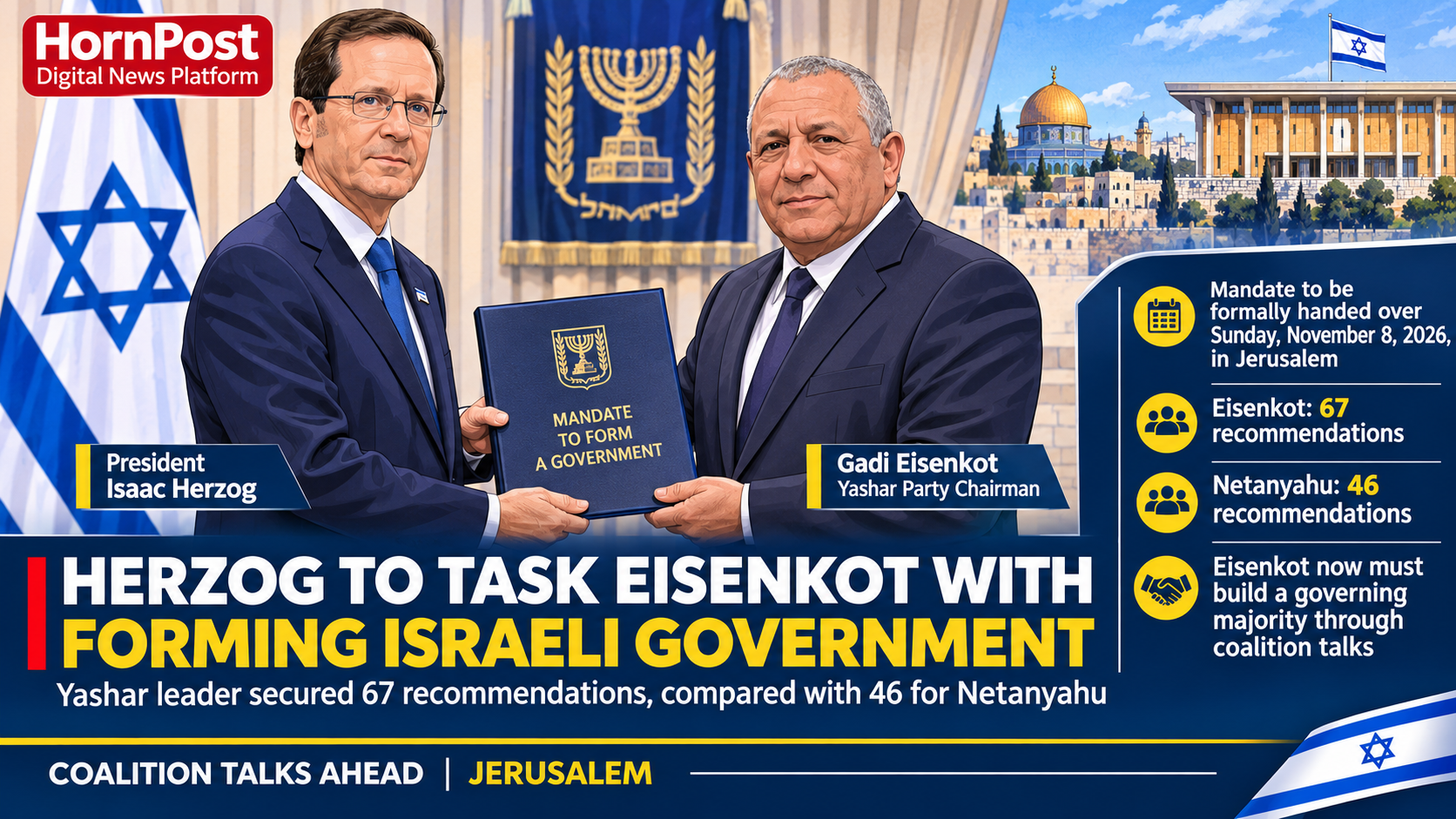
JERUSALEM (HornPost) – Israeli President Isaac Herzog is expected to give opposition leader Gadi Eisenkot the mandate to form the country’s next government on Sunday, November 8, following consultations with political parties elected to the Knesset.
Eisenkot, chairman of the Yashar party, secured recommendations from parliamentary factions representing 67 lawmakers, compared with 46 who backed outgoing Prime Minister Benjamin Netanyahu.
The outcome puts Eisenkot in a strong position to receive the mandate and attempt to establish a new governing coalition following Israel’s October 27 parliamentary election.
Herzog announced that he would make his decision after further discussions with political leaders. He said the recommendations provided a clear picture of the political situation, but questions remained about the candidates’ ability to assemble a stable government.
The president is expected to formally hand Eisenkot the mandate at the President’s Residence in Jerusalem on Sunday.
Eisenkot Wins Majority of Political Recommendations
The 67 recommendations represent support from several opposition parties, including Yashar, Yisrael Beytenu, the Democrats, the Joint List, Ra’am and other political groups.
Netanyahu received 46 recommendations from parties supporting his continued leadership, including Likud, Shas and far-right political factions.
The remaining seven lawmakers from the United Torah Judaism party did not recommend either candidate.
Eisenkot’s total represents the largest number of recommendations received by a candidate seeking to form an Israeli government since 2015, according to his party.
Yashar welcomed the outcome and urged Herzog to give its chairman the mandate without delay.
The party argued that the election results reflected a public demand for political change and a lack of confidence in Netanyahu’s leadership.
Coalition Negotiations Remain Challenging
Despite securing 67 recommendations, Eisenkot faces difficult negotiations to build a functioning parliamentary coalition.
Israel’s Knesset has 120 seats, meaning a government generally needs the support of at least 61 lawmakers to secure a parliamentary majority.
Although six political groups recommended Eisenkot, they do not necessarily agree on the terms of a future coalition.
The opposition includes a 48-member Jewish-led political bloc and a separate 19-member bloc of Arab-led parties.
Some of Eisenkot’s potential Jewish coalition partners have ruled out forming a government that depends on the Arab-led parties.
This political division could complicate his efforts to translate the recommendations into a stable governing majority.
However, reports suggest that Yisrael Beytenu leader Avigdor Liberman may be open to cooperating with the ultra-Orthodox United Torah Judaism party, potentially creating another route for coalition negotiations.
Netanyahu Faces Political Setback
The election outcome represents a major political setback for Netanyahu, Israel’s longest-serving prime minister.
His outgoing coalition lost its parliamentary majority, while several opposition parties united behind Eisenkot as their preferred candidate for prime minister.
Netanyahu’s political future now depends on whether Eisenkot succeeds in forming a coalition or whether the country faces another round of political negotiations and potentially a new election.
The outgoing prime minister is expected to remain in a caretaker capacity while the process of forming a new government continues.
What Happens Next?
Under Israel’s parliamentary system, the president assigns a member of the Knesset the task of forming a government after consulting political factions.
The candidate who receives the mandate normally has 28 days to assemble a coalition. The president can grant an extension of up to 14 additional days.
If Eisenkot receives the mandate on Sunday, he will begin negotiations with potential coalition partners to secure the support needed to govern.
The newly elected Knesset is scheduled to be sworn in on November 10.
The coming days will therefore be crucial for Israel’s political future, as Eisenkot attempts to turn his parliamentary support into a stable government and end Netanyahu’s current leadership.
HornPost Staff Reporter
Email: info@hornpost.com
Website: https://www.hornpost.com