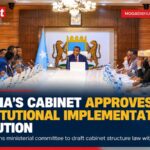
MOGADISHU, Somalia (HornPost) Somalia’s Council of Ministers has approved a resolution on implementing the country’s Constitution, as political disagreements over constitutional changes, elections and the future of federal governance continue to shape the country’s political landscape.
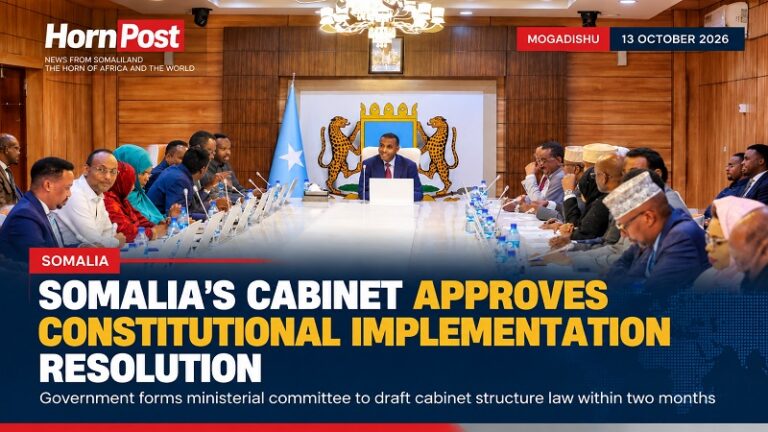
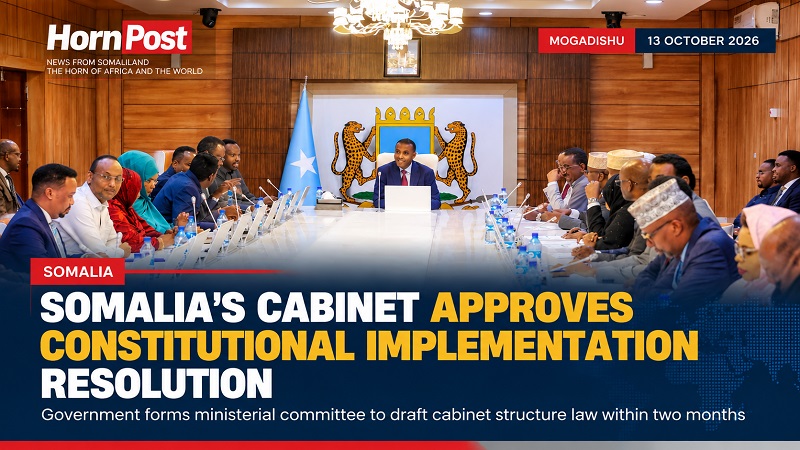
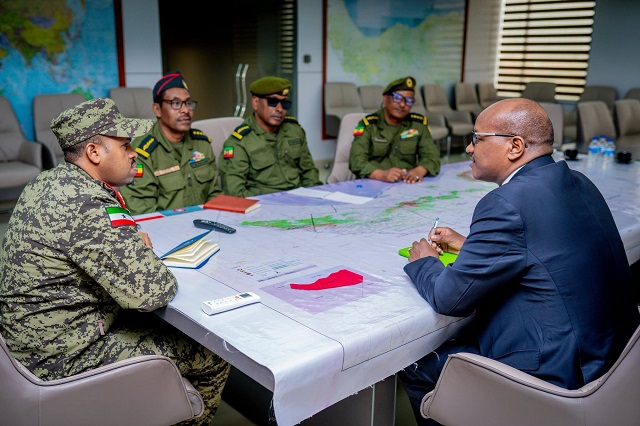
The Cabinet held an extraordinary meeting late Tuesday, chaired by Prime Minister Hamza Abdi Barre, according to a statement released by the Prime Minister’s Office.
The meeting focused on constitutional implementation, state-building, strengthening government institutions and improving national administrative systems.
The government said the resolution was intended to accelerate the implementation of the Constitution and clarify the responsibilities of different state institutions.
Cabinet Appoints Committee to Draft Government Structure Law
Following the approval, the Cabinet appointed a ministerial committee chaired by the Minister of Justice and Constitutional Affairs to oversee the implementation process.
The committee has been tasked with preparing, within two months, legislation governing the structure of the federal government in accordance with the Constitution.
According to the government statement, the proposed law would define the size of the Cabinet and the responsibilities of government institutions. The statement described it as a law the country has not had since 1968.
The legislation could establish a clearer legal framework for the organization and responsibilities of the federal executive, although its final provisions will depend on the draft and subsequent legislative procedures.
Government Reaffirms One-Person, One-Vote Election Plans
Prime Minister Hamza said the Constitution was in force and that its implementation would proceed through different stages.
He also reiterated the government’s intention to hold federal elections based on the one-person, one-vote principle next year.
The election plans remain a major issue in Somalia’s political debate, with disagreements over constitutional amendments, the electoral framework and the need for agreement among federal political stakeholders.
The government presents constitutional implementation and direct elections as part of its state-building agenda. Opposition figures, however, have raised concerns about the constitutional process and its implications for political consensus and the transition of power.
The Cabinet’s latest decision does not, by itself, settle those wider political disputes.
Somalia Reports Restoration of IATA Ticketing Code
In a separate development, the Ministry of Transport and Civil Aviation presented a report to the Cabinet announcing the restoration of Somalia’s IATA code used in airline ticketing arrangements.
The government described the development as an important step towards restoring the country’s ability to manage and regulate airline ticketing services and improve connections with international travel systems.
The International Air Transport Association (IATA) supports industry-wide systems and standards used by airlines and travel service providers.
The government said the restoration would strengthen the administration of civil aviation services and return rights that had previously been unavailable to Somalia.
The statement did not provide further technical details about the code, the date on which the restored arrangements would become operational or the airlines and ticketing systems affected.
Constitutional Dispute Continues to Shape Somalia’s Politics
The Cabinet’s decision comes amid continuing political tensions between the federal government and opposition leaders over constitutional changes and the country’s future electoral arrangements.
Former President Sharif Sheikh Ahmed and former Prime Minister Hassan Ali Khaire have been among the prominent opposition figures challenging aspects of the government’s constitutional and political process.
The dispute extends beyond the implementation of individual constitutional provisions to questions about political consensus, federal power-sharing and the arrangements governing future elections.
The constitutional amendments have also raised concerns about the length of political mandates and the possibility of an extension of the current administration’s tenure.
However, the Cabinet’s October 13 resolution, as described in the government statement, does not explicitly announce a one-year extension of the government’s mandate. Any claim that the decision will result in such an extension should therefore be treated as political interpretation unless supported by a formal decision or legal instrument.
What Happens Next?
The immediate next step is the ministerial committee’s preparation of the proposed law on the structure of the federal government within two months.
The political implications will depend on the details of that legislation, how the Constitution is implemented and whether the government and opposition can reach agreement on electoral arrangements.
For Somalia, the central challenge remains implementing constitutional provisions while maintaining institutional stability and addressing disagreements among political stakeholders.
The Cabinet’s resolution marks another step in the government’s constitutional implementation program, but its broader political consequences remain to be seen.
HornPost.com | Latest News from Somaliland, the Horn of Africa and Around the World
Prepared by:
HornPost staff
info@hornpost.com
www.hornpost.com