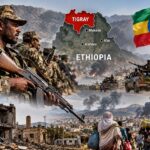
ADDIS ABABA, Ethiopia — Fighting between Ethiopian federal forces and forces aligned with the Tigray People’s Liberation Front (TPLF) has intensified in northern Ethiopia, raising fears that the country could slide back into a wider conflict less than four years after the 2022 Pretoria peace agreement ended the previous Tigray war.
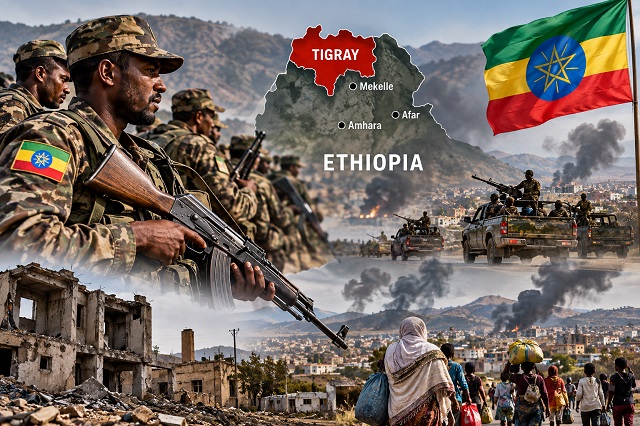
The latest escalation began on Wednesday, when Tigrayan forces seized control of airports in Mekelle, Axum and Shire and clashes were reported in Tigray as well as neighboring Amhara and Afar regions. The African Union has called for an immediate de-escalation and a return to direct talks under the 2022 peace agreement.
The conflict has also disrupted civilian transport and communications. Ethiopian Airlines suspended flights to Mekelle, Axum and Shire following the escalation, while internet and telephone services were disrupted across parts of Tigray.
Federal government and TPLF trade blame
The federal government has accused Tigrayan forces of launching a planned offensive and taking control of civilian infrastructure.
The TPLF, however, has described its military actions as defensive, saying federal forces had attacked Tigray using drones, artillery and ground troops. Reuters reported that both sides have blamed each other for the latest escalation.
The competing accounts have made it difficult to independently establish the full sequence of events because access and communications in parts of Tigray have been severely restricted.
Ethiopian military Chief of Staff Field Marshal Berhanu Jula said Sunday that the army was responding to what he described as provocations from the Tigray front with restraint. He also accused Eritrea of supporting armed groups seeking to weaken Ethiopia. Eritrea has denied accusations that it is backing Ethiopian armed groups.
Fighting spreads beyond Tigray
The renewed violence is no longer confined to Tigray.
Clashes have also been reported in Afar and Amhara, with fighting reported around areas including Abala in Afar and parts of the Raya area. The situation on individual fronts remains fluid, and some battlefield claims have not been independently verified.
The expansion is particularly significant because the conflict is taking place alongside existing armed confrontations in Amhara and Oromia.
Earlier this month, seven armed groups announced the formation of the Ethiopian Peoples’ Forces Alliance for Survival, an alliance that includes the TPLF, the Amhara Fano National Movement and the Oromo Liberation Army.
The groups said they sought to remove Prime Minister Abiy Ahmed’s government. The extent to which the different organizations can coordinate militarily remains unclear because they have different political objectives and longstanding territorial disputes.
What happened to the Pretoria agreement?
The renewed fighting has placed the November 2022 Pretoria agreement under severe strain.
The agreement, reached between the Ethiopian government and the TPLF with African Union mediation, ended the two-year war that began in 2020. The AU continues to regard the agreement as the central framework for resolving the Tigray conflict.
Following the seizure of the three airports, AU Commission Chairperson Mahmoud Ali Youssouf said the actions were inconsistent with commitments under the Pretoria agreement and called for the immediate cessation of actions that could escalate the situation.
The AU has also asked former Nigerian President Olusegun Obasanjo, its High Representative for the Horn of Africa, to engage the parties and support renewed diplomatic efforts.
Civilians face renewed disruption
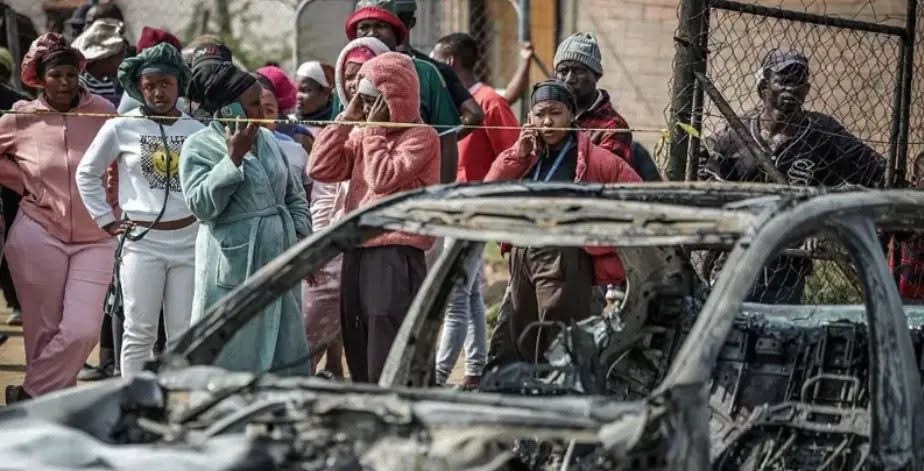
Residents of Mekelle and other parts of Tigray have reported growing fear, shortages and disruption to normal life.
The Associated Press reported that residents were attempting to leave the region amid concerns over renewed fighting, while transport restrictions and communications disruptions were adding to the uncertainty. A senior U.N. human rights official has also expressed alarm over the impact of the fighting on civilians.
Reuters reported that residents in Mekelle and Adigrat were stocking up on food, cash and basic supplies amid fears that the conflict could develop into conditions similar to those experienced during the previous war.
Eritrea adds a regional dimension
Relations between Ethiopia and Eritrea have deteriorated since the end of the previous Tigray war.
Eritrean forces fought alongside Ethiopian federal troops during the 2020–2022 conflict. Since then, disagreements have emerged over regional security, the Pretoria agreement and Ethiopia’s efforts to secure access to the Red Sea.
Addis Ababa has accused Eritrea of supporting armed groups inside Ethiopia. Asmara has repeatedly rejected those accusations.
The involvement or alleged involvement of neighboring countries is one reason international officials are concerned that renewed fighting could develop into a broader regional crisis.
International calls for restraint
The African Union has called for an immediate end to military escalation and a return to dialogue.
The European Union has also called for de-escalation, saying differences should be resolved through dialogue rather than military action.
The United Nations has expressed concern about the humanitarian consequences, while international actors have urged the parties to protect civilians and preserve the gains made under the 2022 peace agreement.
For now, the precise balance of control on several battlefronts remains unclear. What is established is that fighting has resumed between Tigrayan forces and Ethiopia’s federal government, violence has spread into neighboring regions, civilian services have been disrupted and the Pretoria peace process is facing its most serious challenge since the 2022 agreement.
Prepared by:
HornPost staff
info@hornpost.com